

EN │ ES
Third Party Logistics
Shipedge
September 11, 2026
22 min read
A warehouse management system for 3PL is purpose-built software that manages inventory, order processing, and billing across multiple client accounts simultaneously inside a single warehouse. Unlike standard WMS tools designed for single-brand operations, a 3PL WMS provides the multi-tenancy, configurable billing, and client transparency that third-party logistics providers need to scale profitably.
Running a third-party logistics operation is fundamentally different from running a brand's in-house warehouse. You are managing inventory for five, ten, or twenty different clients under one roof — each with distinct SKUs, SLAs, shipping preferences, billing structures, and reporting expectations. The software that powers a brand's internal warehouse cannot handle that complexity. Using it as a 3PL creates gaps that cost you money, damage client relationships, and collapse under peak season pressure.
This guide explains what a warehouse management system for 3PL actually does, how it differs from standard warehouse software, the eight features every 3PL WMS must include, and how to evaluate your readiness before Q4 volume arrives. Whether you are selecting a WMS for the first time or assessing whether your current system can handle growth, this is the reference you need.
A warehouse management system (WMS) is software that controls and optimizes every physical movement of inventory inside a warehouse — receiving, put-away, picking, packing, and shipping. A 3PL WMS extends that core functionality with multi-client architecture: the ability to segregate inventory, operations, and billing by client, all running simultaneously on a single platform.
The "3PL" distinction is not marketing language. It describes a fundamentally different software architecture. In a standard single-client WMS, the entire system is dedicated to one brand's inventory and one set of operational rules. In a 3PL WMS, the system must enforce complete data and operational isolation between clients while still allowing the warehouse team to work across all clients from a single interface.
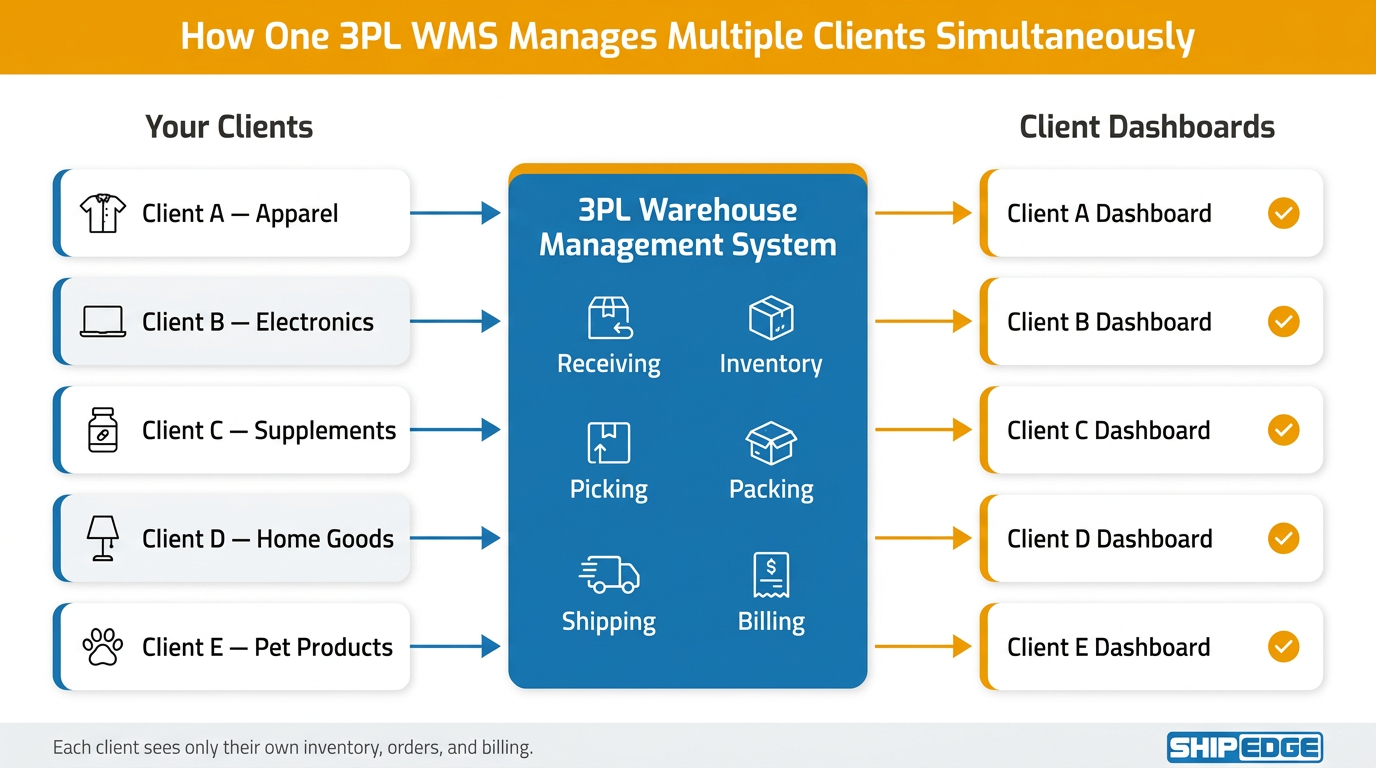
At its foundation, a 3PL WMS performs all the operational functions of any WMS — inbound receiving, inventory tracking, pick path optimization, packing instructions, label generation, and carrier integration. What it adds is a client layer on top of all of these.
Every receiving event is tagged to a client. Every inventory position in the warehouse is segregated so that Client A's stock cannot be accidentally fulfilled against Client B's orders. Every shipping label is generated under the correct carrier account and billing number. Every transaction — storage, pick, pack, special service — is recorded against the correct client for billing purposes.
The 3PL WMS also provides client-facing tools that a standard WMS never needs: portals where each client can log in to see only their inventory, their orders, and their invoices. This self-service transparency reduces the operational support burden on the 3PL and functions as a competitive differentiator when winning new accounts.
Multi-tenancy is the technical term for what makes a 3PL WMS architecturally possible. A multi-tenant system hosts multiple clients ("tenants") on a single instance of the software, with strict data isolation between them. Each client sees only their data; the warehouse operator sees all clients simultaneously through a unified dashboard.
This matters operationally because warehouse staff do not want to log out of one client system and log into another to process different orders. A proper 3PL WMS gives operators a single interface while enforcing client separation in the background. The platform knows which bin location belongs to which client, which order belongs to which client, and which billing event belongs to which client — without the operator needing to manage that separation manually.
Multi-tenancy also enables the 3PL WMS to scale horizontally. Adding a new client is a configuration exercise — not a software installation project. That speed of onboarding is a revenue-critical capability for 3PLs that win new business throughout the year.
Many 3PLs confuse WMS and TMS (Transportation Management System) capabilities when evaluating platforms. A WMS controls what happens inside the four walls of the warehouse: inventory positioning, pick paths, packing, and outbound label generation. A TMS controls what happens outside the warehouse: carrier selection, rate shopping, route planning, and freight audit.
A well-integrated 3PL WMS connects directly to carrier APIs — UPS, FedEx, USPS, DHL, regional carriers — and provides multi-carrier rate shopping at the time of shipment. This embedded capability gives 3PLs the cost control they need without requiring a separate TMS investment. For most small-to-mid-size 3PLs, embedded carrier integration in the WMS is sufficient. For enterprise 3PLs running millions of shipments per month across freight, parcel, and LTL, a dedicated TMS alongside the WMS provides additional optimization.
Most WMS products on the market were built for single-brand warehouses. They were designed with one assumption: there is one business owner, one inventory set, and one set of operational rules. A 3PL turns all of those assumptions upside down. Understanding where standard WMS software breaks down is the fastest way to understand why 3PLs need purpose-built technology.
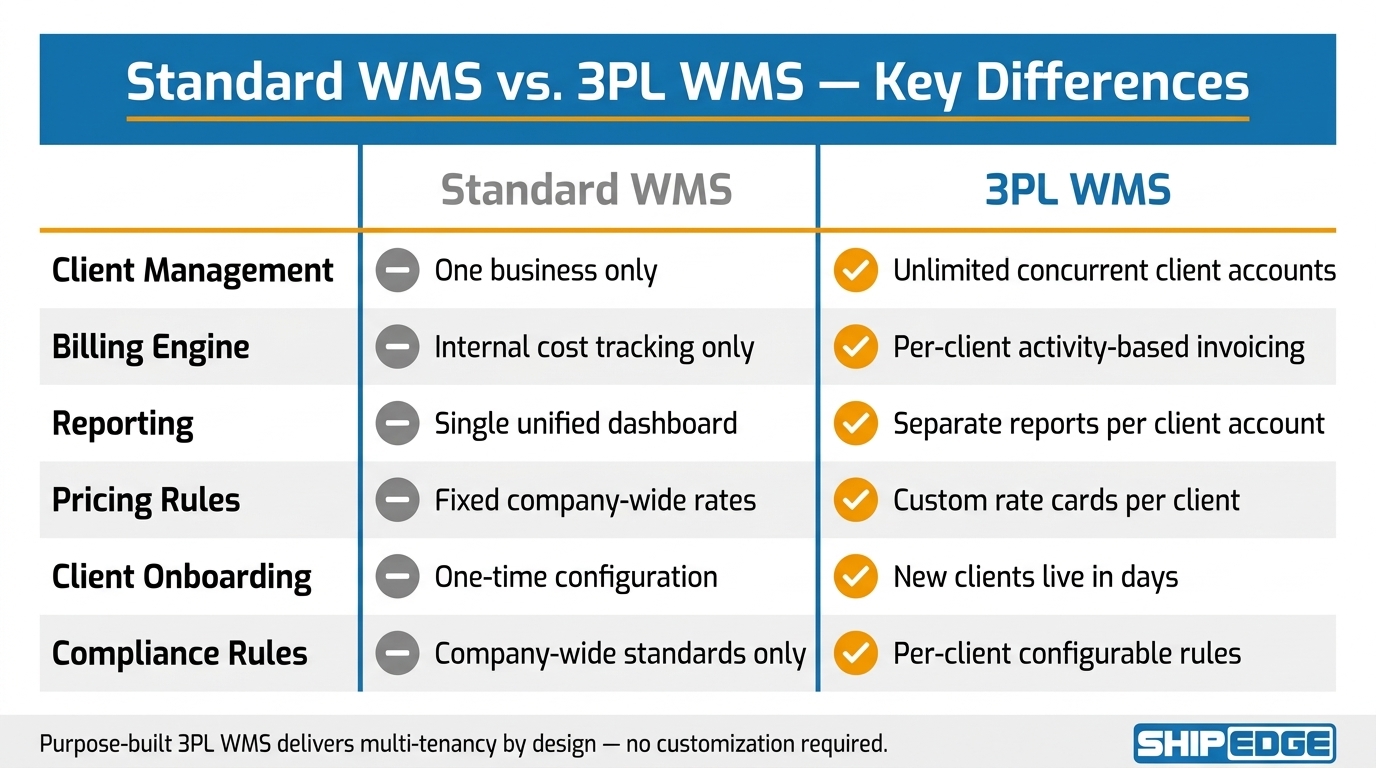
The most immediate difference is in data architecture. A standard WMS stores all inventory under a single organizational entity — one purchase order system, one inventory ledger, one customer database. When a 3PL tries to run multiple clients through such a system, the usual workaround is creating separate "warehouses" or "locations" per client within the software. This creates fragmentation: operators need to navigate between separate views to process orders, reporting is siloed, and any cross-client workflow becomes an error-prone manual process.
A 3PL WMS is built with client isolation as a first principle. The data model puts the client at the center. Every inventory record, every order, every transaction has a client ID attached to it from the moment it is created. The system enforces this isolation automatically, and the warehouse operator interface aggregates across clients intelligently — showing all orders ready to pick while keeping client data completely separate underneath.
Standard WMS products have no billing module at all — or a rudimentary one designed to generate a single monthly invoice for a single entity. A 3PL's billing reality is far more complex. Clients are charged for storage by cubic foot, pallet, or bin. They are billed per-pick, per-pack, per-label, per-special-service. Some clients have flat monthly minimums; some have volume-tiered rates; some have custom line items for value-added services.
A purpose-built 3PL WMS captures every billable event automatically as it occurs. When a warehouse associate scans a pick, the system records a billable pick event for that client's account. At billing time, the 3PL generates an itemized invoice from the accumulated events with a click — no manual spreadsheet reconciliation, no chasing down whether a special project was billed, no disputes over what was actually completed.
According to Gartner's research on warehouse management systems, billing automation is one of the top three features 3PL operators cite as critical for system selection, alongside multi-client inventory management and client portal capabilities.
Clients choose their 3PL partner partly based on the visibility they receive into their own operations. A standard WMS provides reports to the warehouse operator. A 3PL WMS provides portals and reports directly to each client — inventory levels by SKU, order status by shipment date, inbound receipt confirmations, and returns processing status.
This self-service transparency reduces the support burden on the 3PL's operations team. Instead of fielding five phone calls per day from five different clients asking about inventory or shipment status, the team can focus on operations. Transparency also builds trust that translates into contract renewals and account expansion over time.
Evaluating a 3PL WMS is not the same as evaluating a standard WMS. The checklist is different. These eight features are non-negotiable for any 3PL operating at scale or planning to grow.
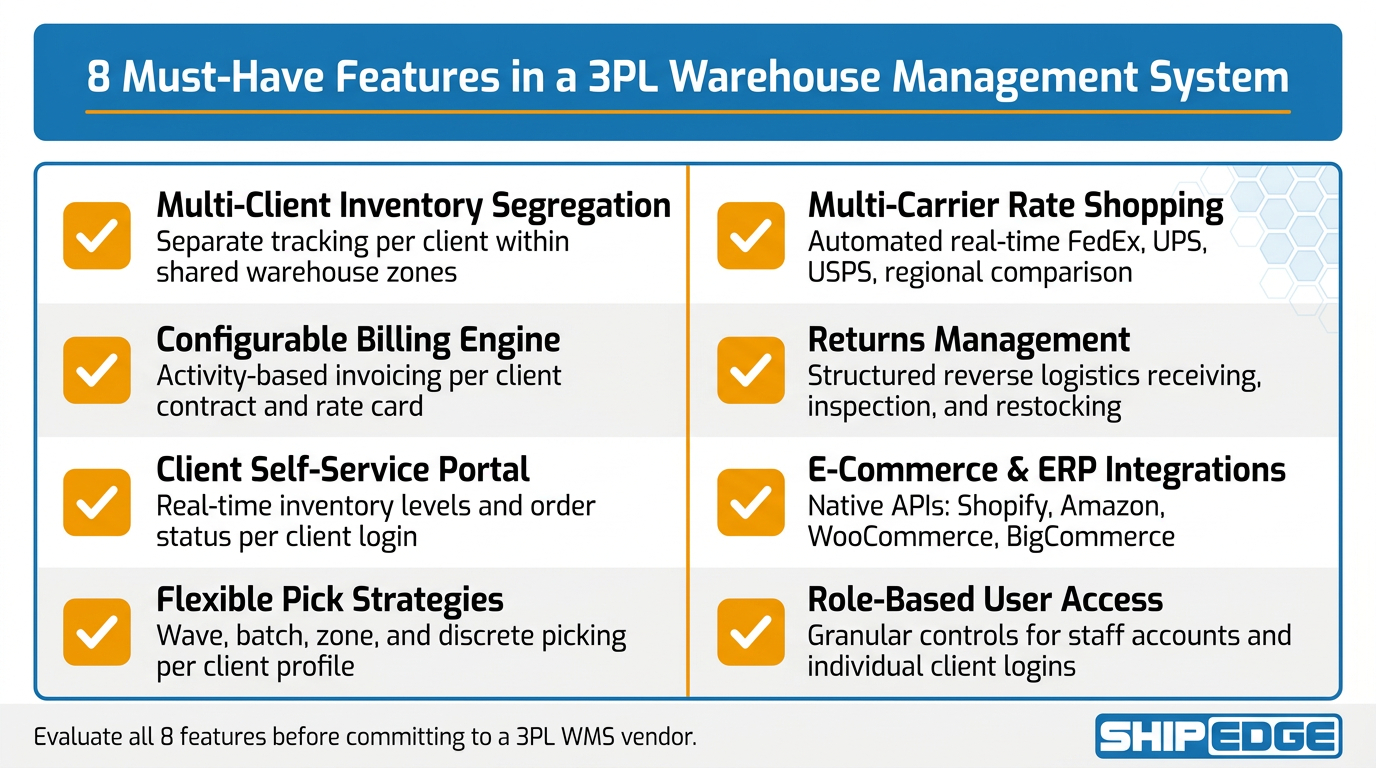
The WMS must enforce complete inventory isolation between clients at the data level — not just at the visual level. This means that even if two clients' products sit in adjacent bin locations, the system cannot accidentally fulfill one client's order with another client's inventory. Look for lot and serial number tracking per client, client-specific expiration date management, and the ability to set client-specific storage rules such as temperature or hazmat requirements.
The billing module must be able to model the way each client is actually charged — which differs from client to client. Look for the ability to define custom billing rate cards per client, automatic capture of billable events at the transaction level, flexible billing periods, and invoice generation directly from the WMS. Automatic dispute resolution is a bonus: when the client has access to the same transaction data used to generate their invoice, billing disputes drop dramatically.
Every client should have their own login with access only to their own inventory, orders, inbound shipments, returns, and invoices. The portal should update in real time as warehouse operations occur. A portal that requires the 3PL to manually refresh or export data before clients can see it creates more work than it saves. Real-time data access is the baseline expectation among e-commerce clients today.
Different clients have different fulfillment rules. One client ships single-unit direct-to-consumer orders; another ships multi-unit B2B pallets. The WMS must support multiple pick strategies — wave picking, zone picking, batch picking, and single-order picking — configured independently per client. The system should optimize pick paths automatically to minimize walk distance, reducing labor cost per pick event.
The WMS should integrate natively with UPS, FedEx, USPS, DHL, and regional carriers and provide real-time rate shopping at the time of label generation. This is especially critical during peak season when carrier surcharges shift and the cheapest carrier for a given zone changes week to week. Embedded rate shopping saves 3PL clients money and positions the 3PL as a value-add partner rather than a commodity storage provider.
E-commerce return rates average 20–30% across most product categories, and during peak season return volumes spike dramatically as holiday gifts are sent back in January and February. The WMS must handle the full reverse logistics workflow: RMA generation, inbound returns receiving, inspection and grading, restocking or disposition routing, and client notification. Returns processing is a billable service — every step must be captured automatically.
A 3PL's clients sell through multiple channels: Shopify, Amazon, WooCommerce, BigCommerce, TikTok Shop, and Walmart Marketplace. The WMS must connect to these channels natively — receiving orders automatically, updating inventory counts in real time, and pushing tracking numbers back to the channel after shipment. Without direct channel integrations, the 3PL and its clients face constant manual data entry, oversell risk, and inventory discrepancies. Clients with ERP systems (NetSuite, SAP, Microsoft Dynamics) need the WMS to sync inventory and order data bidirectionally without custom development work.
As a 3PL grows, so does its team — warehouse associates, supervisors, billing staff, client account managers, and client users all need different levels of access. The WMS must support role-based access control (RBAC) that can be defined granularly: a warehouse associate can scan picks but cannot edit billing rates; a client portal user can view inventory but cannot see another client's data; a billing administrator can generate invoices but cannot modify operational workflows. Without proper RBAC, either the system becomes a security risk or access management becomes an administrative burden that slows the operation.
The operational gaps in a poorly chosen WMS are manageable during normal operating conditions. During peak season — October through January — those gaps become crises. Order volume spikes 3–5× above baseline for most 3PLs serving e-commerce clients. Labor headcount doubles or triples. Error rates that were acceptable at low volume become unacceptable at high volume. Any system downtime during Black Friday or Cyber Monday is a direct threat to the 3PL's client contracts.
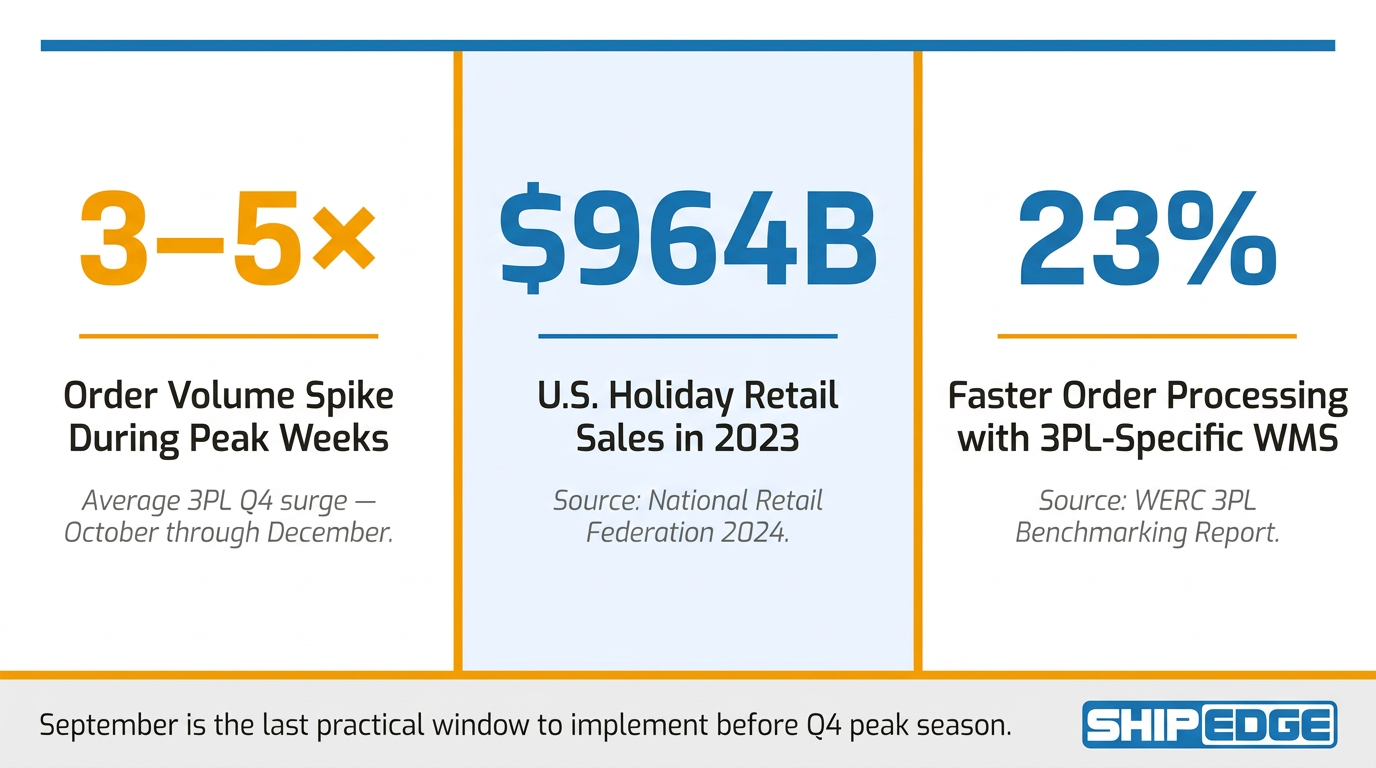
A standard WMS that works acceptably at 500 orders per day may become unusable at 2,500 orders per day. Database queries that return in two seconds at baseline volume may time out under peak load. Manual workarounds that are tolerable at low volume — copying order data between systems, manually checking inventory levels, reconciling shipping carrier charges in spreadsheets — become impossible to sustain when volume is five times higher.
Peak season also concentrates errors. Picking errors that occur at a 0.5% rate at baseline create 5–10× more returns and customer complaints when volume is 5× higher. A 3PL WMS with intelligent pick path optimization, scan-verify workflows, and real-time inventory confirmation reduces the error rate at the transaction level — meaning peak volume does not proportionally increase error volume.
According to the Warehousing Education and Research Council (WERC), facilities using purpose-built WMS solutions report 23% faster order processing and 31% fewer picking errors compared to facilities using generic inventory management tools.
General-purpose WMS products — and virtually all ERP-based WMS modules — share a set of risks that are easy to miss during a vendor evaluation but painful at peak season. No automatic billing capture means every billable pick, pack, special service, and storage event must be manually logged or reconciled from spreadsheets. At 2,000 orders per day during Q4, this becomes a full-time job and an error-prone one.
Without client isolation in reporting, any configuration error in a general WMS could expose one client's inventory or order data to another client — a serious business and legal risk. Without embedded carrier rate optimization, the 3PL either locks clients into a single carrier or handles carrier selection manually, which is impossible at peak volume. Without fast client onboarding, a 3PL that wins a new contract in October and cannot configure the client before November loses that contract's first peak season entirely.
A well-implemented 3PL WMS prepares for peak season through configuration, not heroics. Before Q4 begins, the operations team uses the WMS to pre-configure peak wave schedules, client-specific SLA rules, expanded pick zone assignments for temporary staff, and carrier priority rankings based on the most current rate data.
During peak, the WMS enforces quality at every scan point. Every pick is verified by barcode scan before it moves to pack. Every pack is weight-checked against the expected carton weight. Every shipment is automatically assigned the optimal carrier based on the client's rate card and real-time carrier data. The system handles the volume without manual intervention — which is the only way 2,500 orders per day ships accurately without proportional increases in error rate and labor cost.
After peak season, the WMS's reporting gives the 3PL the data it needs to invoice clients correctly, evaluate labor efficiency by zone and associate, and plan capacity for the following year. This full-cycle visibility is impossible without a system that captured every operational event from the start.
Most WMS selection errors happen because 3PLs evaluate software the way a brand would — not the way a multi-client logistics provider should. These three mistakes cause the most damage and are the easiest to prevent with the right evaluation framework.
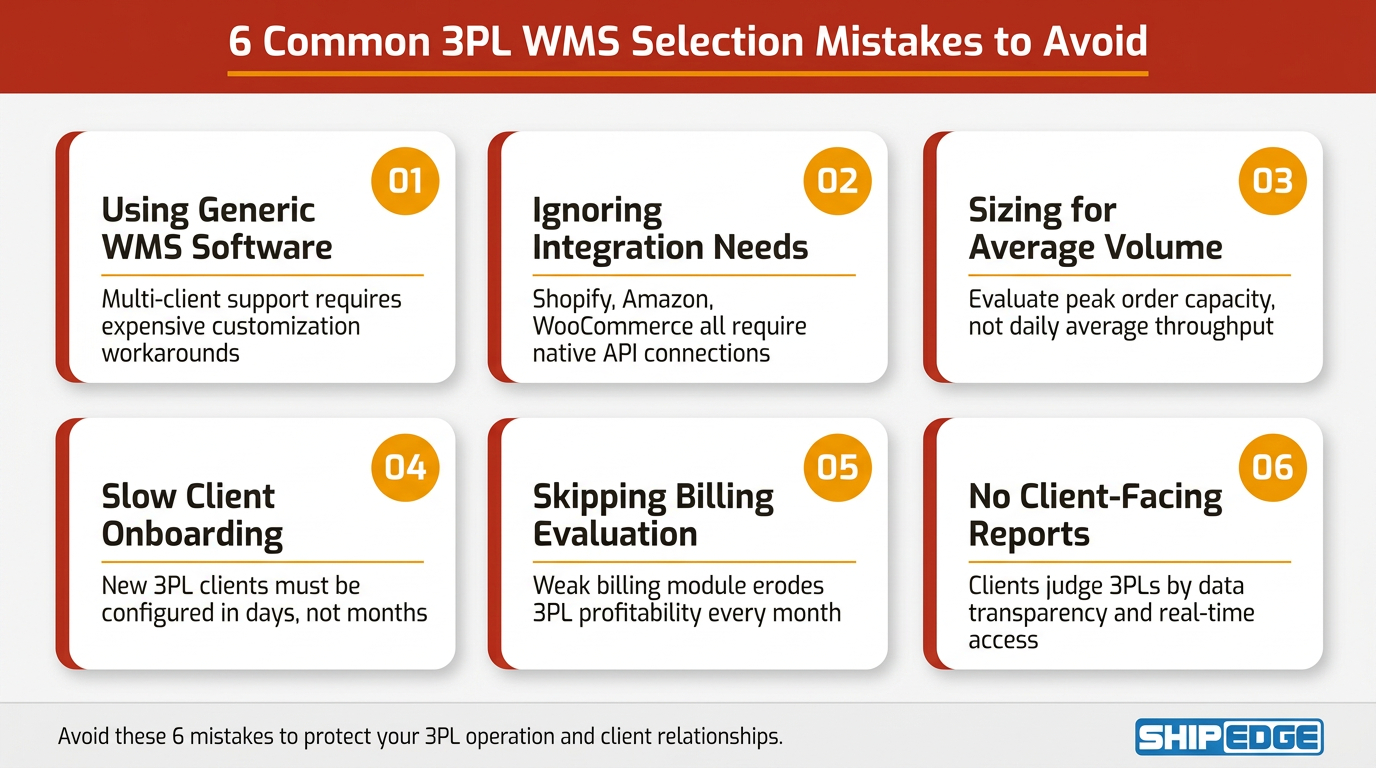
The most frequent mistake is selecting a WMS because it is well-known and affordable without verifying that it is architecturally capable of multi-client management. Many popular WMS products — and virtually all ERP-based WMS modules — were not designed for 3PLs. They can be configured to approximate multi-client operations through workarounds, but those workarounds break under growth and peak volume.
Before signing any WMS contract, a 3PL should run a proof-of-concept test using actual operational scenarios: onboard two mock clients with different SKU configurations, simulate a billing event for each client, and confirm that the system prevents inventory crossover between them. If any of those steps require manual workarounds, the system is not a true 3PL WMS — regardless of how its marketing materials describe it.
A 3PL's clients already have their technology stack in place before they sign with the 3PL. They have their Shopify store, their Amazon Seller Central account, their ERP. The 3PL's WMS must integrate with all of it. Generic WMS products often offer integrations through third-party middleware connectors that require ongoing maintenance, add monthly fees, and introduce sync delays that create inventory discrepancies.
Purpose-built 3PL WMS platforms provide native integrations — direct API connections to major e-commerce channels and ERPs that are maintained by the WMS vendor. Native integrations are more reliable, faster to deploy, and do not require the 3PL to manage a middleware layer. When evaluating a WMS, ask the vendor for a complete integration library and verify that every channel your current and prospective clients use is on that list.
WMS vendors typically demonstrate their platform using average daily order scenarios. A 3PL that accepts those demonstrations without testing peak-volume scenarios sets itself up for failure. Every WMS evaluation should include a stress test: simulate 5× normal order volume and measure system response time, error rate, and the operator interface's usability under load.
Additionally, the 3PL should evaluate staff scalability. Can temporary seasonal workers learn the WMS quickly? A complex WMS that requires two weeks of training is not practical when seasonal staff are onboarded for four weeks and need to be productive on day two. Look for intuitive scan-and-confirm workflows that temporary workers can master in a half-day of supervised training.
Shipedge is a warehouse and order management platform built specifically for 3PLs and multi-channel e-commerce fulfillment providers. Its architecture was designed from the ground up to solve the challenges that general WMS products cannot address — not retrofitted with multi-client features as an afterthought to a single-brand product.
Shipedge's data model treats client isolation as a core architectural requirement. Every inventory record, every order, and every billing event carries a client identifier that is enforced at the database level — not managed through user interface workarounds. Warehouse operators work through a unified interface that shows all clients' orders and inventory simultaneously, while the system prevents any cross-client data contamination automatically.
Client onboarding in Shipedge is a configuration workflow, not a technical project. A new client can be fully configured — with their own inventory rules, carrier preferences, billing rate card, and portal login — in days rather than weeks. For 3PLs that win new contracts frequently, this speed directly protects revenue. A client signed in September can be live and shipping by October, fully ahead of Q4 peak season pressure.
Shipedge provides automated client portal access from day one. Each client logs into their own dashboard to view real-time inventory counts, order statuses, and inbound shipment confirmations. The 3PL's operations team shares data selectively — giving clients what they need without exposing backend workflows or other clients' information.
Shipedge's billing engine captures every warehouse activity automatically as it occurs. Storage fees accrue in real time. Pick and pack events are logged at the scan point. Special services and value-added activities can be configured as custom billing line items and captured with a single tap on the warehouse associate's mobile device. At billing time, the 3PL generates a complete, itemized invoice per client directly from the WMS — no spreadsheet reconciliation required, no missing line items.
On the integration side, Shipedge maintains native connections to Shopify, Amazon, WooCommerce, BigCommerce, and major ERPs including NetSuite and Microsoft Dynamics. Orders flow in automatically, inventory updates flow out in real time, and tracking numbers push back to the channel immediately after label generation. This end-to-end automation allows 3PLs to scale throughput without proportionally scaling their administrative headcount.
To see how Shipedge's 3PL warehouse management software handles multi-client operations and peak season volume, request a demo from the Shipedge team.
A 3PL WMS (third-party logistics warehouse management system) is purpose-built software designed for warehouses that store and fulfill inventory on behalf of multiple clients simultaneously. Unlike standard WMS software built for single-brand operations, a 3PL WMS provides multi-client inventory segregation, activity-based billing per client, and client-facing portals that allow each client to view their own inventory and order data in real time without seeing other clients' information. It is an entirely different category of software — not a configured version of a standard WMS.
A regular WMS manages a single brand's inventory inside a single warehouse, with all operations and reporting oriented toward one entity. A 3PL WMS manages multiple clients' inventory simultaneously on a single platform, enforcing data and operational isolation between clients while giving the warehouse team a unified view across all clients. The critical additional capabilities are activity-based billing per client, client self-service portals, configurable billing rate cards per client, and multi-client inventory segregation enforced at the database level rather than through UI workarounds.
A 3PL WMS must include multi-client inventory segregation, a configurable billing engine that captures billable events automatically, a client self-service portal with real-time data, flexible pick strategy support across wave, batch, zone, and single-order picking, multi-carrier rate shopping, returns management with full reverse logistics tracking, native e-commerce channel integrations for Shopify, Amazon, and WooCommerce, and role-based access control. Any WMS missing more than one of these features will create operational gaps that grow more painful as the 3PL scales its client base and order volume.
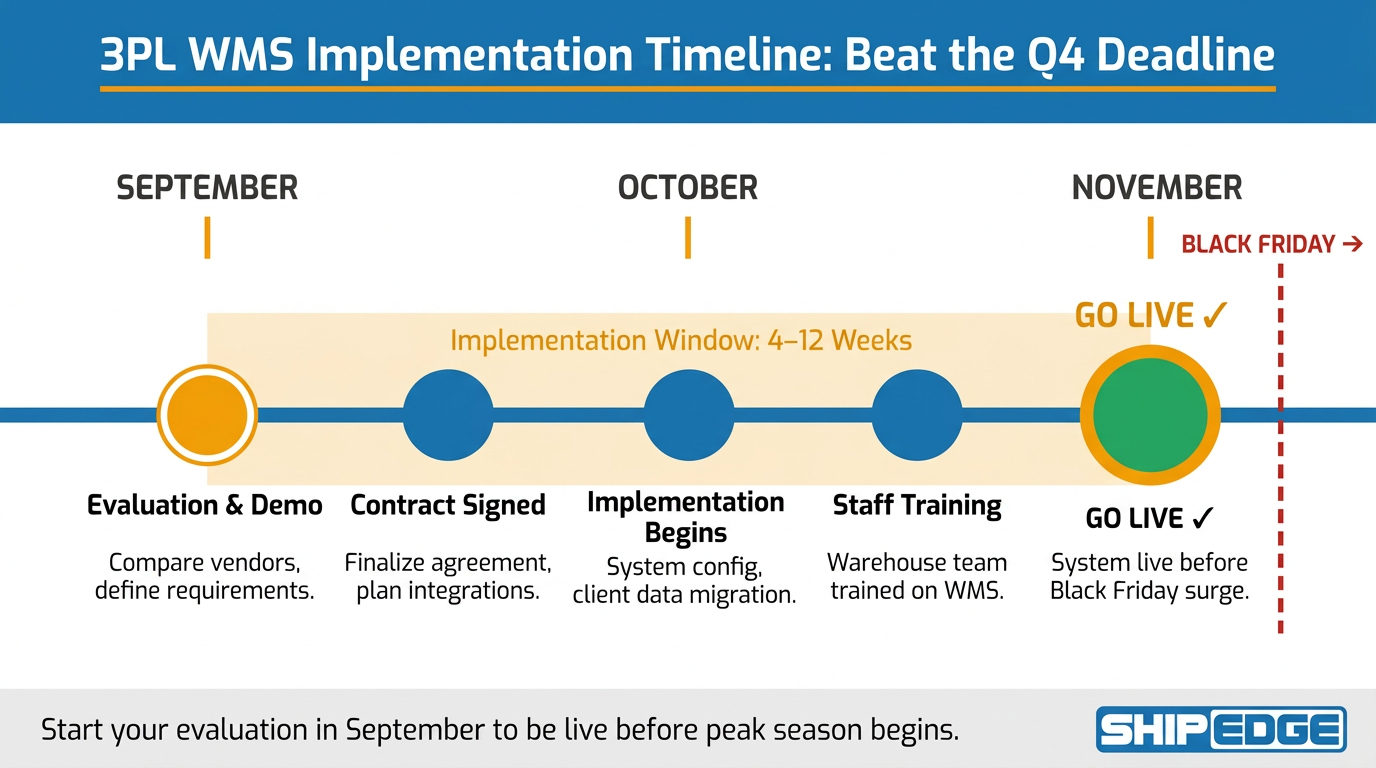
Implementation timelines for a 3PL WMS typically range from four to twelve weeks, depending on the number of active clients, integration complexity, and the volume of data migration required. A focused implementation with one or two clients and standard channel integrations can go live in four to six weeks. Complex implementations involving multiple ERP integrations, custom billing configurations, and large inventory migrations may take ten to twelve weeks. For 3PLs targeting Q4 peak season readiness, September is the last practical window to begin implementation.
Yes — a multi-location 3PL WMS supports operations across multiple warehouse facilities while maintaining centralized client visibility. Inventory can be tracked simultaneously by location and by client. Orders can be routed to the nearest or most optimal warehouse based on configurable rule sets. Clients see a unified view of their total inventory regardless of which physical location holds it. Multi-facility 3PLs should verify that the WMS does not require separate software instances per location, as that fragments operations and creates reconciliation overhead across facilities.
A 3PL WMS eliminates manual billing reconciliation by capturing every billable event automatically at the point of warehouse activity. Storage fees accrue by the configured unit — pallet, cubic foot, or bin position. Pick and pack fees are recorded at each scan event. Special services and value-added activities are logged with a tap on the associate's mobile device. At billing time, the 3PL generates an itemized invoice per client directly from the system. Clients with portal access can see the same transaction data the invoice was built from, which reduces billing disputes significantly and builds long-term trust in the 3PL relationship.
A warehouse management system for 3PL is not a variation of standard WMS software — it is a different category of technology built for a fundamentally different operational model. The multi-client architecture, activity-based billing, client self-service portals, and peak-volume scalability that a 3PL WMS provides cannot be replicated through workarounds in a single-client system.
3PLs that invest in purpose-built WMS technology before peak season do not just survive Q4 — they use it to win new clients. When your operation ships accurately at 5× volume while competitors scramble, that performance becomes a sales asset. When clients can monitor their own real-time dashboard instead of calling your operations team, that transparency extends contracts and increases account value.
September is the window. Any 3PL that begins WMS evaluation and implementation by September can be fully configured and go-live before Black Friday. Any 3PL that waits until October is shipping that peak season on whatever system they already have.
Ready to see what a purpose-built 3PL WMS looks like in practice? Shipedge was built specifically for third-party logistics providers. Request a demo and walk through the multi-client dashboard, billing engine, and client portal with the Shipedge team.

