EN │ ES
3PL Software
Shipedge
August 26, 2026
14 min read
A warehouse management system for 3PL is a specialized software platform designed to manage multi-client logistics operations, automate billing, and provide real-time inventory visibility across disparate brands. Unlike standard warehouse software, a 3PL-specific system natively handles multiple product owners within the same facility while keeping their data, workflows, and invoicing completely isolated and accurate. According to Grand View Research, the global third party logistics market is projected to reach .8 trillion by 2031, demanding that fulfillment centers adopt purpose-built tools to scale efficiently.
Third-party logistics providers (3PLs) operate in a uniquely complex environment. They do not own the inventory they store, pick, pack, and ship. Instead, they act as the operational backbone for dozens or hundreds of different merchants, each with their own specific rules, packaging requirements, and service level agreements (SLAs). Managing this complexity requires more than just basic inventory tracking; it demands a robust infrastructure capable of dynamic billing, seamless client communication, and granular workflow automation.
For operations directors and warehouse managers, selecting the right software is the most consequential decision they will make. The right platform serves as a force multiplier, enabling rapid growth without a proportional increase in administrative headcount. Conversely, the wrong platform creates bottlenecks, drives up labor costs, and damages client relationships through inaccurate billing and missed SLAs.
In this comprehensive guide, we will explore exactly what a warehouse management system for 3PL entails, why generic software fails in multi-client environments, the core features you must look for, and how to seamlessly integrate this technology into your broader operational tech stack.
A warehouse management system (WMS) is software that controls and optimizes daily warehouse operations, from the moment inventory enters a facility until it leaves. For a 3PL, this definition expands significantly. A 3PL WMS is a multi-tenant architecture platform that allows fulfillment centers to manage inventory, process orders, and bill services for multiple independent clients simultaneously, all within a single unified interface.
The fundamental purpose of 3PL logistics software is to act as the central nervous system for your operation. It connects your warehouse floor to your clients' sales channels, routing orders intelligently, directing warehouse staff to the most efficient pick paths, and meticulously recording every billable action taken along the way. This level of orchestration ensures that operations remain profitable, accurate, and transparent to the merchants relying on your services.
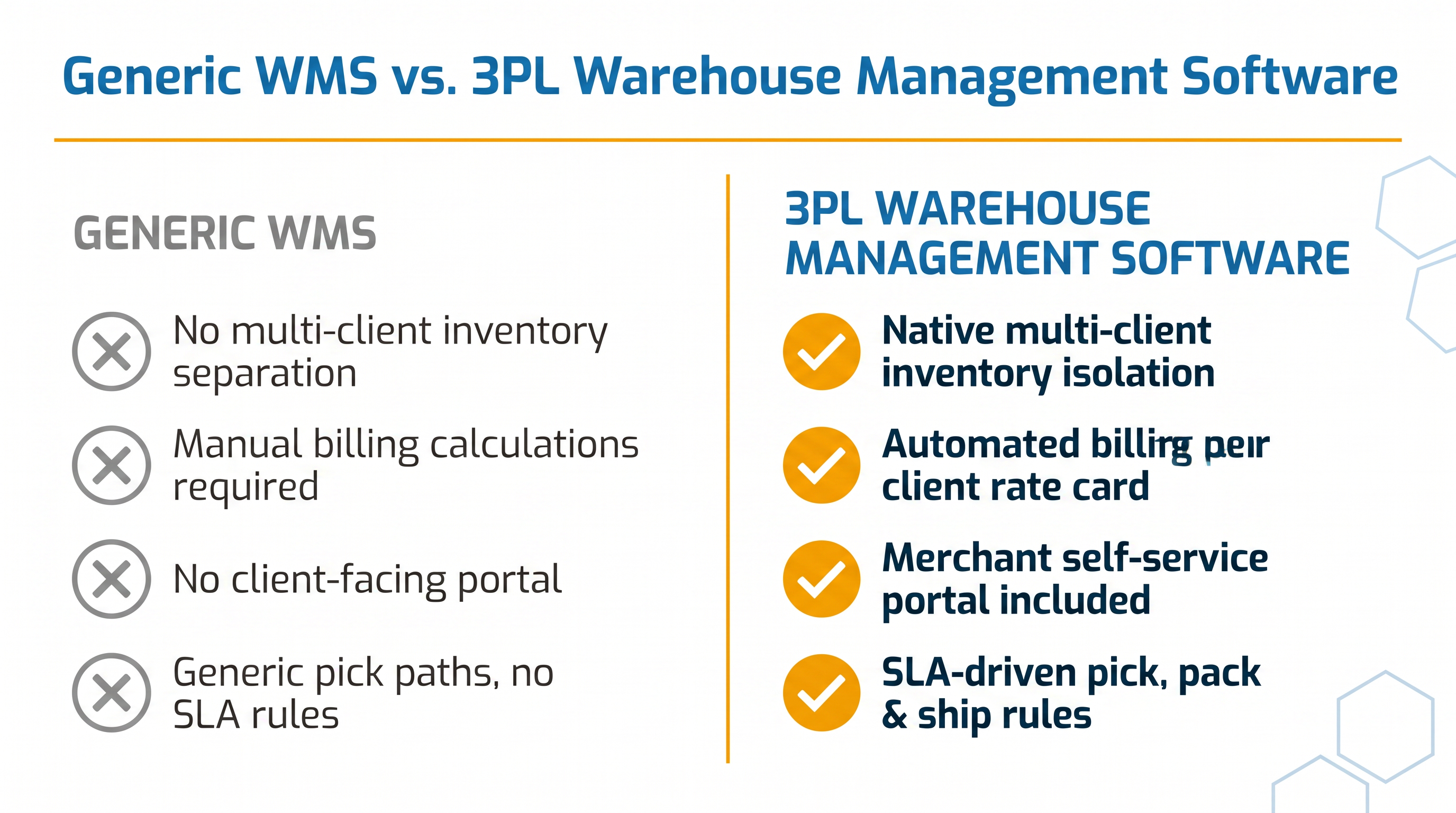
The critical distinction between a standard WMS and a 3PL WMS lies in the concept of ownership and multi-tenancy. A standard WMS assumes that the company operating the warehouse also owns the inventory. A 3PL management software platform inherently understands that the warehouse operator and the inventory owner are two different entities.
First, standard systems lack native multi-client inventory management. They mingle data, making it difficult to report stock levels to individual merchants accurately. A purpose-built 3PL platform segregates client data completely, ensuring that Client A never sees Client B's inventory, orders, or pricing.
Second, a generic WMS does not track billable events. 3PLs make money by charging for services—receiving pallets, storing inventory, picking items, and shipping boxes. A standard WMS tracks the action but ignores the financial implication. A true 3PL WMS automatically captures these actions and translates them into client invoices, eliminating manual spreadsheet calculations.
Third, client communication is built-in. Standard systems do not feature client portals because they assume internal use only. 3PL warehouse management software provides dedicated interfaces where merchants can log in, view real-time inventory tracking, submit advance shipping notices (ASNs), and monitor order statuses without calling your customer service team.
Attempting to run a modern fulfillment center on generic software or outdated on-premise systems is a recipe for operational failure. The logistics industry is moving faster than ever, driven by aggressive e-commerce fulfillment expectations set by retail giants. To compete, independent 3PLs must operate with extreme efficiency, and that requires software built specifically for their business model.
Purpose-built software standardizes workflows across diverse client requirements. When you have fifty clients, you cannot rely on tribal knowledge or paper notes to remember that Client X requires custom tissue paper while Client Y needs a promotional insert. The software must enforce these rules programmatically at the packing station.
Furthermore, warehouse automation is no longer optional. With labor costs rising and turnover in warehouses remaining persistently high, 3PLs must leverage software to direct workers. System-directed put-away, optimized pick paths, and automated rate shopping reduce the cognitive load on warehouse staff, drastically lowering error rates and accelerating training for new hires.
Deploying the wrong software carries steep hidden costs that erode profit margins daily. The most significant cost is revenue leakage from unbilled services. When a 3PL relies on manual billing, workers inevitably forget to record every special project, kitting assembly, or extra pallet received. This missing data directly reduces top-line revenue.
Additionally, poor software leads to severe inventory inaccuracies. According to industry data from Supply Chain Dive, warehouses utilizing outdated systems experience error rates up to three times higher than those deploying modern, automated solutions. When inventory counts are wrong, clients oversell products they do not have, leading to canceled orders, furious consumers, and ultimately, client churn.
Finally, the administrative burden of a generic WMS cripples scalability. If your team spends hours each week manually calculating invoices, generating customized reports, and responding to client emails about order statuses, your business cannot take on new clients without hiring more administrative staff. Purpose-built 3PL inventory management software breaks this linear relationship between client growth and headcount.
When evaluating a warehouse management system for 3PL operations, shiny dashboards mean nothing if the underlying functionality cannot support your specific workflows. The software must be robust enough to handle complex enterprise demands while remaining intuitive enough for temporary warehouse staff to learn quickly.
To ensure long-term success and SLA compliance, your chosen platform must excel in several foundational areas. Below are the non-negotiable core features every modern 3PL requires.
The bedrock of any 3PL operation is flawless inventory control across multiple merchants. The system must support logical separation of inventory while allowing physical co-location. This means you can store Client A's t-shirts in the same aisle as Client B's electronics, but the software maintains strict digital boundaries.
Advanced SKU management is also essential. The system must handle variations, bundles, kits, and aliases seamlessly. Furthermore, robust lot tracking and serial number tracking are critical for 3PLs servicing the medical, food, or electronics industries, ensuring rapid recalls and total compliance with FDA or industry regulations.
Your WMS must be a revenue generation engine, not just an operational tool. 3PL billing software must automatically capture every chargeable event—from receiving a container to storing a pallet, picking an order, and applying a shipping label.
The billing engine must support complex, client-specific rate cards. Client A might pay a flat rate per order, while Client B pays per pick plus a monthly storage fee based on cubic volume. The software should calculate these charges daily, generate detailed invoices at the end of the billing cycle, and push that data directly to your accounting software.
Transparency is the new standard in third-party logistics. Merchants expect to see their operations in real-time. A dedicated client portal allows merchants to log in and view their dashboards, submit support tickets, and run custom reports without consuming your staff's time.
This real-time inventory tracking builds trust. When clients can see exactly how many units of a specific SKU are available, reserved, or damaged, they can make informed purchasing and marketing decisions, cementing their relationship with your 3PL as a strategic partner rather than a commoditized vendor.
Shipping costs represent the largest expense for e-commerce merchants. A 3PL WMS must include robust carrier integrations with major parcel carriers (UPS, FedEx, USPS, DHL) and regional providers.
More importantly, the system must perform automated rate shopping. When an order drops, the software should instantly compare rates across all connected carriers based on weight, dimensions, destination, and delivery SLA, automatically selecting the most cost-effective option. This automation saves your clients money and makes your 3PL vastly more competitive.
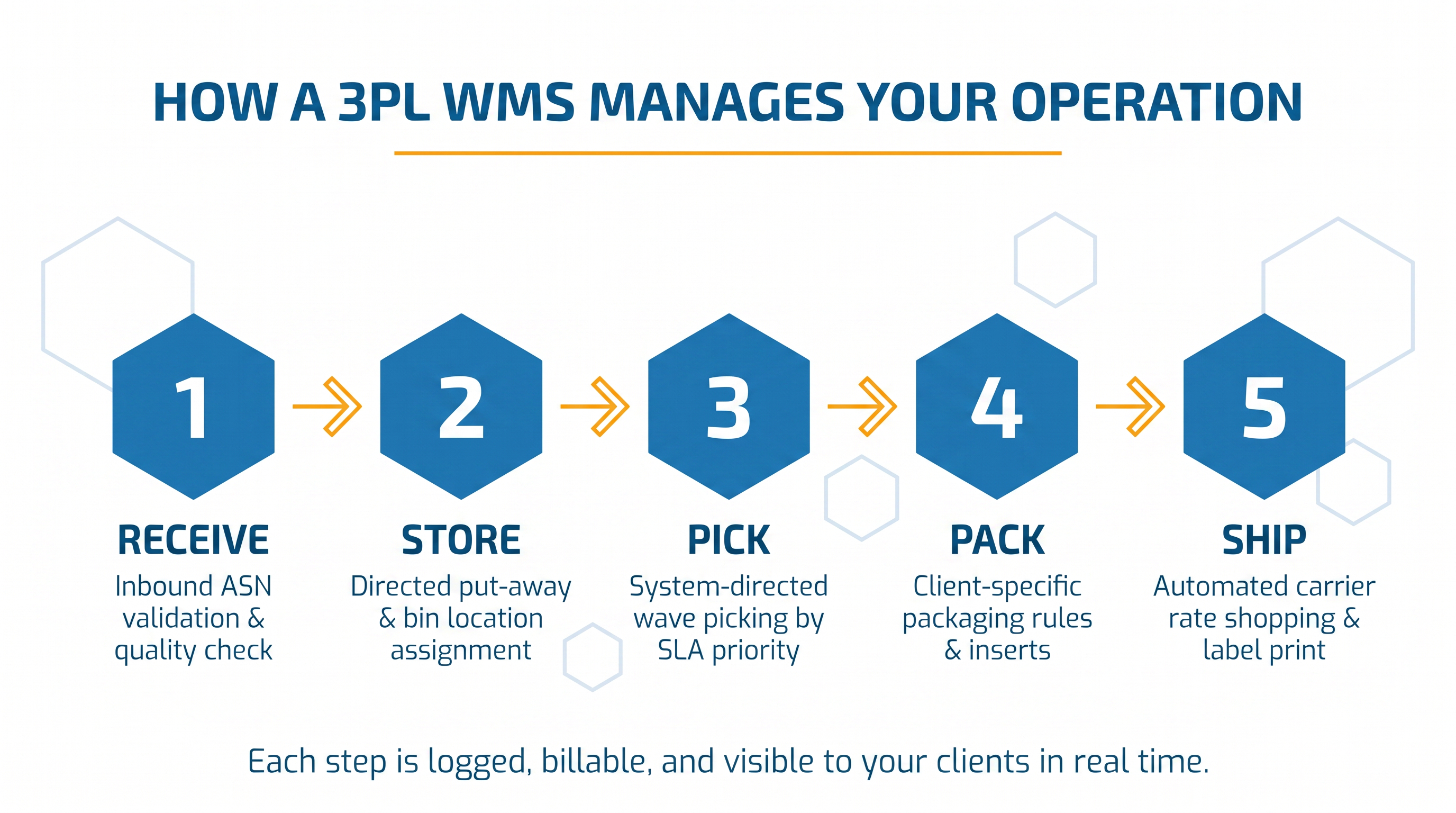
Efficient outbound operations depend entirely on accurate inbound processes. The WMS must streamline receiving through ASN processing, mobile barcode scanning, and immediate discrepancy reporting.
System-directed put-away algorithms should guide workers to the optimal bin locations based on product velocity and dimensions. To maintain accuracy without halting operations, the system must support continuous cycle counting. Instead of shutting down the warehouse for an annual physical inventory, workers verify small subsets of inventory daily during their normal workflows, ensuring perpetual accuracy.
The pick and pack software module is where your warehouse realizes its greatest labor efficiencies. The WMS should support multiple picking strategies—discrete picking, batch picking, wave picking, and zone picking—allowing supervisors to adapt to varying order volumes dynamically.
At the packing station, workflow automation must enforce client-specific rules. The system should display packaging instructions, verify items via barcode scan to eliminate mis-ships, automatically print the correct shipping label and packing slip, and instantly send tracking information back to the client's sales channel.
A 3PL WMS does not operate in a vacuum; it must seamlessly integrate with the broader digital ecosystem of both your business and your clients' businesses. The primary integration point is the order management system (OMS). While the WMS handles physical execution within the four walls of the warehouse, the OMS manages order routing, distributed order management, and multi-channel inventory synchronization.
Furthermore, the WMS must connect to hundreds of different e-commerce platforms, marketplaces, and ERP systems. When a client launches a new Shopify store or starts selling on Amazon, your software must pull those orders in instantly without custom development work.
Finally, integration with accounting software (like QuickBooks or NetSuite) is vital for automated client billing, ensuring that the operational data captured on the warehouse floor translates directly into recognized revenue in your financial ledgers.
Selecting the best 3PL software requires a rigorous evaluation process focused on long-term scalability and vendor partnership. You are not just buying code; you are adopting a methodology for running your business.
Begin by mapping your current operational bottlenecks. Are you losing money on unbilled storage? Are pick errors causing high return rates? Define these pain points clearly and demand that prospective software vendors demonstrate exactly how their platform solves them. Avoid vendors who rely on flashy presentations but cannot show you a live, relevant workflow.
Consider the implementation process. A powerful system is useless if it takes a year to deploy. Ask about onboarding support, data migration strategies, and the average time-to-value for new customers. The best software partners act as consultants, guiding you through best practices rather than just handing you a login and walking away.
Before signing a contract, pose these critical questions to your software vendor: How does your system handle complex, client-specific billing rules?
Shipedge is an industry-leading fulfillment center software platform engineered specifically for the complexities of modern third-party logistics. Our comprehensive solution bridges the gap between order management and warehouse execution, providing 3PLs with a unified toolset to scale operations efficiently.
With Shipedge, multi-client warehouse management becomes effortless. Our robust billing engine captures every chargeable activity automatically, ensuring you never miss revenue. The intuitive client portal provides merchants with total transparency, reducing customer support inquiries and building stronger partnerships.
Furthermore, our advanced mobile applications guide warehouse staff through optimized pick paths, enforcing strict barcode verification to guarantee order accuracy. By automating rate shopping and integrating with over 150 sales channels, Shipedge empowers your 3PL to deliver exceptional service, maintain strict SLA compliance, and drive profitable growth.
A warehouse management system for 3PL is specialized software designed to manage operations for multiple independent clients within a single facility. It segregates client inventory, automates complex billing processes, and provides dedicated client portals. This ensures accurate fulfillment, transparent reporting, and efficient resource allocation across diverse merchant requirements.
A standard WMS is built for a single company managing its own inventory. A 3PL WMS features a multi-tenant architecture, allowing the warehouse to manage multiple distinct inventory owners simultaneously. Crucially, a 3PL WMS includes automated client billing capabilities to capture revenue for services rendered, a feature entirely absent from generic systems.
Essential features include multi-client inventory management, automated activity-based billing, a comprehensive client portal, advanced rate shopping, and mobile barcode scanning. Furthermore, it must offer flexible pick and pack software workflows, robust cycle counting, and seamless integrations with major e-commerce platforms and shipping carriers to ensure maximum warehouse efficiency.
Absolutely. Small 3PLs often benefit the most from implementing a robust WMS early. It eliminates reliance on error-prone spreadsheets, automates manual billing to prevent revenue leakage, and standardizes processes. This foundational technology allows small operations to take on more clients and scale rapidly without needing to hire extensive administrative staff.
Costs vary significantly based on the platform's capabilities, order volume, and the number of users. Pricing models typically include monthly SaaS subscriptions, per-order transaction fees, or tiered user licenses. While enterprise systems can cost tens of thousands upfront, modern cloud-based solutions offer scalable pricing, ensuring you only pay for the capacity you actually use.
The software utilizes a multi-tenant database architecture. Every item, order, and workflow is securely tagged to a specific client ID. This logical separation ensures that inventory data never overlaps. The system applies client-specific routing rules, packaging instructions, and rate cards automatically, allowing warehouse staff to process diverse orders seamlessly.
A comprehensive 3PL WMS must integrate bidirectionally with major e-commerce platforms (Shopify, BigCommerce), marketplaces (Amazon, eBay), and ERP systems. It also requires deep integrations with parcel carriers for automated rate shopping and label generation, as well as connections to accounting software to streamline client invoicing and financial reporting.
Navigating the complexities of third-party logistics requires more than hard work; it requires intelligent, purpose-built technology. A warehouse management system for 3PL is not merely a tool for tracking boxes—it is the operational foundation that dictates your profitability, scalability, and client satisfaction.
By adopting a platform designed for multi-client environments, you eliminate revenue leakage through automated billing, drastically reduce errors via workflow automation, and empower your clients with real-time transparency. As e-commerce demands continue to accelerate, clinging to generic software or manual spreadsheets is a fast track to obsolescence. Investing in the right 3PL logistics software is investing in the future viability of your business.
Ready to upgrade your 3PL operations?Shipedge gives third-party logistics providers the tools to manage multiple clients, automate billing, and scale without adding headcount. Book a free demo and see the difference purpose-built 3PL software makes.