EN │ ES
Third Party Logistics
Shipedge
October 12, 2026
17 min read
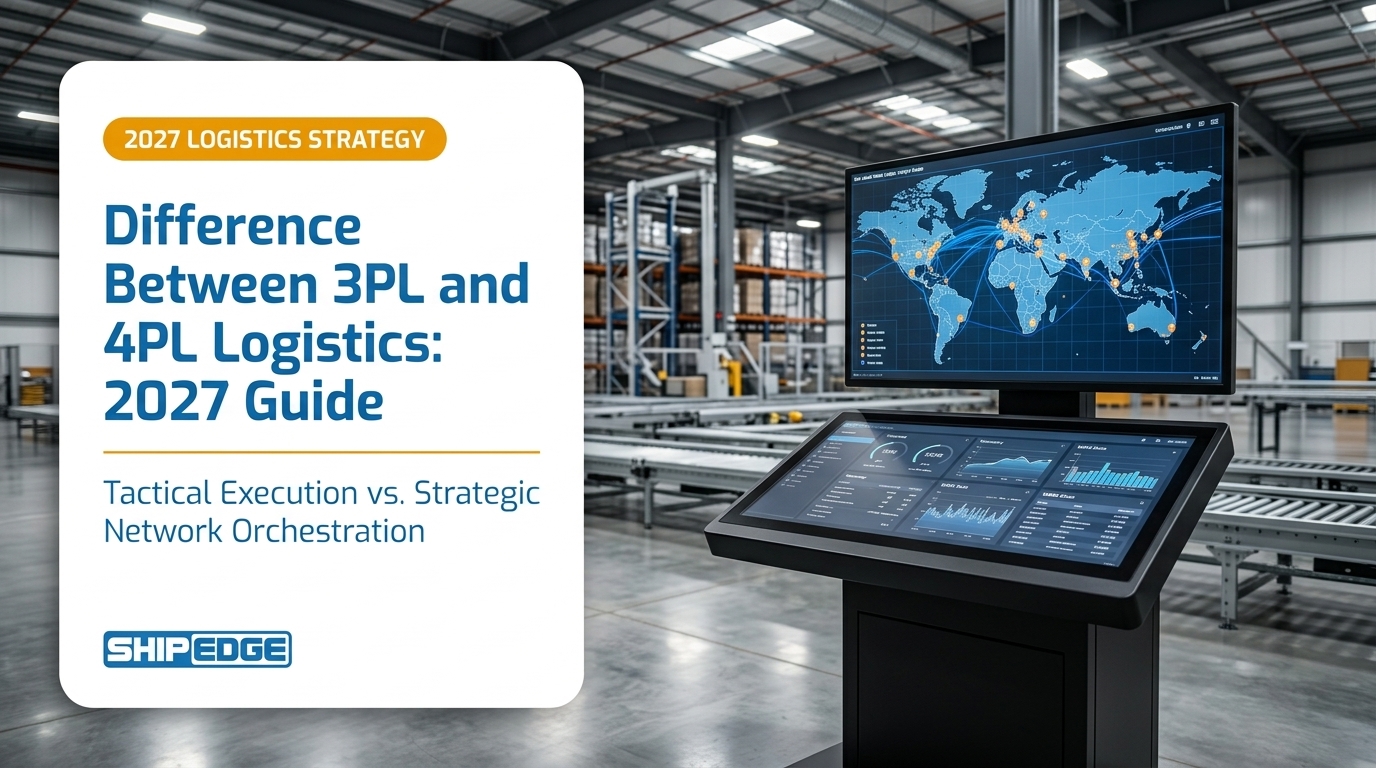
The core difference between 3PL and 4PL logistics centers on physical execution versus strategic orchestration. A third-party logistics provider (3PL) executes tactical fulfillment operations including warehousing, picking, packing, inventory control, and freight transport. In contrast, a fourth-party logistics provider (4PL) serves as a non-asset-based lead logistics coordinator that designs, manages, and optimizes an enterprise's entire supply chain network across multiple independent 3PL vendors.
Modern supply chain leadership demands precision when balancing cost, speed, and visibility. E-commerce merchants and industrial manufacturers continually confront a fundamental structural decision: should operational execution remain with specialized fulfillment partners, or does enterprise complexity require an overarching strategic management layer? Understanding the precise difference between 3PL and 4PL models determines capital allocation, customer experience, and operational resilience.
As fulfillment networks adopt autonomous technologies and global markets expand, this comparison has evolved significantly beyond legacy definitions. Today, market boundaries blur as cloud computing, artificial intelligence, and unified data architectures reshape service offerings. Operational resilience during high-velocity retail cycles and fourth-quarter peak surges further intensifies the need for absolute clarity between tactical execution and systemic management.
This comprehensive guide outlines the operational frameworks, economic realities, emerging 5PL models, and modern software architectures that dictate logistics selection for 2027 and beyond. Whether evaluating immediate fulfillment expansion or orchestrating global trade lanes, selecting the right partner tier establishes your baseline for long-term commercial success.
A third-party logistics (3PL) provider is an external business partner hired to handle outsourced operational logistics and fulfillment functions. Rather than purchasing warehouse space, leasing delivery fleets, and managing picking labor internally, businesses contract a 3PL to execute these day-to-day processes.
According to market data published by Grand View Research, the global 3PL market reached an estimated valuation of $1,356.7 billion in 2026 and is projected to expand to $2,502.2 billion by 2033, exhibiting a compound annual growth rate of 9.1%. This steady expansion reflects how heavily global brands rely on external fulfillment infrastructure to sustain omnichannel velocity.
At its operational foundation, a 3PL concentrates on physical fulfillment mechanics. These specialized providers receive inbound inventory, verify bills of lading, execute quality inspections, and place stock into secure warehouse racking.
When end-customers purchase items through digital storefronts or wholesale electronic data interchange (EDI) channels, the 3PL's warehouse team picks, packs, and labels the orders according to agreed packaging guidelines. Beyond fulfillment, 3PLs coordinate outbound freight, negotiate bulk carrier rates, and manage reverse logistics through dedicated return triage processes.
Most traditional 3PLs operate as asset-based entities. They own, long-term lease, and maintain substantial physical capital, including brick-and-mortar fulfillment centers, automated storage and retrieval systems (ASRS), material handling equipment, and localized vehicle fleets.
Operating their own facilities enables 3PLs to optimize storage density, enforce direct safety protocols, and maximize operational labor throughput. When a brand partners with a 3PL, it directly utilizes physical warehouse square footage and hands-on labor managed by that provider's supervisory staff.
The commercial relationship between a merchant and a 3PL is primarily tactical and transactional. Service contracts reflect clear unit-level activities. Common billing structures itemize pallet storage fees per month, receiving charges per carton, picking fees per item, packaging material surcharges, and postage margins.
This variable-cost model provides immense financial agility for expanding enterprises. Companies convert steep fixed warehouse overhead into predictable variable operational costs that scale linearly with consumer sales volume.
A fourth-party logistics (4PL) provider, frequently termed a Lead Logistics Provider (LLP), functions as an overarching strategic partner that oversees an entire client supply chain. While a 3PL focuses on executing warehousing and parcel delivery, a 4PL acts as a single control tower that coordinates suppliers, freight forwarders, customs brokers, and multiple competing 3PL warehouses.
Research conducted by Allied Market Research highlights that enterprise demand for integrated logistics management continues to accelerate as multi-regional distribution networks become too complex for in-house teams. The 4PL steps into this management vacuum, aligning diverse third-party operations with the client's high-level commercial objectives.
The term "4PL" was originally conceptualized to describe an integrator that brings together the resources, capabilities, and technology of its own organization and other organizations to design, build, and run comprehensive supply chain solutions.
Under an LLP architecture, the enterprise outsources the total management of logistics rather than discrete execution tasks. The 4PL assumes operational responsibility for carrier negotiations, procurement strategies, cross-border compliance, inventory deployment modeling, and service level agreement (SLA) enforcement across dozens of discrete logistical vendors.
A defining characteristic of a 4PL is its supervisory relationship with 3PLs. Instead of replacing 3PL warehouses, the 4PL actively procures, contracts, and manages them on the client's behalf.
For instance, an enterprise selling goods across North America, Europe, and Asia might utilize five distinct regional 3PLs for localized fulfillment. A 4PL manages all five relationships, standardizing performance metrics, routing orders dynamically to the optimal geographic facility, and consolidating financial auditing into a single executive dashboard.
Unlike traditional warehouse operators, the vast majority of 4PLs are non-asset-based organizations. They rarely own physical distribution centers, forklifts, or delivery vans. Their proprietary assets are intellectual capital, advanced software, analytics platforms, and logistics engineers.
By operating free from physical asset overhead, a pure 4PL maintains objective neutrality when evaluating fulfillment partners. The 4PL chooses carriers, storage facilities, and shipping lanes solely based on cost efficiency, transit time reliability, and contractual performance.
To evaluate the operational difference between 3PL and 4PL models effectively, businesses must compare how each provider handles daily operations, financial structures, organizational control, and technology ecosystems.
As supply chain networks prepare for 2027 operational demands, the distinction between transactional execution and strategic management has deepened across four primary dimensions.
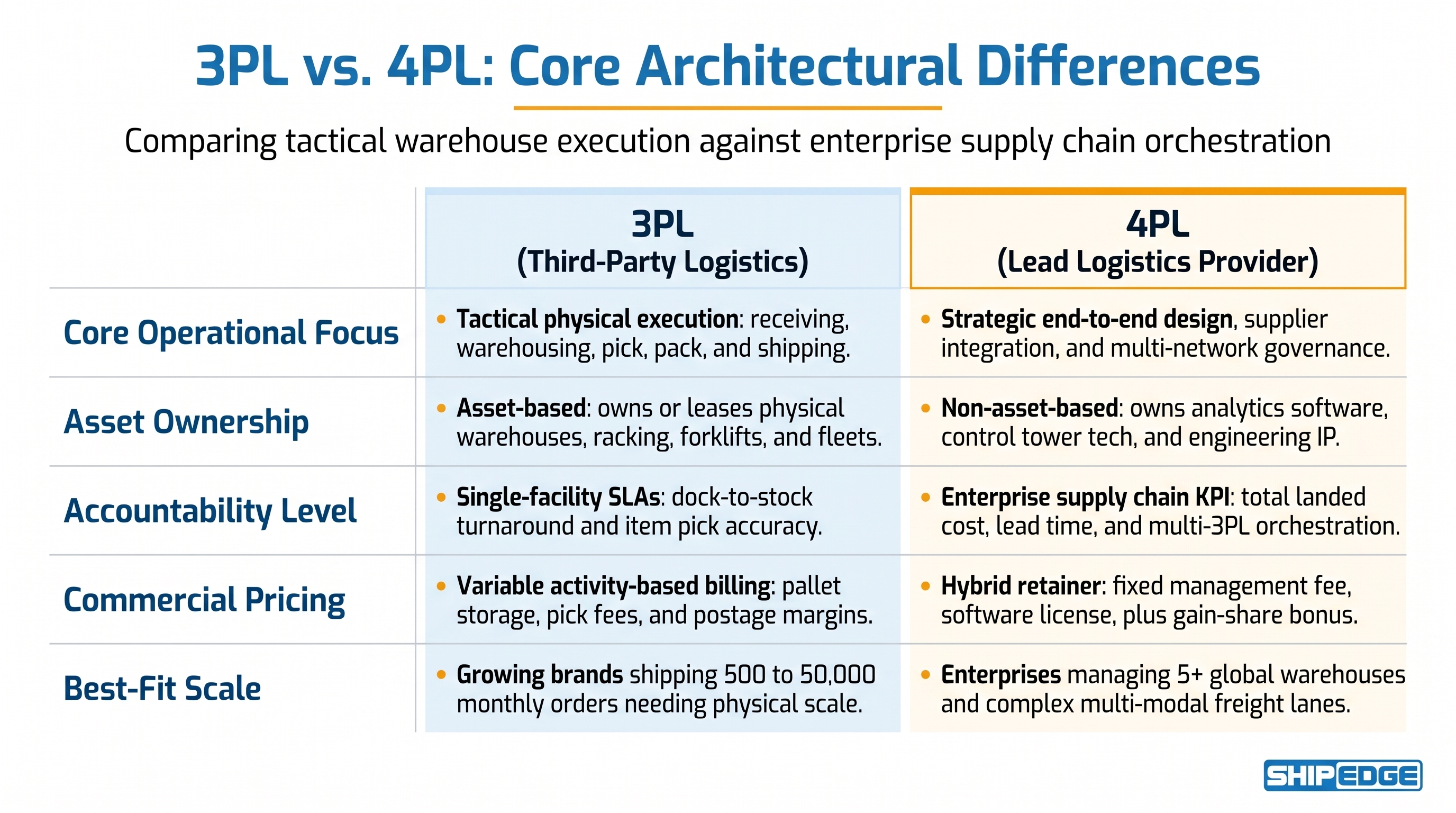
The primary operational distinction lies in task execution versus network design. A 3PL concentrates on doing the work: receiving pallets, packing corrugated boxes, and tendering shipments to parcel couriers. Its operational metrics evaluate dock-to-stock turnaround time, order picking accuracy, and labor efficiency per labor hour.
Conversely, a 4PL concentrates on designing the system that enables execution. The 4PL continuously analyzes freight lanes, models optimum fulfillment node locations, redesigns packaging specifications, and resolves upstream supplier bottlenecks before raw materials arrive at the warehouse.
When working directly with a 3PL, the brand maintains internal responsibility for integrating that facility into its broader business strategy. If a merchant operates across three distinct 3PL warehouses, internal staff must coordinate inventory transfers between facilities, reconcile disparate inventory records, and hold each warehouse manager accountable for discrepancies.
A 4PL eliminates this coordination burden by serving as the central point of contact. The 4PL arbitrates network disputes, redistributes safety stock during localized inventory shortages, and ensures consistent packaging standards across all fulfillment nodes globally.
The financial profiles of 3PL and 4PL engagements diverge significantly:
While a 3PL relationship directly reduces variable fulfillment costs, a 4PL engagement requires substantial strategic investment justified by systemic supply chain savings, reduced freight spend, and lower internal administrative overhead.
Data ownership and operational visibility establish a critical operational divide. In a direct 3PL partnership, the client retains immediate, granular oversight of its warehouse workflows through direct portal access. The client retains ultimate strategic control over routing rules, inventory allocation, and customer service escalation paths.
In a 4PL arrangement, the client surrenders granular control in exchange for executive-level network visibility. The 4PL's centralized control tower ingests data from dozens of suppliers, warehouses, and freight lines, delivering distilled executive reports rather than raw transaction logs. For brands requiring intimate, hands-on control over fulfillment nuances, this managerial insulation can feel restrictive.
Beyond 3PL execution and 4PL strategic oversight, supply chain engineering has introduced a higher conceptual tier: Fifth-Party Logistics (5PL). While historically treated as academic theory, 5PL models are emerging as tangible operational systems for large-scale omnichannel commerce.
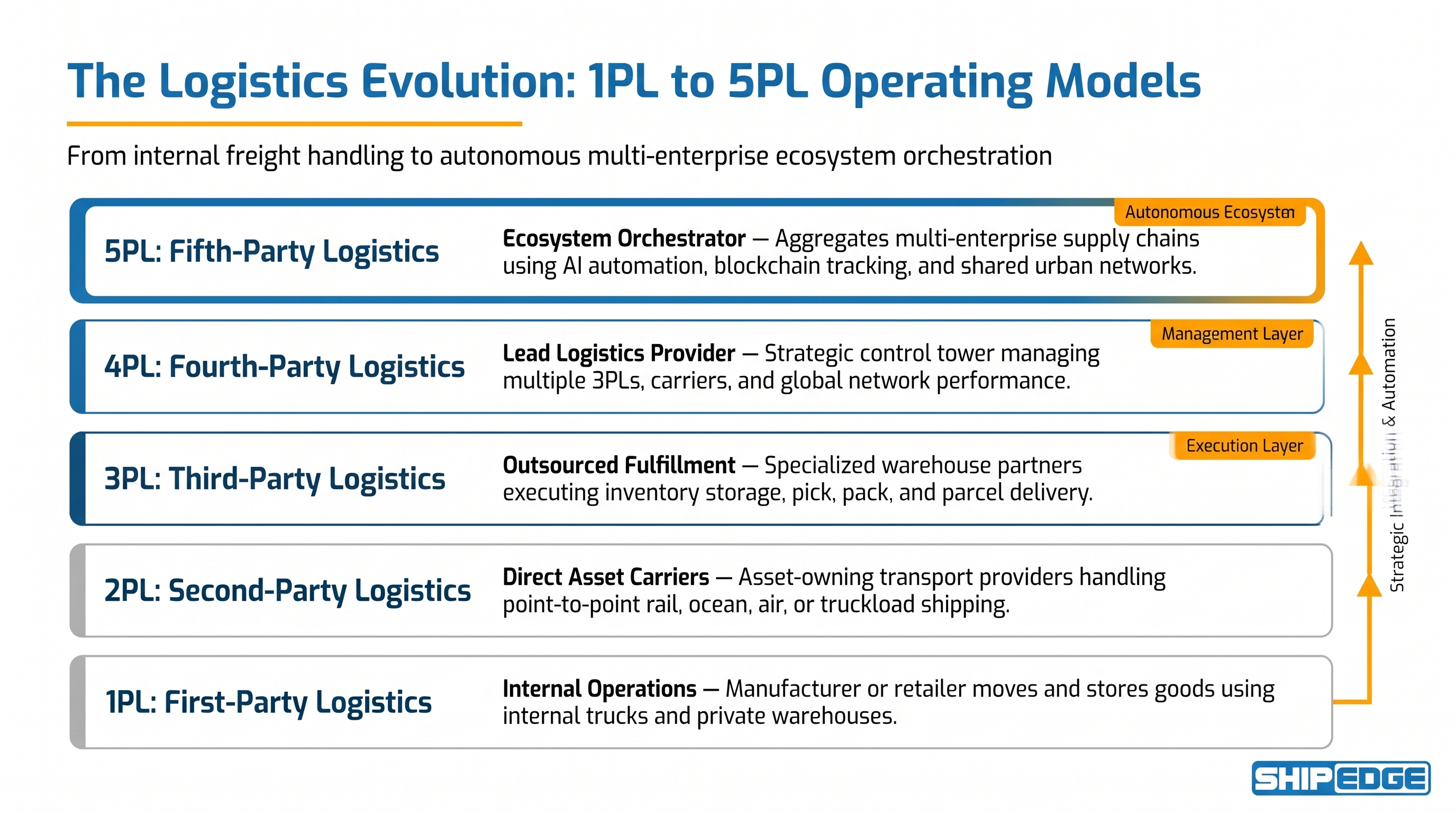
A fifth-party logistics (5PL) provider is an overarching supply network orchestrator that aggregates entire logistics ecosystems into unified, autonomous digital supply chains. Where a 4PL optimizes the supply chain of a single corporate enterprise, a 5PL integrates multiple supply chains across complementary industries to maximize macro-level logistical efficiency.
5PL operators leverage aggregated shipment volumes across hundreds of non-competing enterprises to negotiate unprecedented bulk shipping rates, secure dedicated ocean freight charters, and build shared, decentralized urban micro-fulfillment networks.
The acceleration of 5PL models is propelled by digital e-commerce marketplaces and decentralized logistics protocols. 5PL frameworks utilize advanced technologies to achieve trustless visibility and automated execution:
To distinguish these structural tiers clearly across practical operational boundaries:
For most growing brands, 5PL services remain specialized solutions utilized primarily by digital native conglomerates and global retail aggregators requiring universal network orchestration.
The rapid maturation of artificial intelligence, robotic process automation, and machine vision is dramatically altering the traditional boundaries between 3PL and 4PL providers. Historically, the division between physical execution (3PL) and strategic optimization (4PL) was distinct. In 2026 and 2027, cutting-edge software is enabling physical operators to offer unprecedented strategic value.
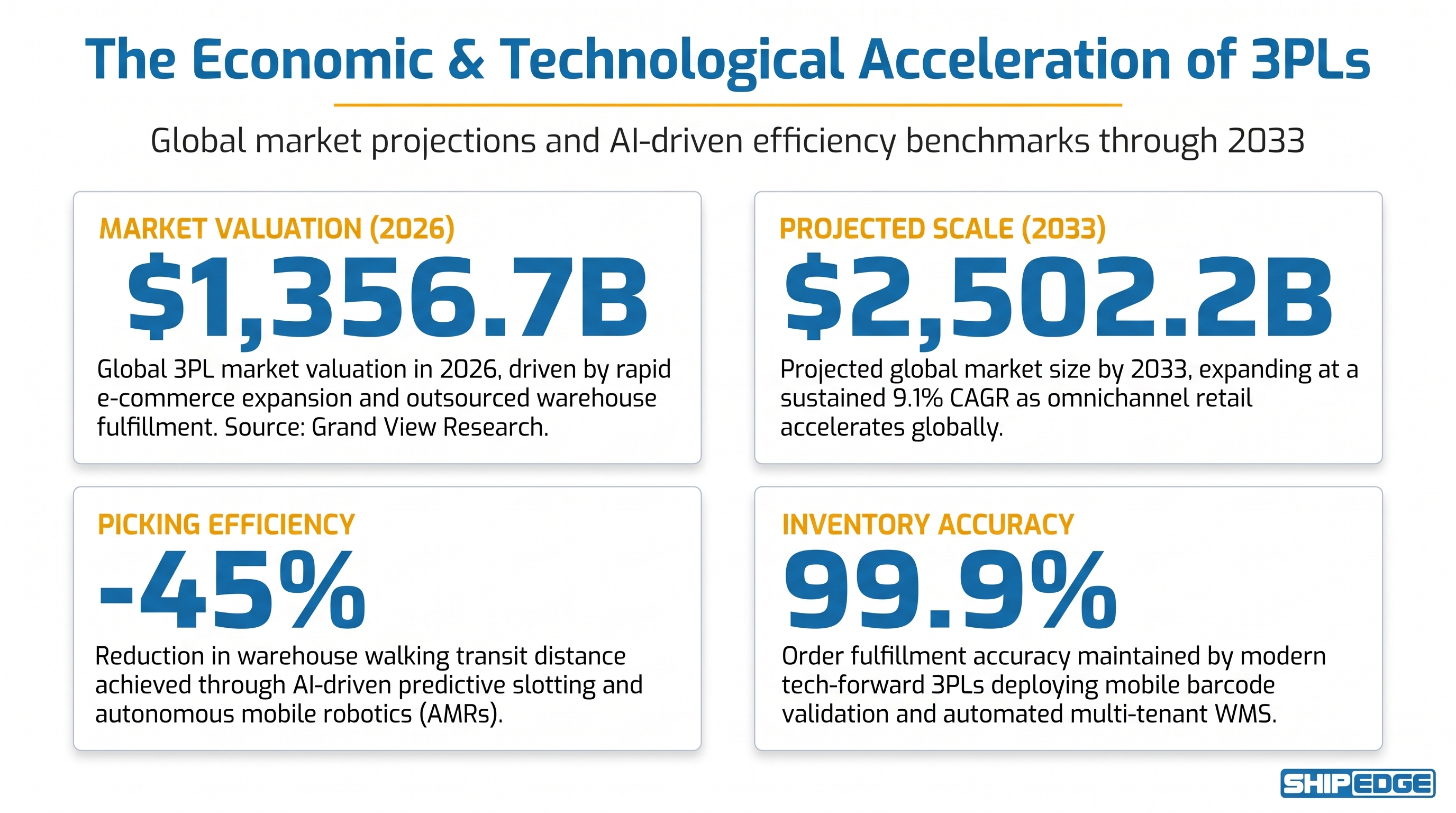
Inside progressive 3PL distribution centers, autonomous mobile robots (AMRs) and automated sorting systems now navigate warehouse floors alongside human associates. These robotic systems communicate directly with specialized warehouse software to optimize daily workflows.
Machine learning algorithms analyze order velocity, seasonal seasonality, and SKU correlation patterns to execute predictive slotting. High-velocity holiday SKUs are automatically staged near primary packing lines during off-peak night shifts, cutting daytime pick travel distances by up to 45%. This level of automated intelligence empowers modern 3PLs to achieve order turnaround speeds that previously required extensive manual industrial engineering.
At the 4PL tier, artificial intelligence has evolved from static business intelligence reporting into autonomous agentic coordination. Modern 4PL platforms deploy autonomous software agents capable of monitoring global shipping lanes, maritime weather patterns, and localized port congestion in real time.
When an unexpected geopolitical disruption or severe blizzard threatens a key freight corridor, agentic 4PL systems autonomously reroute inbound inventory to alternate ports, recalculate customs clearance paperwork, and dynamically reassign regional fulfillment nodes without requiring manual human intervention.
The most critical market shift facing business leaders is the functional convergence of logistics tiers. Historically, companies were forced to hire a costly 4PL simply to obtain unified multi-facility inventory tracking and sophisticated carrier rate shopping.
Today, technology-forward 3PLs leverage enterprise cloud platforms to deliver these strategic capabilities directly. By integrating automated inventory routing, predictive stock replenishment, and multi-location order orchestration into standard service packages, modern 3PLs allow growing brands to capture 4PL-grade strategic intelligence without paying steep 4PL management markups.
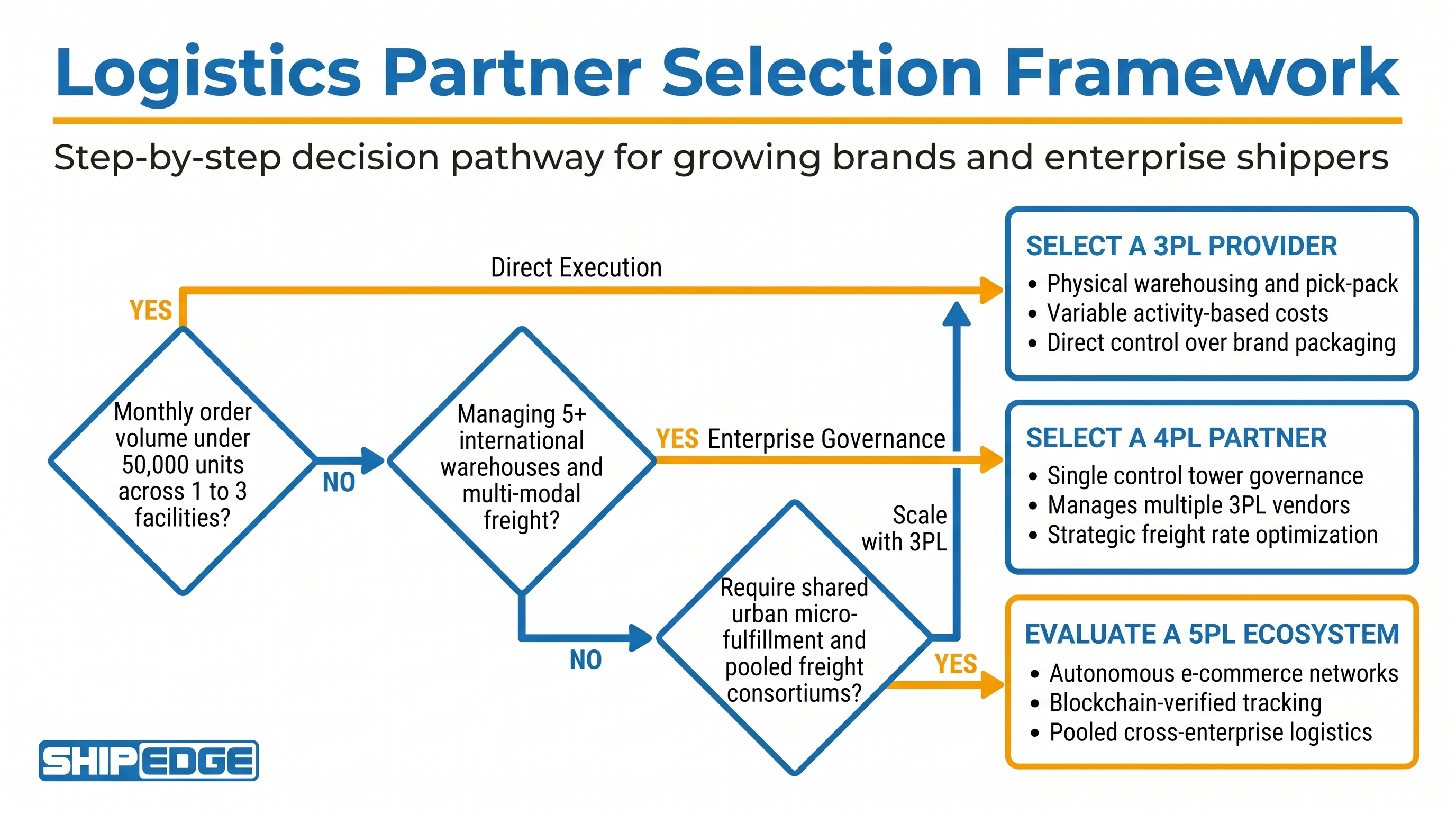
Selecting the ideal logistics partnership requires honest evaluation of order volume, supply chain complexity, international footprint, and internal operational capabilities.
Choosing the wrong model creates painful friction: contracting an enterprise 4PL prematurely burdens an agile business with unnecessary administrative overhead, while relying on a regional 3PL for complex global distribution results in fragmented visibility and missed delivery promises.
A 3PL partnership represents the optimal operational model for organizations that need reliable execution without bureaucratic overhead. A 3PL is the correct choice if your business matches these criteria:
For brands operating at this scale, partnering directly with an agile 3PL provides immediate labor scalability, fast onboarding, and direct visibility into daily warehouse performance.
Transitioning to a 4PL becomes economically and operationally imperative when enterprise scale overwhelms internal management bandwidth. Consider an LLP engagement when your organization experiences:
At enterprise scale, the management fees paid to a 4PL are easily offset by systemic freight rate reductions, consolidated inventory carrying costs, and reduced internal headcount.
Partnering with an emerging 5PL framework makes strategic sense under specialized conditions. High-growth omnichannel brands should consider 5PL ecosystems when:
A critical stress test for any logistics structure occurs during fourth-quarter peak season volumes. When consumer order surges spike shipment volume by 300% to 500% between Black Friday and Christmas, structural differences become glaringly apparent.
Direct 3PL partnerships require transparent communication months in advance to lock in dedicated temporary labor, reserved pallet racking, and carrier trailer drops. In contrast, a 4PL mitigates peak volatility by balancing order volume dynamically across an expansive network, re-routing orders to facilities with available capacity when a primary regional hub encounters bottlenecks.
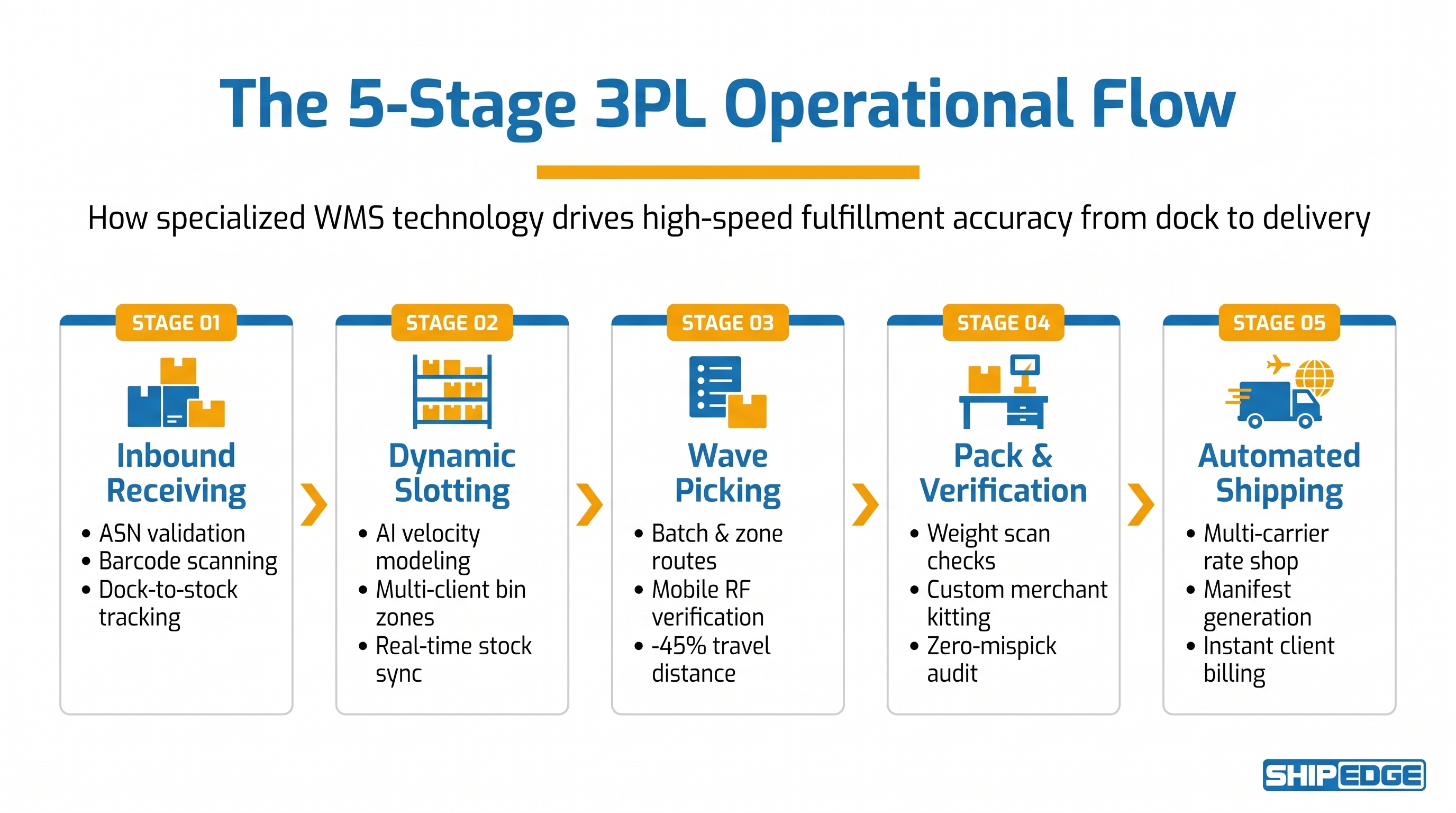
Regardless of whether a company partners with an agile 3PL or relies on an enterprise 4PL, operational success ultimately hinges upon the technology operating on the warehouse floor. At the core of every high-performing 3PL facility sits an advanced warehouse management system.
A modern WMS does not merely record inventory locations; it acts as the central operating engine orchestrating labor, inventory movement, and data synchronization across the entire fulfillment lifecycle.
In a third-party fulfillment environment, a single warehouse manages inventory for dozens of independent corporate clients simultaneously. A professional 3PL WMS enforces strict multi-tenant architecture, ensuring each client's inventory records, billing schedules, and custom packaging rules remain isolated and secure.
Every inbound receipt, cycle count scan, and outbound shipment registers in real time. This instant synchronization provides merchants with live stock visibility across digital storefronts, preventing backorders and eliminating stockouts across omnichannel sales channels.
Manual billing calculations represent one of the greatest operational drains and margin risks for growing 3PL facilities. Sophisticated 3PL platforms automatically capture every billable event as it occurs on the warehouse floor:
Automated capturing of these events eliminates billing disputes between 3PLs and clients while protecting warehouse operating margins.
As warehouse demands intensify, fulfillment centers require software built specifically for modular execution. Purpose-built WMS platforms like BinLogic focus specifically on warehouse operations, delivering streamlined inventory tracking, receiving workflows, and cycle counting without the burdensome overhead of monolithic legacy ERPs.
Simultaneously, for brands orchestrating high-velocity multi-channel sales across complex retail ecosystems, platforms like OmniOrders provide streamlined order routing and tracking capabilities that feed clean, validated order data directly into warehouse fulfillment pipelines. Utilizing agile, modular software allows warehouse operators to deploy advanced functionality rapidly without enduring year-long implementation cycles.
To deliver the high-level visibility demanded by modern shippers while maintaining lean operational costs, third-party logistics providers require software purpose-built for multi-client fulfillment excellence. This is precisely where Shipedge delivers transformative capabilities.
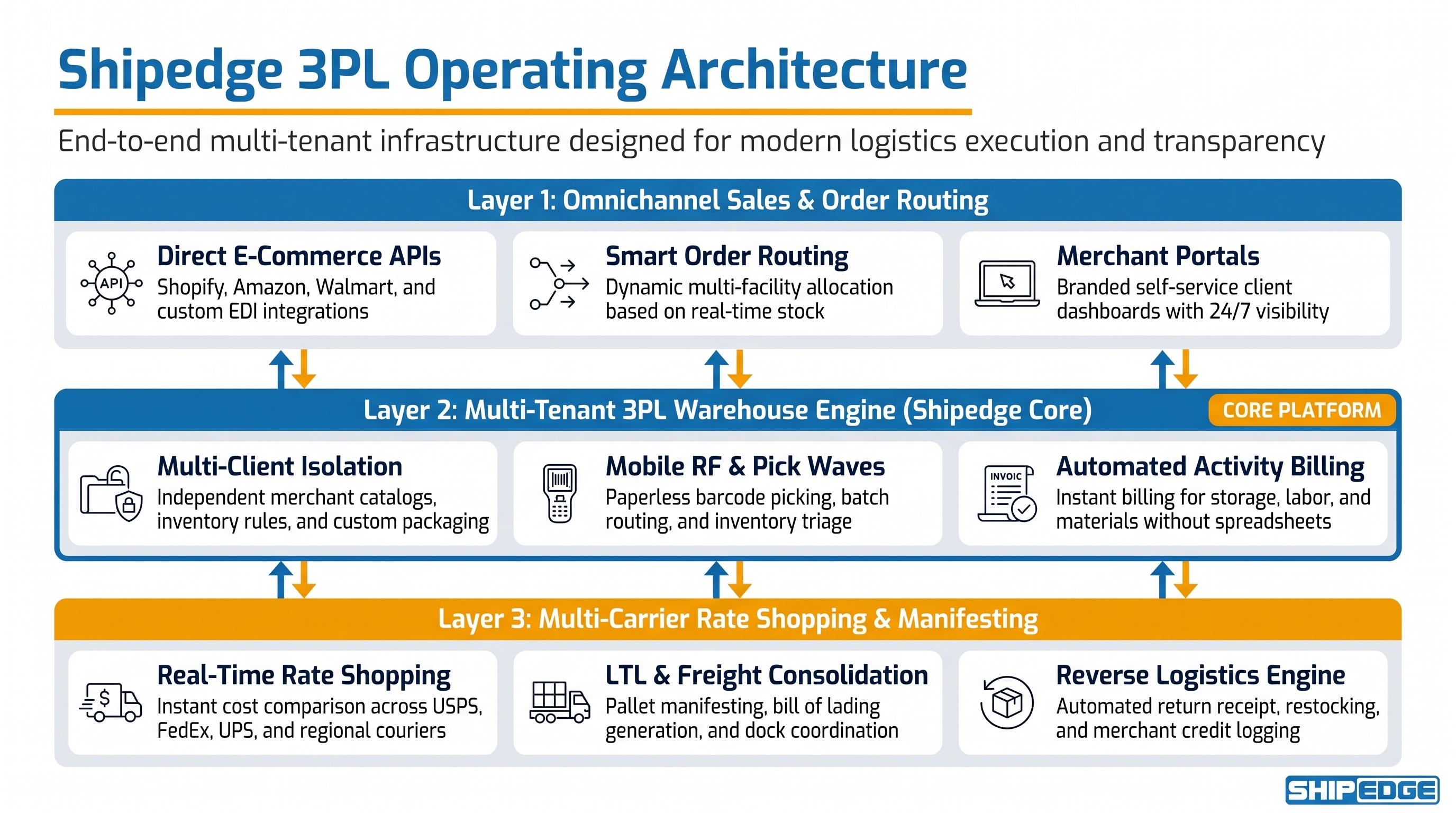
Shipedge provides an end-to-end, cloud-based logistics ecosystem engineered specifically to empower 3PLs, warehouse operators, and omnichannel merchants with enterprise-grade capabilities.
Many logistics providers struggle with disconnected software stacks, attempting to bridge separate order management, warehouse management, and shipping label systems with brittle third-party connectors.
Shipedge eliminates this fragmentation by unifying an advanced warehouse management system with native order management, inventory control, and multi-carrier shipping rate shopping. By centralizing these critical modules within a unified platform, warehouse associates work within a seamless interface that streamlines operations from inbound receiving to outbound carrier manifest generation.
Engineered with multi-client operations at its foundation, Shipedge's specialized 3PL software empowers fulfillment providers to onboard new merchant clients in minutes rather than weeks.
The platform features:
By equipping 3PL facilities with state-of-the-art mobile barcode scanning, wave picking optimization, and direct carrier API integrations, Shipedge enables physical warehouse operators to deliver the strategic transparency and data intelligence typically associated with high-cost 4PL providers.
Merchants gain complete visibility and peace of mind, while 3PL operators expand their service margins and scale operations seamlessly across expanding warehouse footprints.
Understanding the operational and strategic difference between 3PL and 4PL logistics is vital for building an agile, profitable, and customer-centric fulfillment operation in 2027. Neither model is universally superior; each solves distinct organizational challenges at different stages of corporate maturity.
For most expanding e-commerce merchants, direct partnership with a technology-driven 3PL provides the ideal balance of variable-cost flexibility, rapid execution, and direct control over the customer unboxing experience. As businesses expand into multi-continental enterprises managing dozens of distribution nodes, transitioning to a strategic 4PL orchestrator delivers the high-level network governance required to harmonize complex global trade.
Ultimately, physical execution excellence remains the bedrock of customer satisfaction. Whether you manage an independent fulfillment warehouse seeking to deliver market-leading 3PL services or an enterprise brand demanding absolute visibility across your distribution network, your software infrastructure determines your success.
Ready to scale your fulfillment operations with enterprise-grade agility? Shipedge equips 3PL providers and growing brands with the unified warehouse and order management technology required to drive operational velocity, eliminate fulfillment errors, and automate client billing. Schedule a personalized demo today and experience the future of intelligent logistics management.
The fundamental difference between 3PL and 4PL logistics centers on execution versus management. A 3PL is a tactical, asset-based partner that physically performs fulfillment operations, including warehousing, inventory storage, pick-and-pack, and shipping. A 4PL is a non-asset-based strategic coordinator that oversees an enterprise's entire supply chain, managing multiple 3PL providers, negotiating freight contracts, and optimizing global network design.
No, the vast majority of 4PL providers are non-asset-based organizations that do not own physical warehouses, trucks, or shipping containers. Instead, a 4PL invests in advanced technology, data analytics control towers, and supply chain engineering expertise. They leverage independent 3PL warehouses and freight carriers to execute physical operations while remaining focused on objective, network-wide optimization.
A 5PL (Fifth-Party Logistics) provider is an aggregate supply network orchestrator that manages and synchronizes multiple supply chains across complementary industries. While a 4PL optimizes logistics for a single enterprise, a 5PL pools freight demand and logistical requirements across hundreds of companies, utilizing blockchain tracking and automated smart contracts to secure unmatched economies of scale in global e-commerce.
A business should consider transitioning from a 3PL to a 4PL when internal supply chain complexity exceeds operational bandwidth. Key indicators include managing more than four independent regional warehouses, coordinating multi-modal international freight across diverse regulatory boundaries, experiencing rapid international expansion, or requiring an outsourced control tower to integrate disjointed logistics vendors following corporate acquisitions.
Yes, modern technology-forward 3PLs increasingly provide capabilities previously exclusive to 4PL providers. By deploying advanced cloud-based warehouse management systems, modern 3PLs offer multi-location inventory synchronization, automated smart order routing, real-time analytics portals, and deep carrier rate shopping. This allows growing businesses to achieve enterprise-level supply chain transparency and intelligence without paying expensive 4PL retainers.
In 2027, artificial intelligence and autonomous robotics significantly reduce unit fulfillment costs while improving accuracy. AI-driven predictive slotting minimizes warehouse pick travel by staging high-velocity SKUs strategically, while autonomous mobile robots accelerate order turnaround times. These automated efficiencies reduce mispick errors, lower direct labor overhead, and allow 3PL providers to offer more competitive fulfillment rates to e-commerce merchants.
Modern 3PL operations require a dedicated, multi-tenant warehouse management system that natively integrates with e-commerce storefronts, electronic data interchange protocols, and parcel carrier networks. Critical capabilities include real-time multi-client inventory tracking, automated activity-based client billing, mobile barcode scanning, wave picking logic, automated rate shopping, and self-service merchant portals for complete operational transparency.