EN │ ES
3PL Software
Shipedge
September 17, 2026
23 min read
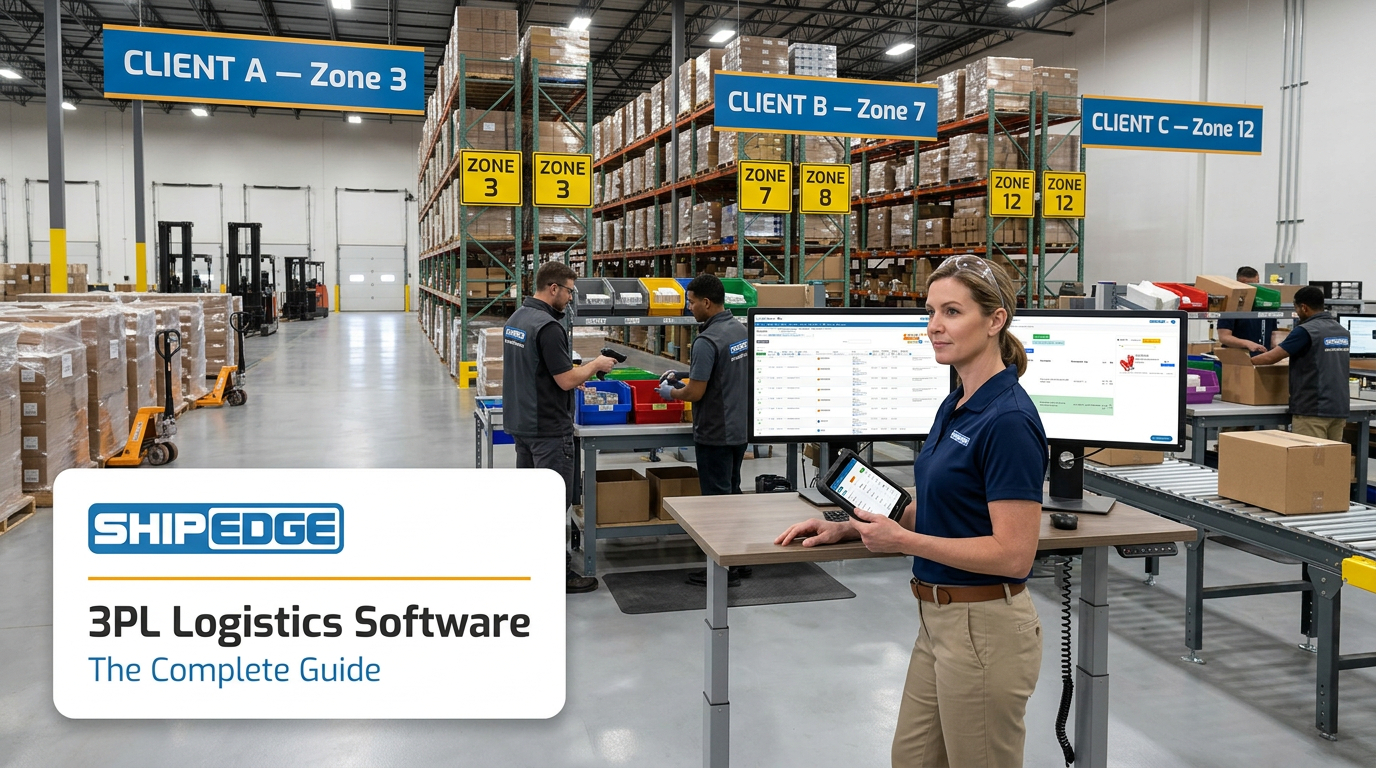
Running a third-party logistics business requires more than a warehouse and a team. It requires technology that can simultaneously track inventory for fifteen clients, route orders through multiple channels, generate accurate invoices per client, connect to dozens of e-commerce platforms, and give every client real-time visibility into their own data — without exposing any of it to other clients.
Most 3PLs start with general-purpose tools and outgrow them. A WMS designed for a single brand breaks down when you are managing inventory for ten clients in parallel. Spreadsheet-based billing becomes a full-time job and an error source once order volume rises. Generic reporting tools cannot produce the client-specific dashboards that e-commerce clients now expect as a baseline.
This guide covers what 3PL logistics software actually is, which tools belong in a complete stack, how they integrate, what features are non-negotiable, and how to choose the right platform before Black Friday — the most consequential test of any 3PL's technology. September is the practical window. Anything implemented later will not be stable in time for Q4.
3PL logistics software is the technology layer that enables a third-party logistics provider to manage operations on behalf of multiple client businesses simultaneously. It is not a single application — it is a stack of interconnected systems that together cover every operational and administrative workflow in a 3PL business.
The defining characteristic of 3PL software is multi-tenancy: the ability to run all clients on a single platform while maintaining complete data isolation between them. Each client sees only their inventory, their orders, and their billing data. The 3PL operations team sees all clients simultaneously. This architecture is what separates purpose-built 3PL logistics software from general warehouse or ERP tools that were designed for single-brand environments.
According to Grand View Research, the global 3PL market reached $1.35 trillion in 2024 and is projected to grow at 7.1% annually through 2030. That growth is fueled by e-commerce expansion — and it requires software that scales with the volume and complexity of modern multi-channel fulfillment.
A standard logistics tool — a WMS for a single brand, a shipping platform for a direct-to-consumer business, or an ERP module for a manufacturer — is designed for one set of operational rules, one client, and one billing entity. It does not need to separate inventory by client, because there is only one client. It does not need multi-client billing, because there is only one invoice recipient.
A 3PL faces a completely different operational reality. A single warehouse may hold inventory for twenty clients. Each client has different SKUs, different fulfillment rules, different SLAs, and different billing rate structures. The same warehouse team must pick and pack orders for all twenty clients on the same shift. The software must know which bin belongs to which client, which order belongs to which account, and which billing rate applies to which transaction — all in real time, without operator error.
The architecture distinction is the data model. In a standard WMS or ERP, all inventory records share a single organizational entity. In purpose-built 3PL logistics software, a client identifier is attached to every inventory record, order, transaction, and billing event at the database level. This enforcement happens automatically — not through UI workarounds or manual separation that can break under volume.
This architecture also enables client self-service: because client data is cleanly separated at the data layer, each client can have their own login, their own dashboard, and their own reporting without the 3PL having to export and share data manually. Real-time visibility is available from the moment the first product arrives at the dock.
Generic ERP systems and standard warehouse management tools are not designed for multi-client operations. When 3PLs try to use them, the typical workarounds — creating separate "warehouse" instances per client, managing billing in parallel spreadsheets, building custom reports for each client — work at small scale and collapse as the operation grows.
The specific failure points are predictable: billing reconciliation errors when spreadsheets are updated manually across dozens of clients; inventory crossover when the WMS does not enforce client separation at the database level; inability to onboard new clients quickly because each new client requires manual configuration across multiple disconnected systems; and no client-facing portal, forcing the 3PL operations team to answer constant inbound questions about inventory levels and order status.
A modern 3PL logistics operation requires five distinct software capabilities. Some providers offer these as a unified platform; others require integration of multiple specialized tools. Understanding what each component does — and why each is non-negotiable — is the foundation for evaluating any 3PL software solution.
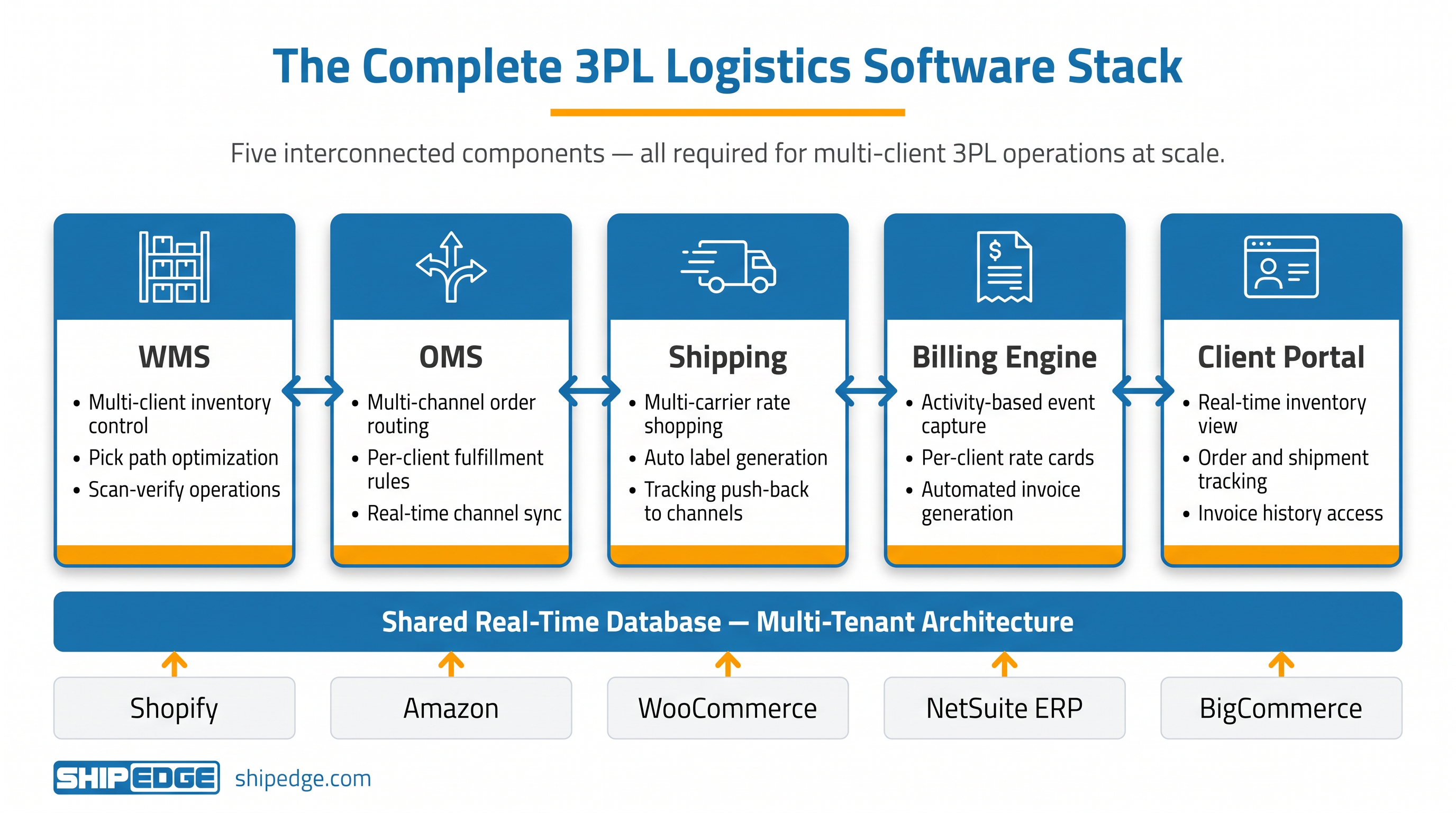
The WMS is the operational core of any 3PL. It manages every physical movement of inventory inside the warehouse: receiving, put-away, inventory positioning, pick path optimization, packing, and outbound shipment preparation. In a 3PL context, the WMS must enforce multi-client inventory segregation — knowing which bin belongs to which client and preventing any crossover.
Critical WMS capabilities for 3PLs include lot and serial number tracking per client, configurable pick strategies per client (wave, batch, zone, and single-order), scan-verify workflows that reduce picking errors to below 0.1%, and directed put-away rules that optimize bin utilization across all clients simultaneously. The WMS is also where barcode scanning, mobile device management, and warehouse slotting happen — all the physical operations of the warehouse floor.
The OMS receives orders from every channel — Shopify, Amazon, WooCommerce, BigCommerce, TikTok Shop, EDI — and routes them into the WMS for fulfillment. In a 3PL environment, the OMS must handle orders for multiple clients simultaneously while keeping each client's order queue completely separate.
Beyond order routing, the OMS manages order rules: which orders ship same-day, which require special packaging, which must use a specific carrier, which trigger a backorder notification. It also handles order modifications, cancellations, and split shipments. For 3PLs serving e-commerce clients, the OMS is the bridge between the client's sales channels and the warehouse floor — and its reliability directly determines whether orders ship on time.
Carrier integration in 3PL logistics software goes beyond printing labels. The shipping module must connect natively to UPS, FedEx, USPS, DHL, and regional carriers, perform real-time rate shopping across all connected carriers at the moment of shipment, apply each client's carrier account and billing number correctly, and push tracking numbers back to the originating channel automatically.
Rate shopping embedded in 3PL logistics software is one of the highest-value features for 3PL clients. When carrier surcharges shift — as they do frequently during peak season — the system automatically selects the optimal carrier per shipment, per client, based on live rate data. This saves money and positions the 3PL as a strategic partner rather than a commodity logistics provider.
The billing engine is what separates 3PL logistics software from general warehouse software. A 3PL does not issue one monthly invoice — it issues separate, itemized invoices to each client covering storage fees, pick and pack fees, inbound receiving, value-added services, carrier charges, and any custom services the client has contracted for.
Purpose-built 3PL billing software captures every billable event automatically at the point of warehouse activity. A warehouse associate scans a pick; the system records a billable pick event for that client's account. Storage fees accrue daily based on actual occupied bin or pallet positions. At billing time, the 3PL generates a complete, itemized invoice per client from the system — no manual reconciliation, no spreadsheet, no missed line items.
The client portal is the 3PL's customer success tool. Every client logs into their own dashboard with access only to their data — real-time inventory levels by SKU, open order status, inbound shipment tracking, returns processing status, and invoices. The portal should update in real time as warehouse operations occur; a portal that requires manual refreshes or exports is not fit for purpose in 2026.
A strong client portal reduces the 3PL's customer support burden dramatically. Instead of fielding constant inbound calls and emails about inventory status, the operations team focuses on running the warehouse. Clients get the transparency they need to manage their own business — which is the foundation of a long-term 3PL relationship. According to Logistics Management, 3PLs that provide real-time client visibility report 34% higher client retention rates than those that do not.
The five components of a 3PL software stack only deliver full value when they are tightly integrated. Disconnected systems create manual data entry, sync delays, and inventory discrepancies that compound under volume. Here is how a well-integrated 3PL logistics platform connects each component:
The OMS receives an order from a client's Shopify store. Within seconds, it validates inventory availability against the WMS, creates a pick task, and assigns it to the pick queue. The warehouse associate scans the pick; the WMS updates the inventory count. The OMS updates order status to "fulfilled." The tracking number returns to Shopify automatically. All of this happens without a single manual step — and all of it is logged against the correct client's account for billing.
This real-time data flow between the WMS and OMS is what prevents overselling. When inventory updates flow back to the sales channel in real time, the client's Shopify store reflects accurate available inventory and cannot sell more than the warehouse can fulfill.
3PL logistics software must integrate natively with every sales channel a client uses. Native integrations — direct API connections maintained by the software vendor — are more reliable and faster to deploy than middleware connector solutions. They also have lower ongoing costs because the vendor maintains the connection, not the 3PL.
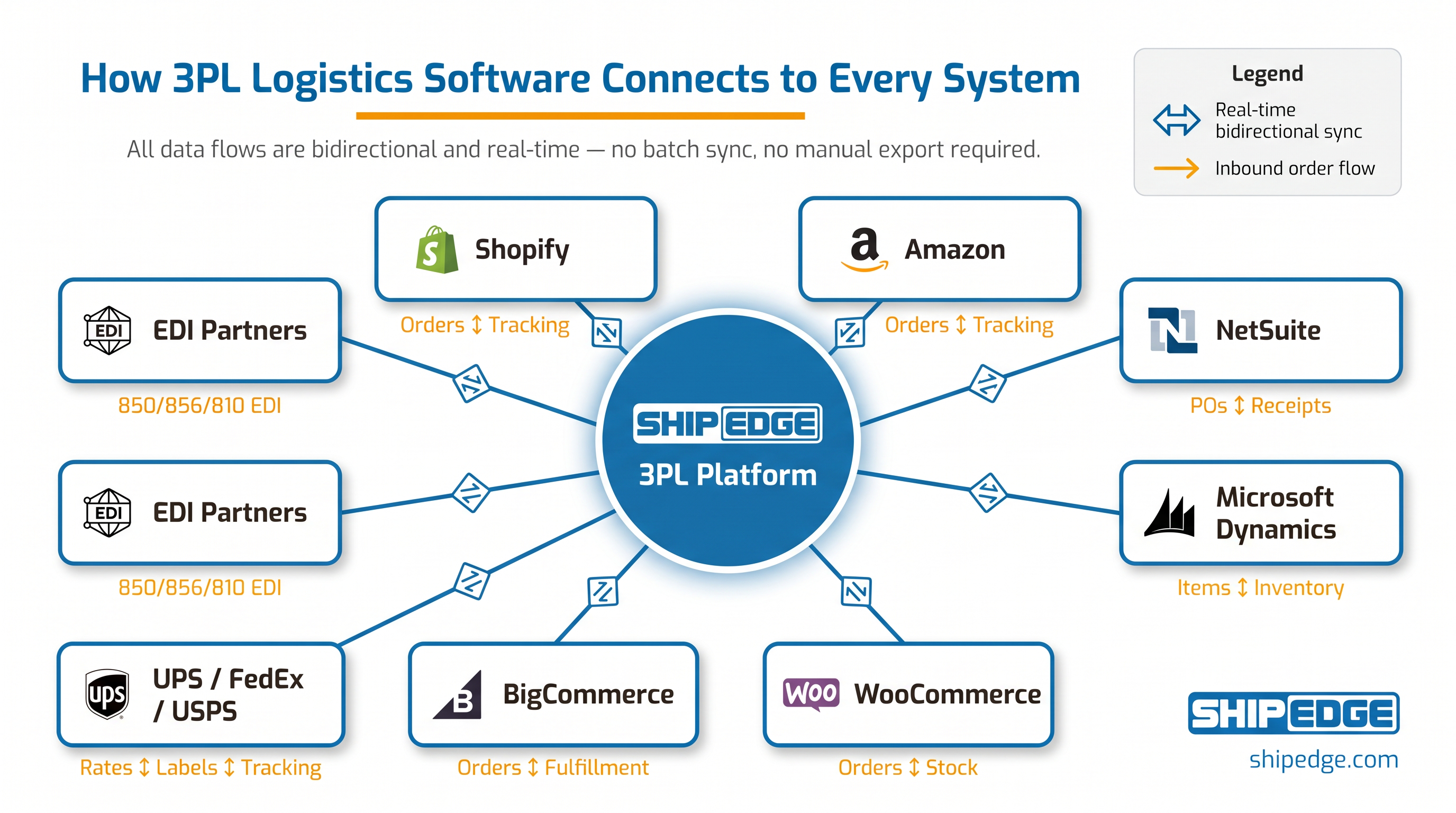
Essential integrations for any 3PL logistics software platform: Shopify, Shopify Plus, Amazon Seller Central, Amazon Vendor Central, WooCommerce, BigCommerce, eBay, Walmart Marketplace, TikTok Shop, and EDI for retail clients. Beyond e-commerce channels, the platform must connect to each client's ERP — NetSuite, SAP, Microsoft Dynamics, and QuickBooks are the most common — for bidirectional inventory and order synchronization.
Many 3PL clients run their business on NetSuite, QuickBooks, or a similar ERP. They expect their 3PL's software to sync purchase orders, receipts, and shipment data directly into their ERP without manual export. Similarly, the 3PL's own accounting team needs the billing data from the 3PL management software to flow cleanly into the 3PL's accounting system.
A well-integrated 3PL logistics platform eliminates the double-entry problem at both ends. Client purchase orders flow into the WMS automatically. Shipment confirmations and inventory receipts flow back to the client's ERP automatically. The 3PL's invoices feed directly into the 3PL's accounting system with a complete audit trail.
The features below are the minimum requirements for a 3PL software platform to function effectively at scale. Any platform missing more than one of these will create operational gaps that grow more damaging as client count and order volume increase.
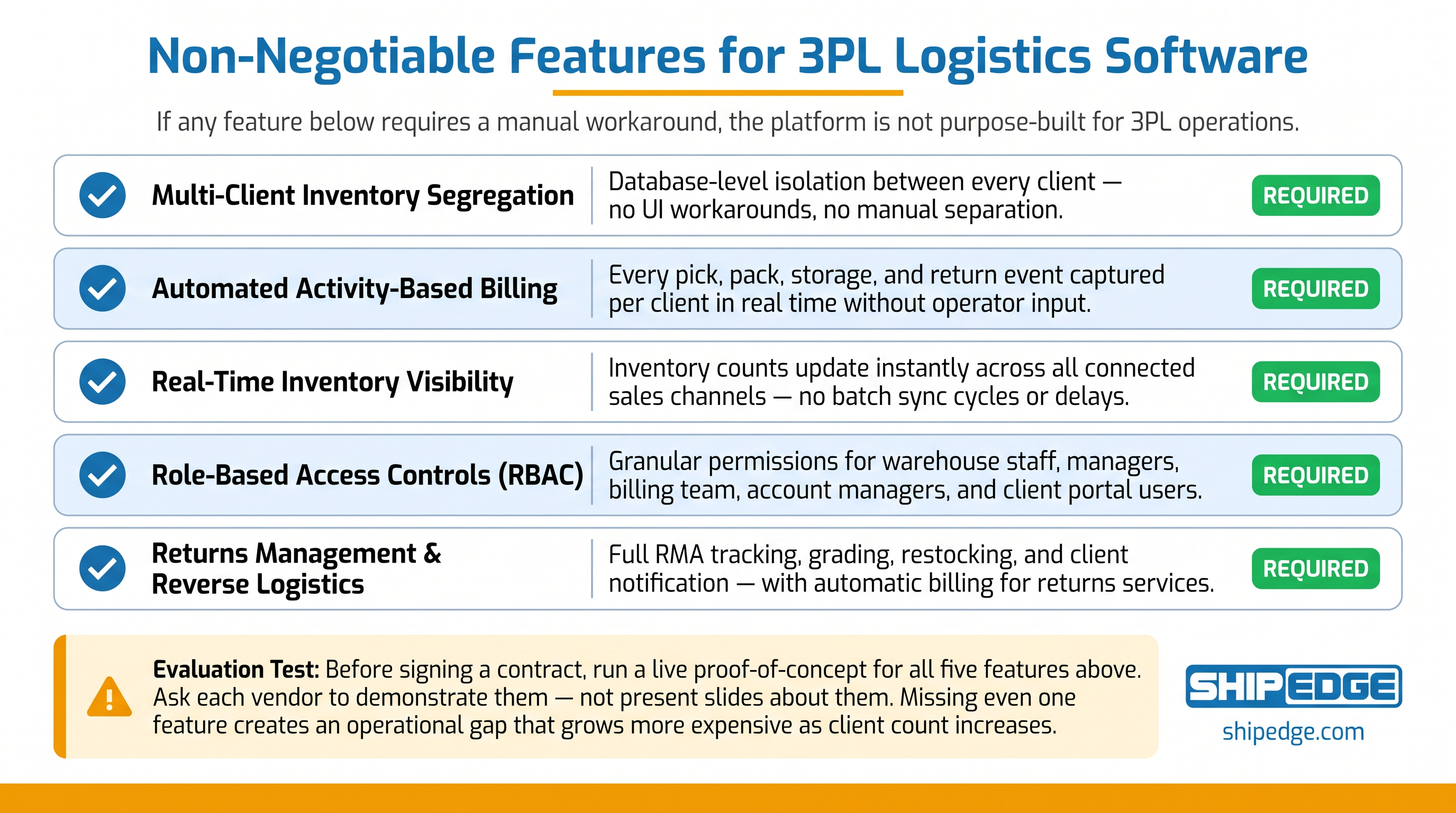
This is the architectural foundation. The platform must enforce inventory isolation between clients at the database level — not through UI workarounds. Test this during evaluation: onboard two mock clients with different SKUs, simulate receiving for each, then attempt to fulfill one client's order using the other client's inventory. If the system allows it, the architecture is not suitable for 3PL operations.
The billing engine must capture billable events automatically and support different rate structures per client. Rate cards should cover: storage rates (per pallet, cubic foot, or bin); pick and pack fees (per unit or per order); inbound receiving fees (per pallet or per SKU); value-added service rates; and minimum monthly billing thresholds. The system should generate itemized invoices per client on demand or on a scheduled billing cycle without any manual assembly.
The platform must provide real-time inventory counts — not batch-updated snapshots. E-commerce clients manage their purchasing decisions based on 3PL inventory data. A system that updates inventory every four or eight hours creates purchasing errors, oversells, and stockouts that damage the client relationship. Real-time inventory sync across all connected channels is non-negotiable.
As a 3PL grows, different users need different access levels: warehouse associates, supervisors, billing staff, client account managers, and client portal users each require their own permission set. The platform must support granular role-based access control (RBAC) that is easy to configure and does not require IT development to update. A client portal user must never be able to see another client's data — this is enforced at the permission layer.
E-commerce return rates average 20–30% across apparel, electronics, and consumer goods. Post-holiday return volume can spike 3–5× above baseline in January. The 3PL management software must handle the complete reverse logistics workflow: RMA generation, inbound returns receiving with client notification, inspection and grading, restocking or disposition routing, and automatic billing for returns processing services. Returns are a revenue-generating service — every step must be tracked and billed automatically.
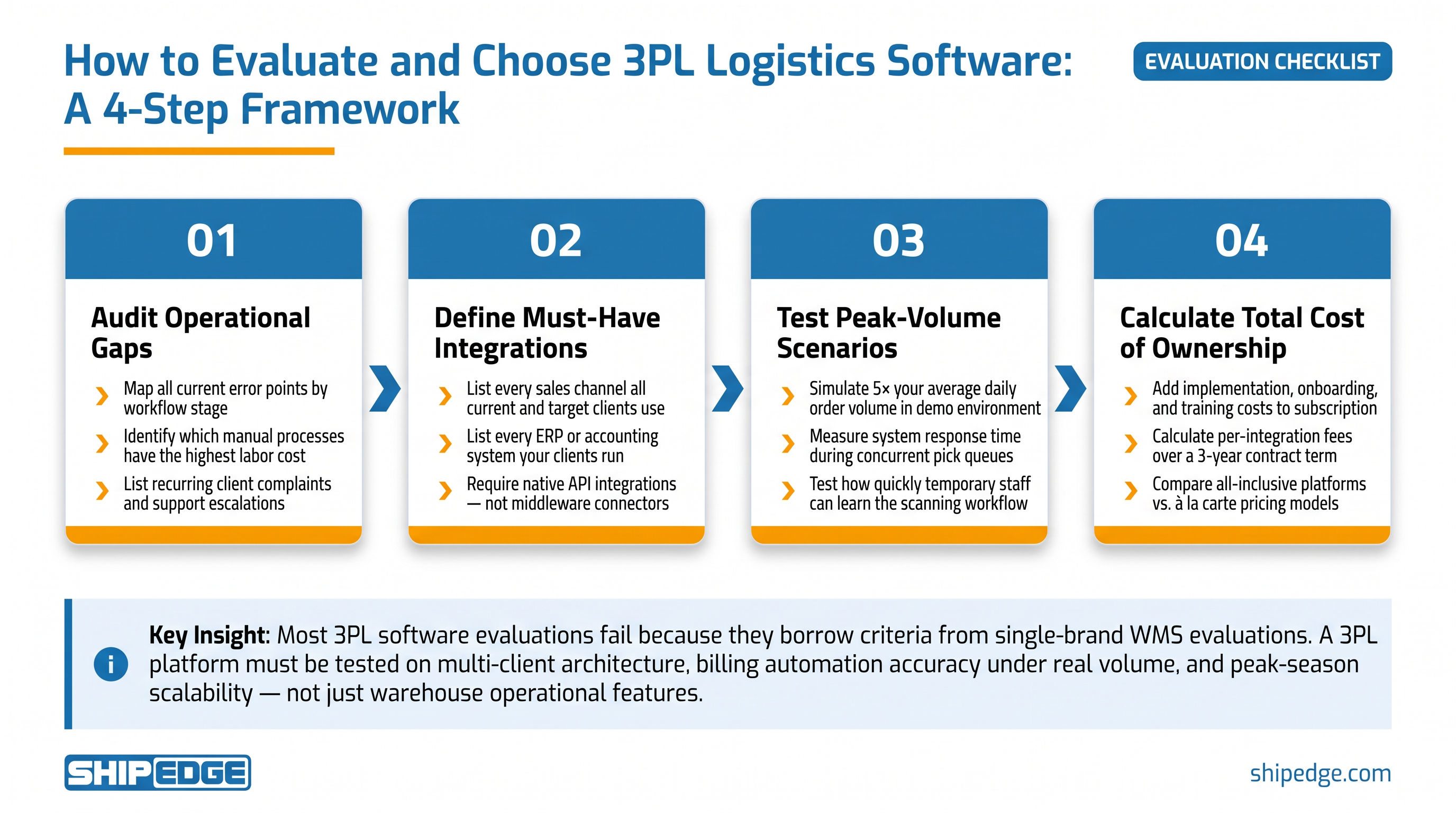
Selecting a 3PL software platform is a business-critical decision. Most 3PL software evaluations fail because the evaluation criteria are borrowed from single-brand WMS evaluations — and the requirements are different. Use this four-step framework:
Before evaluating vendors, map your current operational pain points. Where are errors occurring — receiving, picking, packing, shipping? Where is the most manual effort — billing reconciliation, client reporting, carrier selection? Which clients are making the most service calls about inventory status or billing disputes? The answers define your highest-priority requirements.
Common gaps in 3PLs using non-purpose-built software: billing reconciliation takes 5–8 hours per billing cycle per client; inventory discrepancies appear between the WMS and the client's records; new clients take three to four weeks to onboard because configuration is manual across disconnected systems.
List every sales channel your current and target clients use. List every ERP your clients run. Then verify that every platform you evaluate has native integrations — not middleware-dependent connectors — for every item on that list. A platform that integrates with 80% of your clients' channels requires you to manually manage the remaining 20%, which defeats the purpose of integrated 3PL logistics software.
Ask each vendor: "Who maintains this integration when the channel updates its API?" If the answer is "our integration partner" or "you would need to contact [middleware company]," that is not a native integration. Native integrations are maintained by the software vendor as a core product commitment.
Every 3PL software demo uses average-volume scenarios. You need to test at 5× your average daily order volume. Measure: system response time during peak load; pick path generation speed when 100+ picks are queued simultaneously; label generation throughput; and whether the billing system captures all events correctly without queuing delays.
Also evaluate temporary staff scalability. How quickly can a new warehouse associate learn the scanning workflow? A system that requires two weeks of training is not practical when seasonal staff join for four weeks during Q4. The onboarding time for new users is a real operational cost — and a real risk to Q4 performance.
3PL logistics software costs go beyond the monthly subscription fee. Calculate: implementation and onboarding costs; integration costs for each channel and ERP; training costs for initial team and ongoing new hires; and the cost of any functionality you need but the platform does not include natively (which you would need to purchase separately or build with custom development).
A platform that costs $2,000/month but requires $15,000 in integration work and charges per-integration fees may cost more than a $4,000/month all-inclusive platform over a three-year period. Total cost of ownership analysis is the only way to make a fair comparison.
The relationship between 3PL logistics software and peak season performance is direct and causal: 3PLs with fully integrated, purpose-built software ship orders accurately at peak volume; those running on general tools and manual workarounds fail under the load. The difference is not effort — it is infrastructure.
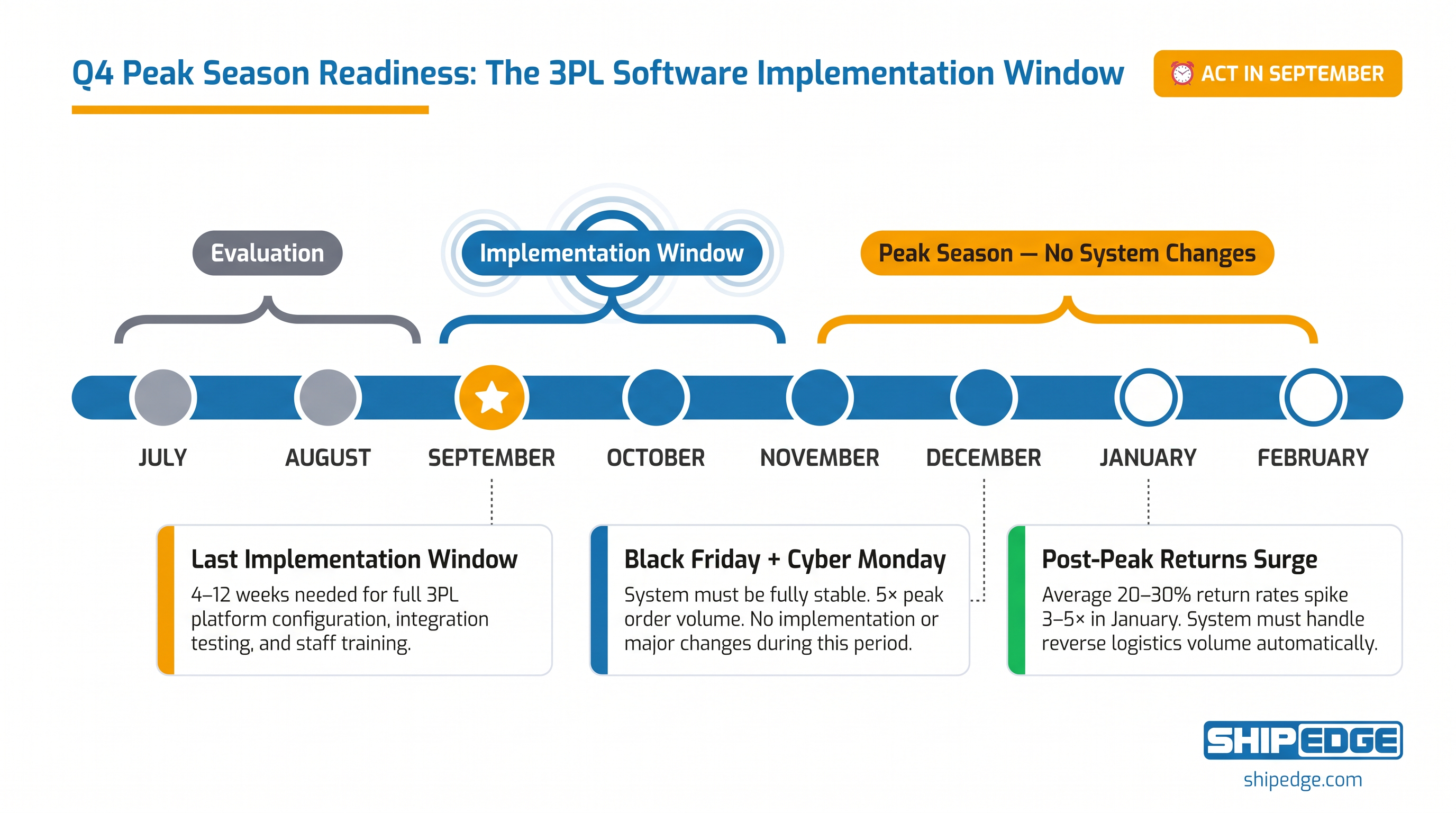
October 1 is the practical deadline for any system changes before Black Friday. Implementation and configuration of a new 3PL logistics platform takes four to twelve weeks depending on the number of active clients, the volume of integrations, and the complexity of billing configurations. A 3PL that starts evaluation in September and moves quickly can be fully configured by mid-October — leaving three to four weeks of stable operation before Black Friday volume hits.
A 3PL that waits until October to begin evaluation will be implementing during peak season — the worst possible time for a system transition. Any operational disruption during Q4 carries client SLA penalties, contract risk, and reputational damage that takes years to repair.
The most common Q4 failures in under-equipped 3PLs are predictable: picking errors from a WMS that cannot handle simultaneous high-volume pick queues; carrier cost overruns from manual carrier selection without rate shopping; billing disputes from a billing system that loses track of transactions during high-volume periods; and client escalations from a lack of real-time visibility.
Integrated 3PL logistics software eliminates each of these. Automated pick path optimization handles high-volume queues without degradation. Embedded rate shopping selects the optimal carrier at every shipment automatically. The billing engine captures every transaction in real time regardless of volume — there is no "high-volume mode" that turns off billing event capture. And the client portal gives every client real-time order status so they are not calling the operations team during your busiest periods.
According to the Warehousing Education and Research Council (WERC), 3PLs using purpose-built logistics software report 28% faster order cycle times and 22% fewer billing errors compared to 3PLs relying on general-purpose tools and manual processes.
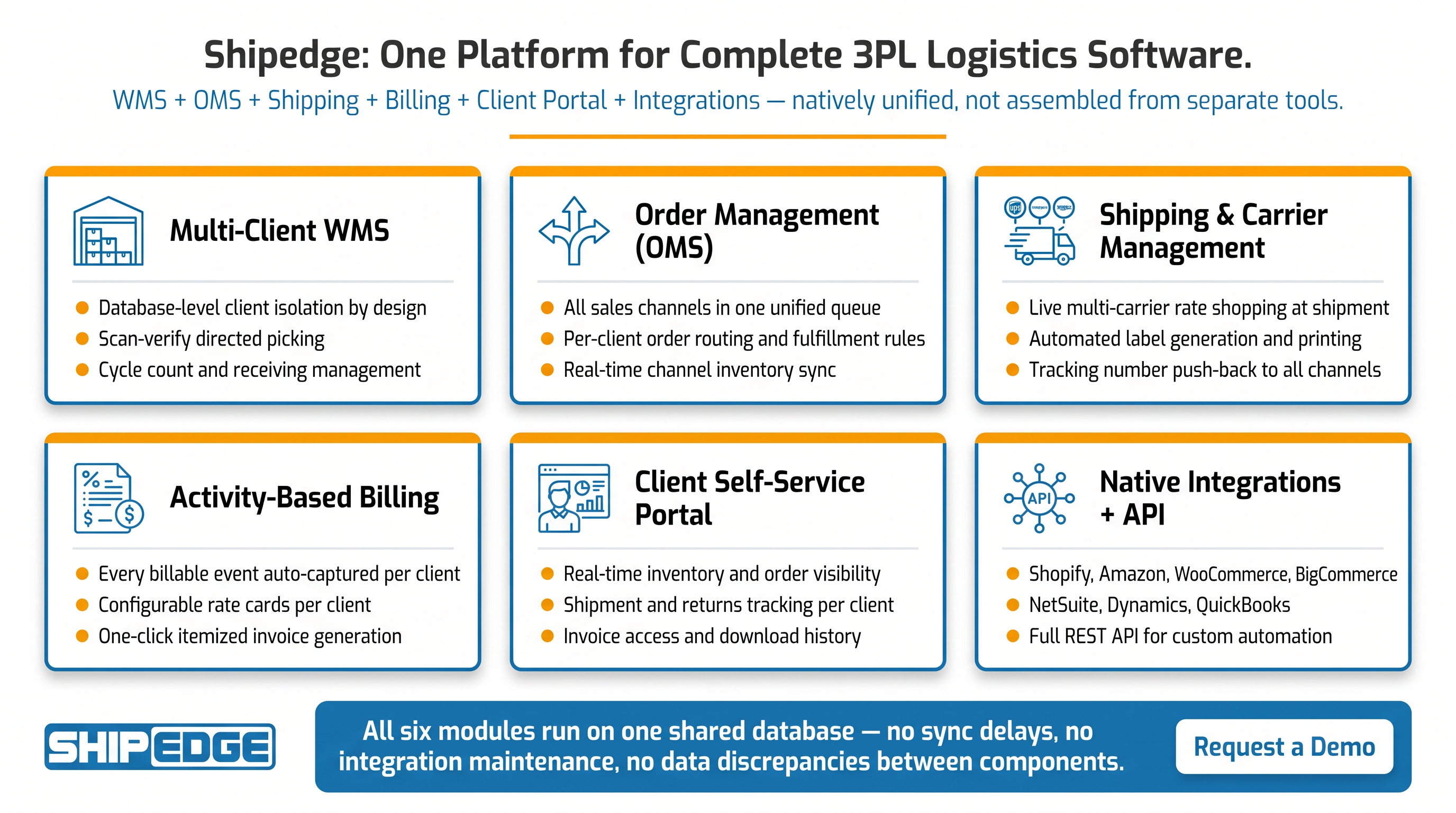
Most 3PL operators face a choice: assemble a software stack from multiple specialized vendors and manage the integrations between them, or find a platform that provides all five capabilities natively. The first approach gives flexibility but creates integration maintenance overhead. The second approach simplifies operations but requires finding a platform that is genuinely strong across all five components.
Shipedge was built as a unified 3PL logistics software platform. The WMS, OMS, shipping module, and billing engine are not separate products connected by APIs — they are a single platform sharing one database, one client configuration layer, and one operational interface. When a warehouse associate scans a pick, that single event simultaneously updates inventory in the WMS, marks the order as fulfilled in the OMS, queues the shipment for label generation in the shipping module, and records a billable pick event in the billing engine.
This single-event, multi-system update is what eliminates the sync delays and data discrepancies that plague multi-vendor stacks. There is no batch sync cycle between WMS and OMS. There is no billing event that gets missed because the billing system was not notified. Everything happens in real time because everything runs on one platform.
Shipedge's warehouse management system provides directed put-away, scan-verify picking, cycle count management, and multi-client inventory segregation as native capabilities — not add-ons. The order management system connects directly to every major e-commerce channel and handles order routing, modification, and exception management for all clients simultaneously.
Shipedge provides every client with a dedicated portal login from day one. The portal displays real-time inventory, order status, inbound shipments, and invoices — updated as warehouse operations occur. No exports, no manual refreshes, no scheduled report delivery.
The integration library covers Shopify, Amazon, WooCommerce, BigCommerce, eBay, Walmart, TikTok Shop, and major ERPs including NetSuite and Microsoft Dynamics. All integrations are native — maintained by Shipedge's engineering team, not by third-party middleware vendors. Adding a new channel integration for a client is a configuration step that takes hours, not weeks.
For 3PLs with unique operational requirements, Shipedge also provides full API access — allowing custom integrations, custom reporting, and custom automation without requiring the 3PL to manage the core platform infrastructure. Request a demo to see the full platform in action before peak season.
3PL logistics software is the technology stack built specifically for third-party logistics providers that manage warehousing and fulfillment on behalf of multiple clients. It includes a warehouse management system (WMS), order management system (OMS), shipping and carrier integration, activity-based billing per client, and a client self-service portal. Unlike general warehouse tools, 3PL logistics software enforces complete data isolation between clients while giving the warehouse team a unified operational view across all accounts simultaneously.
A 3PL company typically uses five categories of software: a WMS to manage physical warehouse operations, an OMS to receive and route orders from multiple channels, a shipping platform to connect to carriers and generate labels, a billing system to track and invoice each client's activity separately, and a client portal for real-time visibility. Some providers offer all five as an integrated platform (like Shipedge); others assemble a multi-vendor stack connected by integrations. An integrated platform reduces sync errors and eliminates integration maintenance overhead.
3PL logistics software costs typically range from $1,000 to $10,000+ per month depending on platform capabilities, number of active clients, monthly order volume, and the number of channel integrations. Enterprise platforms with full WMS, OMS, billing, and portal capabilities generally price between $3,000 and $8,000 per month for mid-size 3PLs. Total cost of ownership — including implementation, integrations, training, and ongoing support — is a more accurate comparison metric than monthly subscription price alone.
The best 3PL logistics software for a given operation depends on three factors: the number of clients and complexity of their operations, the e-commerce channels and ERPs you need to integrate, and whether you need a fully integrated platform or are comfortable managing a multi-vendor stack. For 3PLs prioritizing operational simplicity, billing accuracy, and client transparency, a unified platform like Shipedge that covers WMS, OMS, shipping, and billing natively is typically the better choice over assembling separate specialized tools.
3PL software handles multiple clients through multi-tenant architecture — a data model where every inventory record, order, transaction, and billing event is tagged with a client identifier at the database level. This ensures that Client A's inventory cannot be accidentally used to fulfill Client B's orders, that each client's billing is completely separate, and that each client can only see their own data in the portal. The warehouse operations team sees all clients simultaneously through a unified interface; the client isolation happens automatically in the system.
Yes — any production-ready 3PL logistics software platform should offer native integrations with Shopify, Amazon Seller Central, and other major e-commerce channels. Native integrations (direct API connections maintained by the software vendor) are more reliable than middleware-dependent connectors. Shopify integration allows the 3PL to receive orders automatically, update inventory in real time, and push tracking numbers back to the Shopify store after shipment. Amazon integration covers both Seller Central (FBM) and can complement FBA for specific SKUs. Verify that all integrations your clients use are natively supported before committing to a platform.
3PL logistics software is not a single tool — it is a stack of five interconnected capabilities that enable a third-party logistics provider to operate efficiently across multiple clients at scale. The WMS handles the warehouse floor. The OMS routes orders from every channel. The shipping module connects to carriers and optimizes cost automatically. The billing engine captures every client's activity for accurate, dispute-free invoicing. The client portal gives every client real-time transparency that reduces support burden and builds long-term relationships.
The 3PLs that enter Q4 with a fully integrated, purpose-built platform are the ones that ship accurately under 5× normal volume and come out the other side with satisfied clients and clean invoices. The 3PLs that enter Q4 on patched-together general tools spend the holiday season managing errors, billing disputes, and client escalations.
September is the window. A 3PL that starts evaluating 3PL logistics software in September can be fully implemented and stable before Black Friday. A 3PL that waits until October is running Q4 on its current system — whatever that looks like.
Ready to see what a purpose-built 3PL logistics software platform looks like in practice? Shipedge gives third-party logistics providers a unified WMS, OMS, billing engine, and client portal on a single platform. Request a demo and walk through the full 3PL software stack with the Shipedge team before peak season begins.