EN │ ES
Third Party Logistics
Shipedge
October 29, 2026
15 min read
Modern 3PL fulfillment allows independent e-commerce brands to outsource warehousing, order preparation, multi-carrier parcel delivery, and returns management while retaining complete customer data ownership, custom packaging flexibility, and cross-channel inventory sovereignty—capabilities that Amazon's closed fulfillment infrastructure fundamentally restricts.
Amazon’s logistics machine is the undisputed marvel of modern supply chain engineering. Through relentless infrastructure investments and technological breakthroughs, Amazon has redefined consumer expectations for delivery speed. However, as the retail giant aggressively expands Amazon Logistics (AMZL) and pushes Buy with Prime, growing merchants face a critical strategic fork in the road.
Relying exclusively on Amazon for order processing increasingly forces merchants to surrender control over their customer relationships, profit margins, and inventory mobility. For enterprise merchants and direct-to-consumer pioneers, partnering with specialized 3pl fulfillment providers has emerged as the premier operational counterweight. Rather than surrendering operational autonomy, smart retailers are utilizing independent logistics networks to rival marketplace delivery speeds while safeguarding brand equity.
By combining the precision of an independent fulfillment network with robust software infrastructure, modern brands no longer have to choose between delivery velocity and operational freedom. The current logistics landscape proves that rapid fulfillment is no longer an Amazon monopoly, but an industry-wide standard that independent 3PL networks are executing with superior flexibility and transparency.
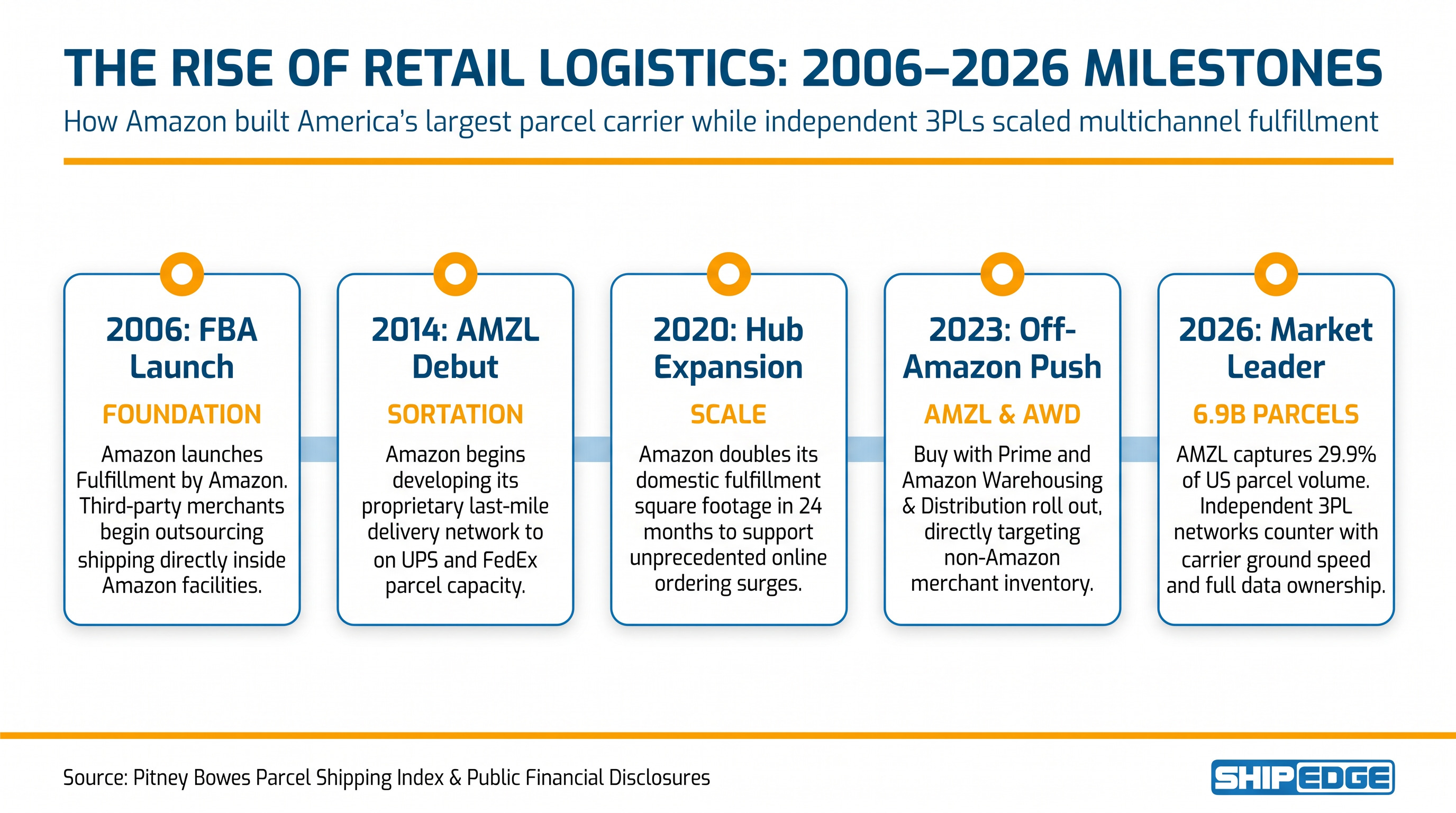
Amazon's recent earnings reports and logistics disclosures highlight an unmistakable strategic transformation. The company has evolved from an online merchant using national couriers into an independent logistics powerhouse capable of managing third-party parcels at planetary scale. Understanding the true scope of this infrastructure shift reveals why the independent fulfillment sector is simultaneously experiencing record demand.
According to the Pitney Bowes Parcel Shipping Index, Amazon Logistics (AMZL) officially became the single largest parcel delivery provider by volume in the United States, delivering approximately 6.9 billion parcels and capturing roughly 29.9% of the domestic market. In reaching this milestone, Amazon surpassed legacy shipping giants such as UPS, FedEx, and the United States Postal Service.
This aggressive parcel growth is not merely an internal efficiency metric. It signifies that Amazon has constructed a comprehensive, vertically integrated delivery network designed to compete directly with independent third party fulfillment providers and national carriers alike.
Amazon's strategic ambitions extend well beyond its primary marketplace. With the rollout of Buy with Prime and Amazon Warehousing and Distribution (AWD), Amazon has explicitly targeted off-Amazon fulfillment volume. These programs invite independent merchants to store wholesale inventory inside Amazon warehouses and display Prime checkout buttons on independent storefronts.
While the convenience appears tempting, the strategic implications are profound. Merchants that surrender off-Amazon fulfillment to Amazon effectively turn their proprietary storefronts into secondary distribution nodes for a competing marketplace operator.
Amazon's capital investments demonstrate that one-to-two-day delivery transit is no longer a luxury differentiator. Fast shipping has become table stakes across all e-commerce categories.
For independent merchants, the strategic takeaway is empowering rather than intimidating. Amazon has permanently educated consumers to expect rapid order turnarounds, and enterprise 3pl fulfillment companies equipped with advanced warehouse technologies can now meet those exact consumer expectations without platform lock-in.
While Fulfillment by Amazon (FBA) offers immediate access to Prime badges, exclusive reliance on the service conceals severe structural expenses. A growing cohort of multichannel retailers is realizing that platform lock-in slowly erodes unit margins and suffocates long-term enterprise valuation.
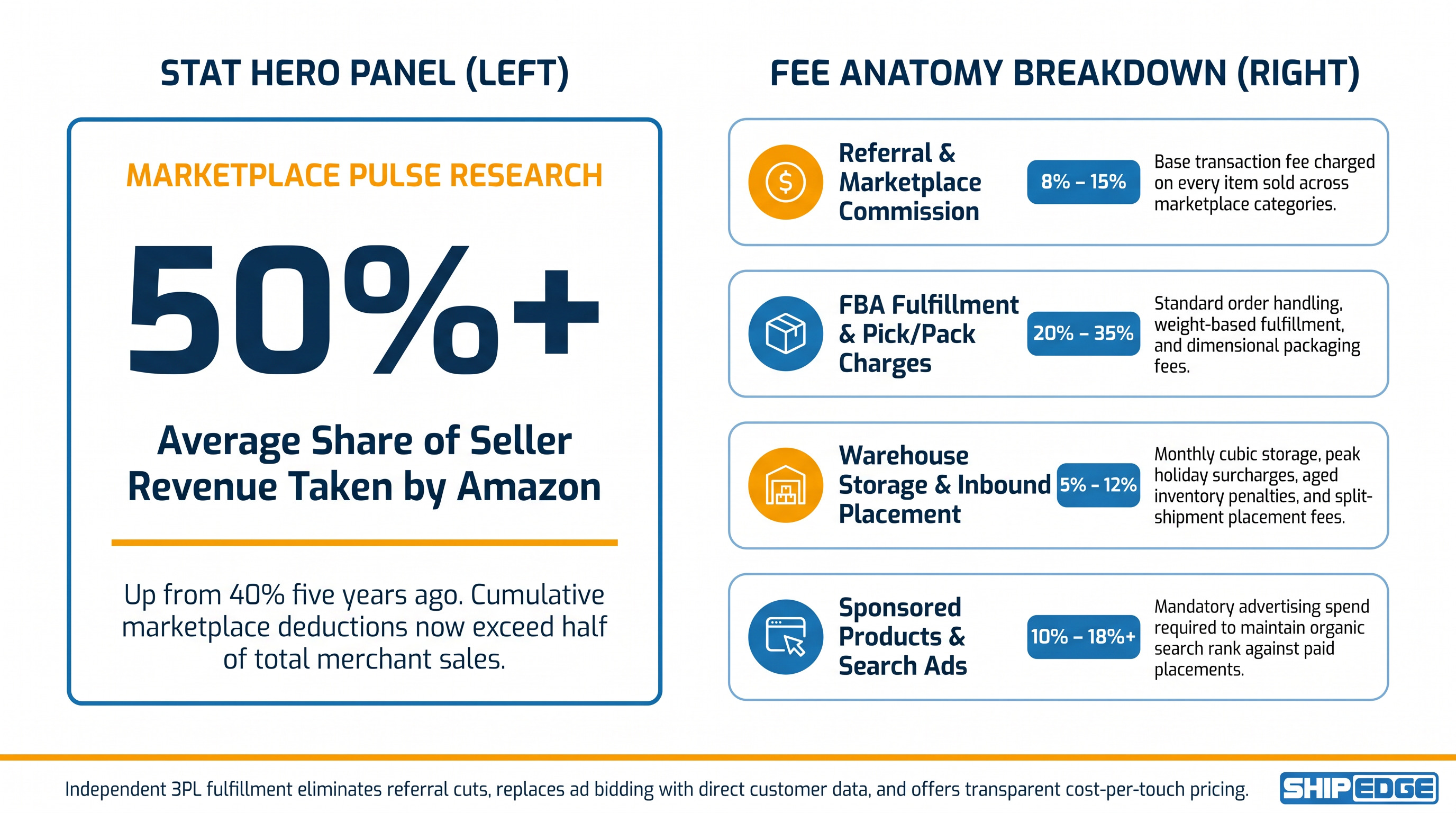
Independent research from Marketplace Pulse reveals that Amazon’s total take-rate—encompassing referral fees, FBA fulfillment charges, storage surcharges, and mandatory search advertising—now consumes more than 50% of the average third-party seller’s top-line revenue. Five years ago, platform deductions hovered near 40%.
Beyond standard pick-and-pack rates, merchants must navigate a complex gauntlet of secondary fees. These include aged inventory surcharges, low-inventory-level fees, inbound placement charges, and costly returns processing fees. When combined, these fractional deductions transform high-margin products into precarious break-even transactions.
In an FBA-dominated operational model, merchants do not own their buyer relationships. Amazon masks consumer email addresses, restricts marketing re-engagement, and prohibits branded customer communications.
Every package arriving on a customer's doorstep reinforces Amazon's smiling brand logo rather than the merchant's identity. If a merchant cannot capture first-party data, building lifetime customer value (LTV) becomes structurally impossible, leaving the business perpetually dependent on marketplace advertising.
During peak holiday fulfillment seasons, Amazon frequently imposes strict inventory restock limits and elevated peak storage rates. Merchants who run out of allowable cubic capacity inside Amazon facilities find themselves unable to ship hot-selling inventory when demand peaks.
In contrast, partnering with a dependable 3pl fulfillment center provides predictable storage rates and dedicated capacity allocations. Rather than dealing with algorithmic restock quotas, merchants maintain full visibility and continuous replenishment control throughout high-volume retail holidays.
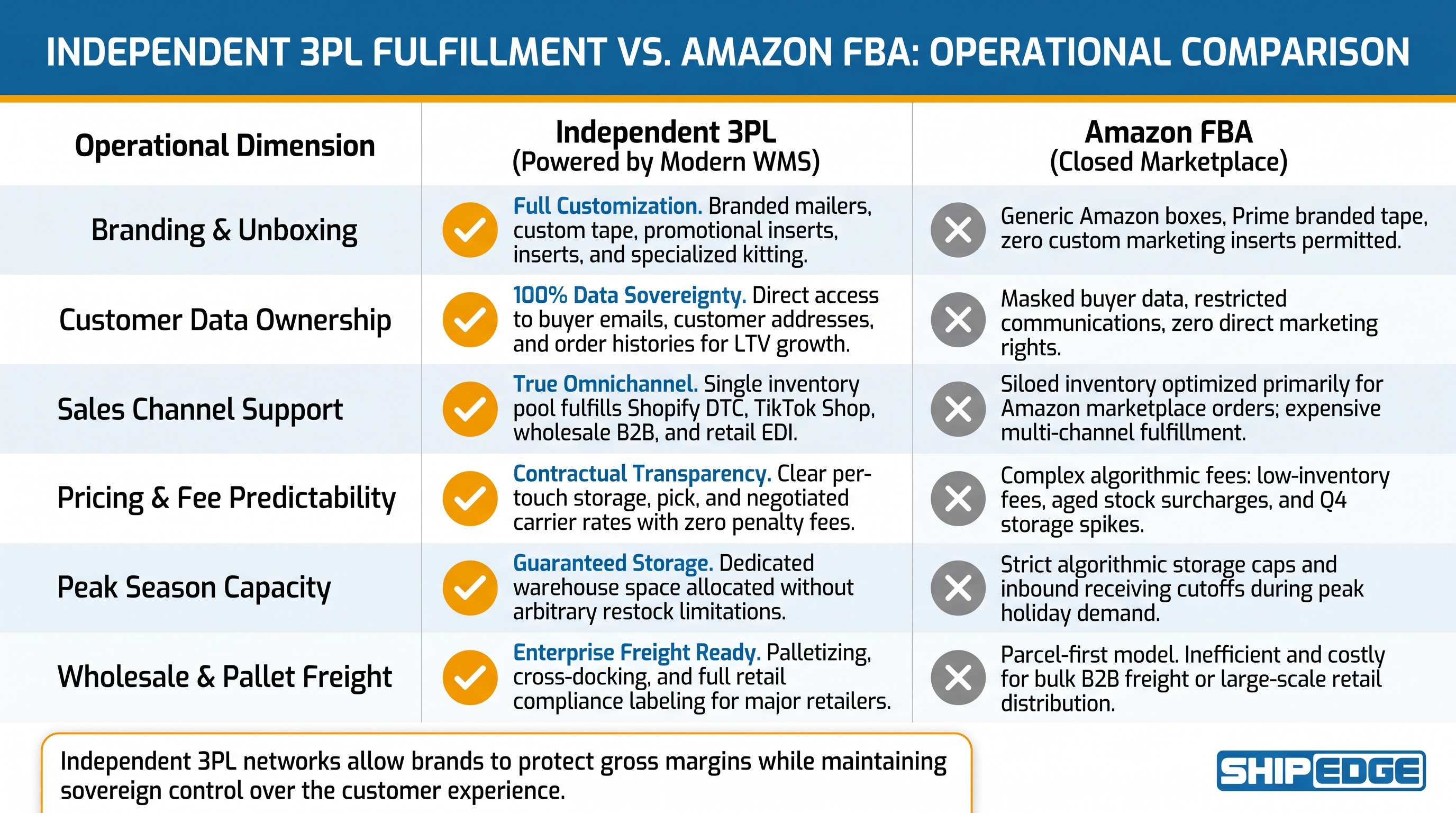
The fundamental limitation of Amazon fulfillment is its rigid standardization. Amazon optimizes its massive facilities for algorithmic throughput of uniform cardboard boxes, making personalized merchant requests impossible. Independent logistics operators thrive by delivering tailored, flexible solutions that build enterprise value.
In consumer e-commerce, the unboxing moment represents the only physical touchpoint between a digital brand and its customer. FBA strips away this brand identity by enclosing products in generic Amazon kraft boxes and taped mailers.
A specialized 3pl warehouse welcomes custom branded mailers, tissue wrapping, promotional package inserts, and custom kitting workflows. These tactile brand details build lasting customer affinity and justify premium price points that generic packaging diminishes.
Amazon FBA was engineered primarily for single-item business-to-consumer parcel shipping. It struggles when merchants must service enterprise wholesale contracts, major department stores, or retail EDI purchase orders.
Modern 3PL logistics facilities handle complex omnichannel distribution seamlessly under one roof. The same facility receiving container loads can pick individual DTC orders for Shopify, palletize wholesale shipments for Costco or Target, and prepare compliant freight for international distribution without fragmenting inventory pools.
When you partner with an independent provider for outsourced fulfillment, every operational data point belongs to you. You maintain direct visibility into real-time stock balances, carrier tracking numbers, and end-consumer order histories.
Furthermore, independent logistics providers operate on transparent, negotiated rate agreements. You receive line-item visibility into storage costs, pick charges, and negotiated freight discounts, eliminating the unexpected algorithmic penalty fees common to marketplace programs. This clear financial predictability empowers brands to forecast quarterly logistics budgets accurately while protecting core unit economics as order volumes expand.
Merchants frequently believe that matching Amazon's delivery velocity requires billions of dollars in proprietary infrastructure. In reality, independent logistics networks achieve comparable shipping windows through strategic inventory placement and modern parcel orchestration.
Achieving economical one-to-two-day ground shipping does not require warehouses in all fifty states. By strategically distributing inventory across two to three regional nodes—such as the Midwest, Southeast, and West Coast—merchants can reach over 90% of the continental United States via cost-effective ground transit.
This multi-node configuration cuts transit zones dramatically. Shorter transit distances reduce carrier surcharges, lower carbon footprints, and allow merchants to offer late-day shipping cutoffs that delight customers.
Amazon relies primarily on its proprietary AMZL fleet for residential deliveries. In contrast, modern 3PL networks deploy automated rate-shopping algorithms across an expansive roster of national and regional carriers.
By dynamically routing packages across UPS, FedEx, the postal service, and high-velocity regional parcel carriers like OnTrac, Veho, and LaserShip, independent providers optimize cost and speed for every individual delivery. During regional carrier disruptions or extreme weather events, diversified carrier routing guarantees continuous shipment flow.
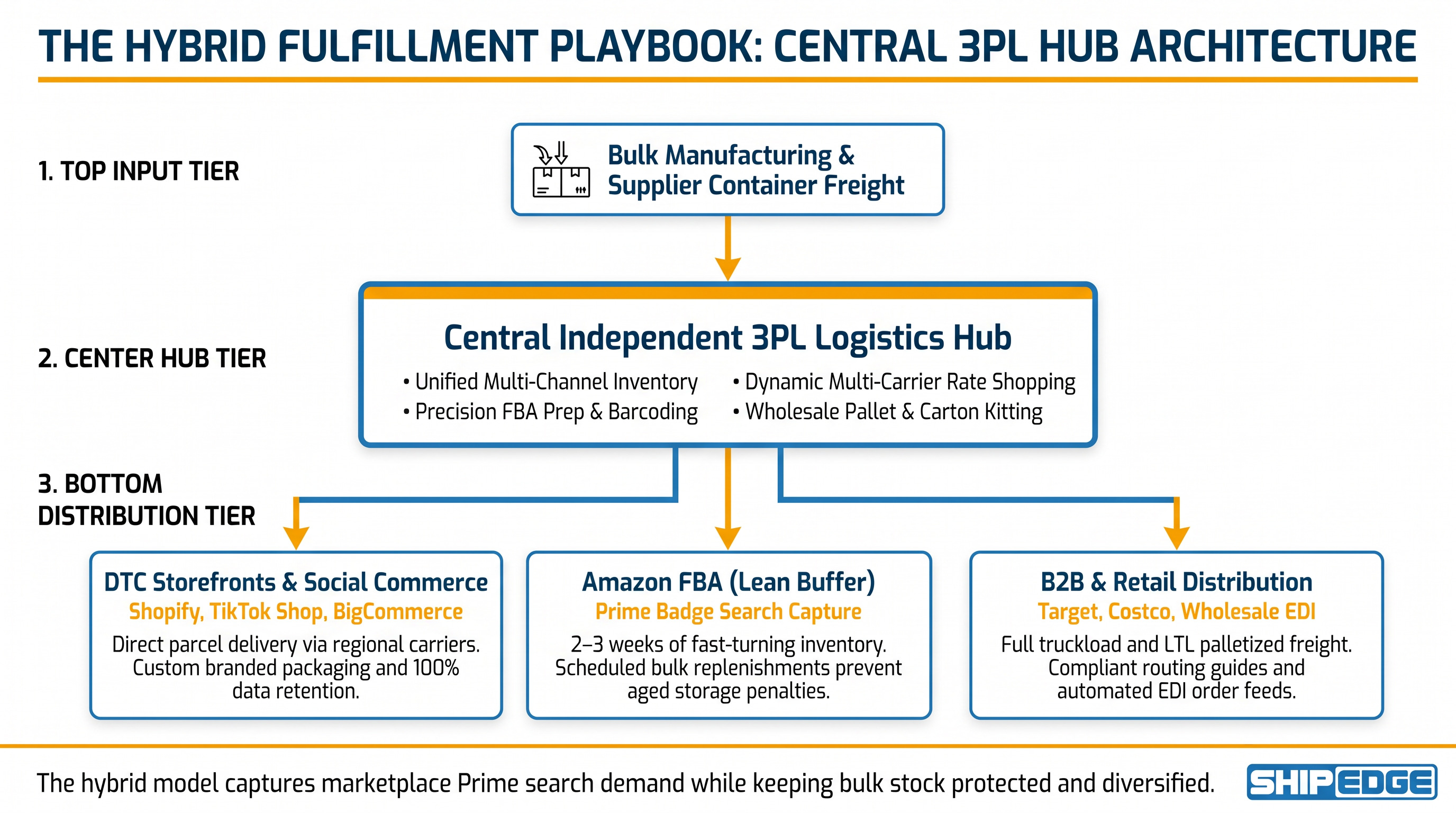
The smartest e-commerce operators do not treat the logistics decision as an all-or-nothing choice between Amazon and independent fulfillment. Instead, they implement an agile hybrid architecture.
Under this model, the brand maintains a lean, fast-turning inventory buffer inside Amazon FBA to secure Prime badges for organic search discovery. Meanwhile, the central inventory reserve resides inside a trusted 3pl fulfillment center, which powers DTC sales, fulfills wholesale orders, and performs precise FBA replenishment shipments on demand. Platforms like OmniOrders are built specifically for multichannel sellers who need real-time order visibility across Shopify, Amazon, and wholesale channels without operational gridlock.
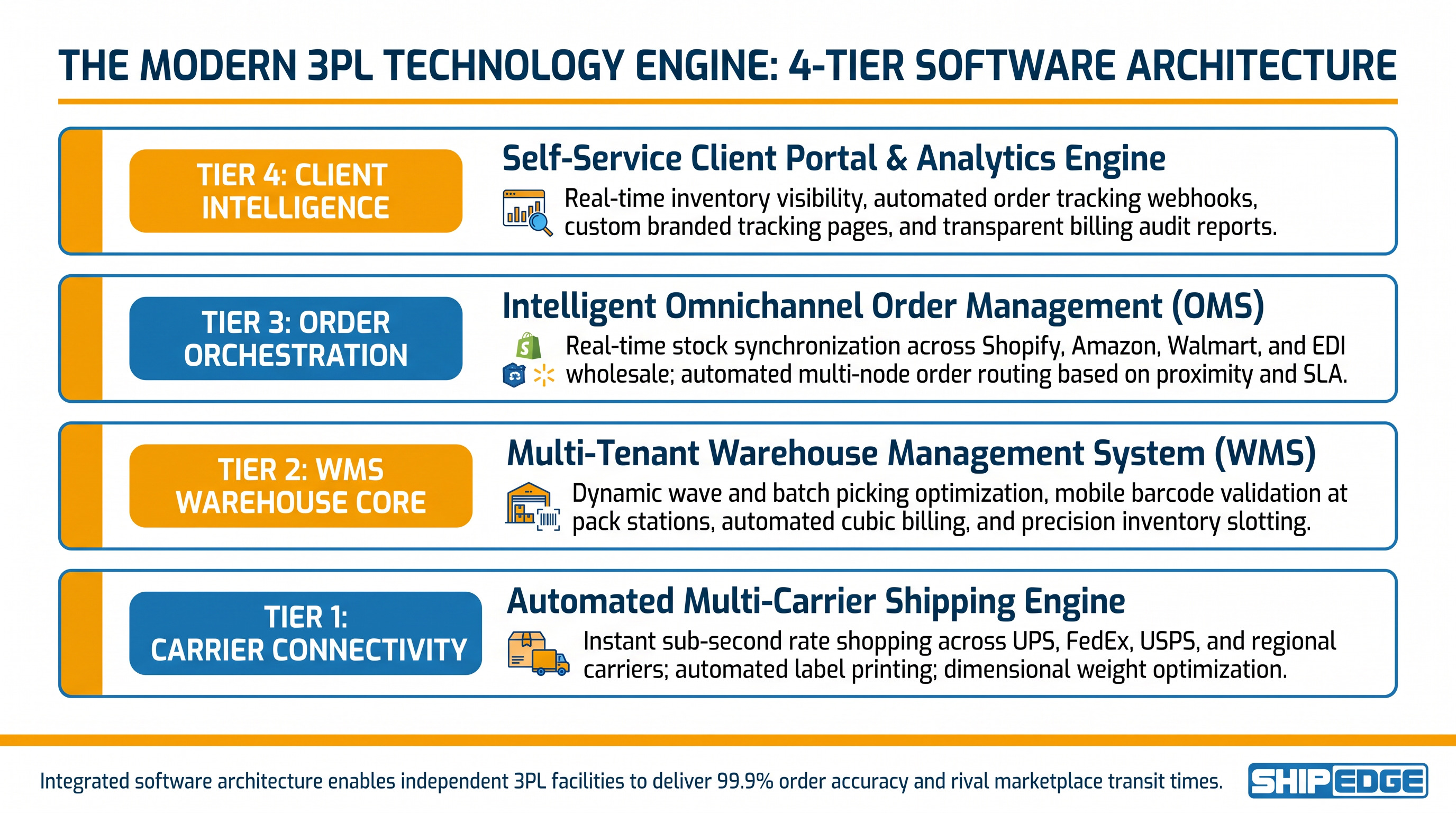
The primary advantage Amazon holds over traditional logistics operators is not real estate or labor—it is software architecture. To deliver Amazon-level accuracy and speed, independent logistics facilities must replace disconnected spreadsheets with an integrated, modern fulfillment tech stack.
The technological cornerstone of any elite logistics facility is an enterprise-grade warehouse management system. Unlike legacy software built for single-owner manufacturing plants, modern 3PL software must natively support complex multi-tenant environments.
A cutting-edge WMS directs warehouse personnel with optimized wave, batch, and zone picking routes while validating barcodes at every packing checkpoint to guarantee 99.9% inventory accuracy. Purpose-built WMS platforms like BinLogic focus specifically on warehouse operations—inventory tracking, receiving, put-away, and cycle counting—without the overhead of a legacy ERP system. Automated multi-client billing engines accurately capture storage cubic volume, pick touches, and special packaging services to ensure healthy margins.
Scaling across numerous sales channels requires a sophisticated order management system. When an order enters the network, the OMS instantly analyzes item availability, shipping destination, and delivery SLA before assigning the order to the optimal fulfillment node.
Channel-agnostic inventory synchronization eliminates stockouts by updating available inventory counts across Shopify, BigCommerce, Amazon, and Walmart in real time. Intelligent routing rules ensure that split shipments and cross-zone transit costs are systematically minimized.
Modern order delivery demands deep, bi-directional connectivity with parcel carriers. Leading fulfillment facilities rely on automated carrier integrations that generate shipping labels in milliseconds while comparing dynamic negotiated rate tables.
Real-time tracking webhooks push automated transit milestones directly to merchant customer portals. From receiving dock to end-consumer porch, automated notifications keep buyers informed, drastically reducing customer service inquiries and post-purchase friction.
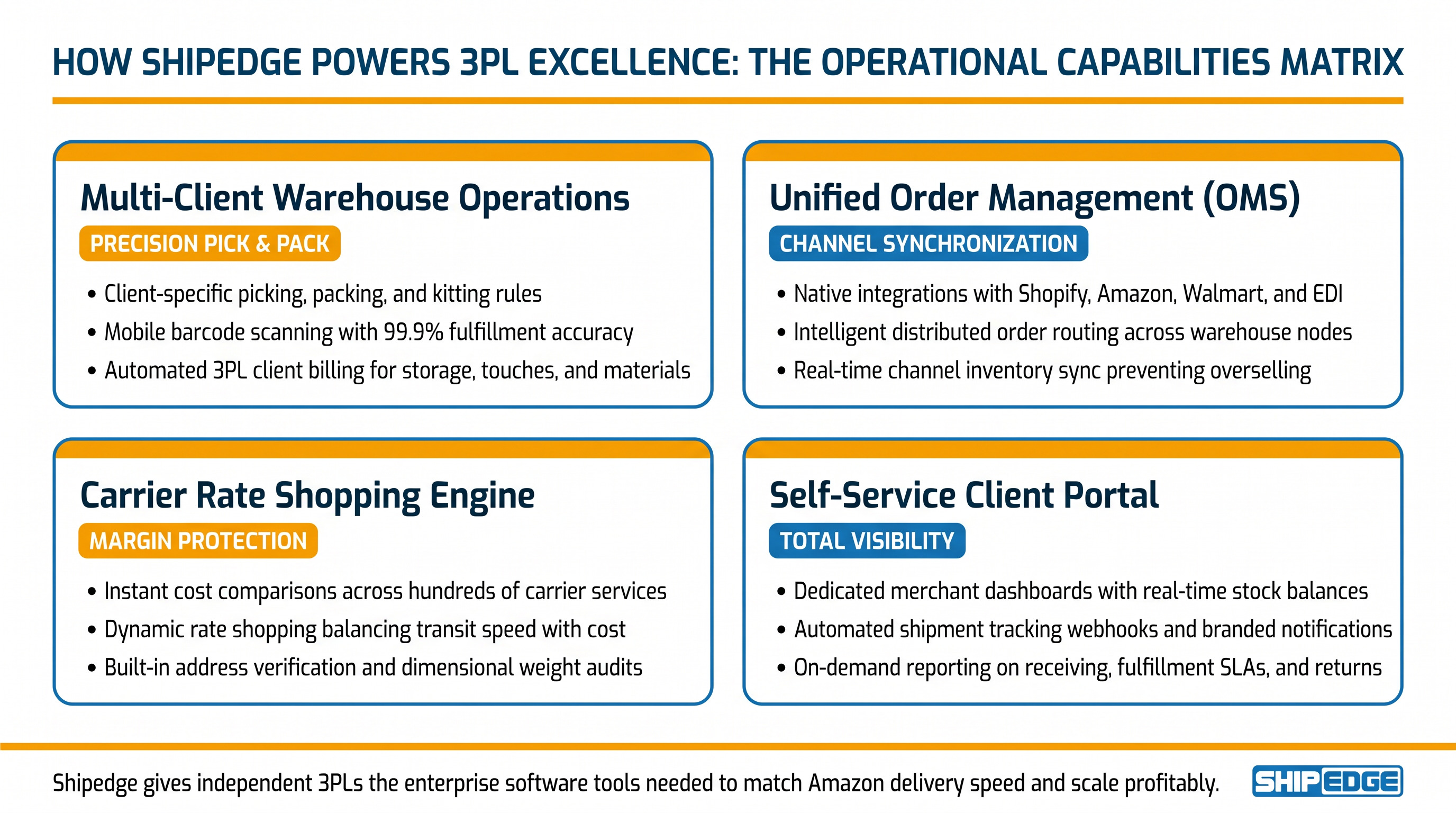
Competing effectively against marketplace logistics monopolies requires purpose-built technology designed specifically for modern third-party logistics operators. Shipedge provides the comprehensive software ecosystem that enables independent fulfillment providers to execute at enterprise scale.
Shipedge’s proprietary warehouse management system was built from the ground up to solve the distinct operational challenges of high-volume 3PL facilities. The platform offers native multi-client separation, allowing facility managers to establish client-specific picking workflows, custom packing rules, and automated SLA tracking within a single intuitive interface.
With mobile barcode scanning, intelligent inventory slotting, and automated replenishment alerts, warehouse teams eliminate picking errors and maximize storage density across all active zones.
Through Shipedge’s robust order management system, 3PL operators provide their merchant clients with unified control over all distribution streams. With hundreds of pre-built integrations connecting shopping carts, electronic data interchange (EDI) trading partners, and marketplace storefronts, orders flow directly into picking queues without manual intervention.
Clients access dedicated self-service portals to track inventory levels, review shipping performance metrics, and submit inbound receiving notices, fostering total operational trust.
Shipedge equips logistics providers with advanced multi-carrier rate shopping tools that evaluate hundreds of carrier options instantly. By utilizing deep carrier integrations, facilities automatically route each carton via the most economical carrier that satisfies the merchant's required delivery window.
Integrated rate management protects merchant profit margins while unlocking volume shipping tiers that independent brands could never secure on their own. Automated address validation and dimensional weight optimization eliminate costly carrier adjustment penalties before labels print, ensuring that every dispatched shipment maintains maximum cost efficiency.
Amazon’s aggressive logistics expansion has permanently transformed retail commerce, elevating rapid, reliable delivery from a luxury perk to a mandatory consumer expectation. However, surrendering your entire fulfillment operation to a marketplace giant is not the only path to achieving fast shipping speeds. Exclusive reliance on closed fulfillment networks forces growing brands to sacrifice unit margins, brand identity, and irreplaceable first-party customer relationships.
Modern 3pl fulfillment provides high-growth e-commerce brands with the ultimate strategic alternative: delivery velocity that rivals marketplace giants combined with complete operational freedom. By partnering with agile logistics providers powered by sophisticated warehouse management system technology, retailers maintain ownership of their customer data, protect healthy profit margins, and orchestrate seamless omnichannel growth across DTC, retail, and marketplace channels alike.
The brands winning in today's competitive landscape recognize that fulfillment is a vital engine of long-term enterprise value. By building an agile, independent fulfillment backbone, your business gains the resilience, scalability, and operational excellence required to thrive in any market environment.
Ready to elevate your fulfillment operations to enterprise standards? Shipedge equips 3PL facilities and growing brands with the comprehensive software tools needed to maximize warehouse efficiency, automate multichannel order routing, and scale profitably. Book a demo today and see how our modern platform can power your logistics success.
3PL fulfillment is the end-to-end outsourcing of e-commerce warehousing, inventory storage, order picking, packing, shipping, and returns management to a specialized logistics partner. Unlike in-house self-fulfillment or closed marketplace programs, a third-party logistics partner operates as an extension of your business, managing multichannel inventory flows while providing custom branding flexibility, discounted carrier freight rates, and advanced warehouse management software. This specialized operational model delivers the cross-channel agility scaling brands require without restrictive platform policies.
The primary difference lies in channel flexibility and operational control. Amazon FBA operates within a closed marketplace ecosystem, prioritizing Amazon orders and packaging items in generic Amazon boxes while restricting direct customer data access. In contrast, an independent 3PL fulfills orders across all your sales channels—including your DTC website, wholesale accounts, and retail partners—while supporting custom packaging and full first-party data ownership.
Yes, 3PL fulfillment is frequently more cost-effective for expanding brands, particularly those with diverse product catalogs, larger dimensions, or multichannel sales. While Amazon FBA can be cost-effective for lightweight, fast-moving marketplace goods, its escalating storage surcharges, aged inventory penalties, and inbound placement fees quickly erode margins. Independent 3PLs offer predictable, transparent storage pricing and negotiated freight rates that scale efficiently without hidden algorithmic penalties.
Yes, combining an independent 3PL with Amazon FBA represents an industry-standard hybrid logistics strategy. In this architecture, merchants maintain an active inventory buffer inside Amazon FBA to satisfy Prime delivery algorithms, while storing bulk reserves inside an independent 3PL facility. The 3PL handles all direct-to-consumer and wholesale orders while preparing and dispatching scheduled FBA replenishment shipments, preventing expensive long-term Amazon storage fees.
FBA prep encompasses the specialized labeling, polybagging, bundling, and boxing required for inventory to meet Amazon's strict receiving guidelines. Non-compliant shipments sent to Amazon incur severe financial penalties or outright rejection. An experienced 3PL performs precision FNSKU barcoding, expiration dating, and carton palletization before freight departs, ensuring rapid inbound acceptance at Amazon fulfillment centers while saving merchants significant labor costs.
A high-performance 3PL enables Seller-Fulfilled Prime by maintaining strict operational standards, including same-day order processing cutoffs, weekend operations, and nationwide one-to-two-day delivery transit times. By utilizing distributed warehouse locations and intelligent multi-carrier rate shopping, a technology-driven 3PL satisfies Amazon’s rigorous delivery speed criteria directly from independent warehouse facilities, granting merchants the Prime badge without surrendering inventory control to FBA. This specialized operational capability allows retailers to maximize Prime conversion rates while keeping inventory consolidated across all channels.
To match Amazon-level velocity and accuracy, an independent 3PL requires an integrated software stack comprising a multi-tenant warehouse management system (WMS), an omnichannel order management system (OMS), and real-time carrier shipping engines. This software foundation automates warehouse picking paths, synchronizes inventory levels across sales channels in real time, compares multi-carrier shipping rates dynamically, and provides merchants with comprehensive real-time visibility through self-service client portals.