EN │ ES
Third Party Logistics
Shipedge
October 13, 2026
19 min read
Prominent 3PL examples demonstrate how third-party logistics—the outsourced management of warehousing, inventory control, picking, packing, and freight shipping—enables modern enterprises to scale order fulfillment dynamically without purchasing commercial real estate or leasing private delivery fleets.
Every expanding enterprise eventually hits an operational bottleneck where shipping volume strains existing warehouse capacity. As order volumes multiply across digital storefronts, wholesale distributors, and retail partners, internal fulfillment workflows either accelerate commercial momentum or consume profit margins. Facilities run out of pallet racking, fulfillment errors multiply, and working capital becomes trapped in rigid long-term industrial leases.
To solve these physical constraints, world-class enterprises turn to proven 3pl examples across retail, consumer electronics, and apparel. Industry leaders understand that customer satisfaction depends on rapid delivery and flawless order accuracy. However, owning physical fulfillment infrastructure rarely creates a lasting competitive advantage. Managing complex supply chain logistics requires dedicated personnel, specialized material handling equipment, and continuous software engineering.
Outsourcing fulfillment becomes especially urgent as organizations prepare for high-volume sales events. During Q4 peak season and major promotional surges, order velocity can quadruple overnight, overwhelming internal teams. According to research from Grand View Research, the global 3PL market reached \$1,261.0 billion in 2025 and is expanding toward \$1,356.7 billion in 2026. This sustained 9.1% compound annual growth rate proves that modern enterprises treat third-party logistics as a strategic growth engine rather than a mere operational convenience.
A third party logistics 3pl provider acts as an external operations engine for commercial enterprises. Instead of building private distribution networks from scratch, brands contract specialized operators to orchestrate day-to-day logistics operations. This partnership spans the physical journey of a product, from container arrival at maritime ports to final doorstep delivery.
Understanding how does 3pl work in practice begins with examining its operational integration. Modern logistics partners connect directly with merchant commerce platforms, ingest order data continuously, and manage storage, picking, and shipping workflows. By sharing facility footprints, labor pools, and advanced material handling equipment across multiple brand clients, 3PL facilities achieve operating efficiencies that standalone businesses cannot replicate internally.
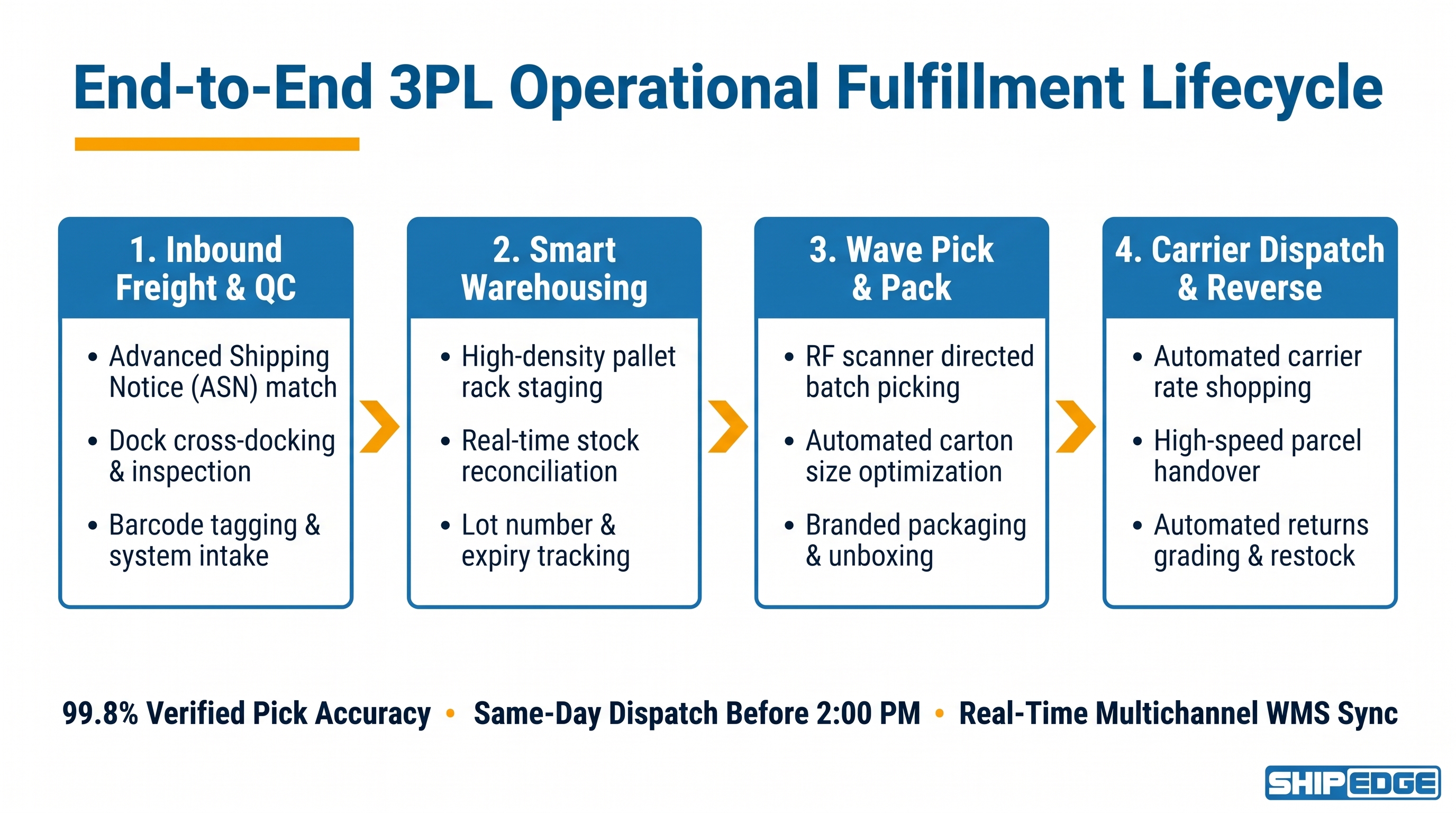
A full-service 3PL delivers integrated services designed to handle complex supply chain workflows:
The financial motivation behind outsourcing logistics centers on capital efficiency. Building an internal warehouse network demands multi-year commercial leases, millions in racking and conveyor investments, and rigid staffing overhead. During seasonal lulls, businesses continue paying for idle warehouse square footage and underutilized staff.
Partnering with an external provider shifts these liabilities into a flexible, variable cost structure. Brands pay exclusively for the pallet positions occupied, labor hours utilized, and packages dispatched each billing cycle. When order volumes fluctuate during promotional campaigns or economic shifts, operational expenses scale proportionally. This structural elasticity protects operating cash flow and allows organizations to reinvest capital into product development and customer acquisition.
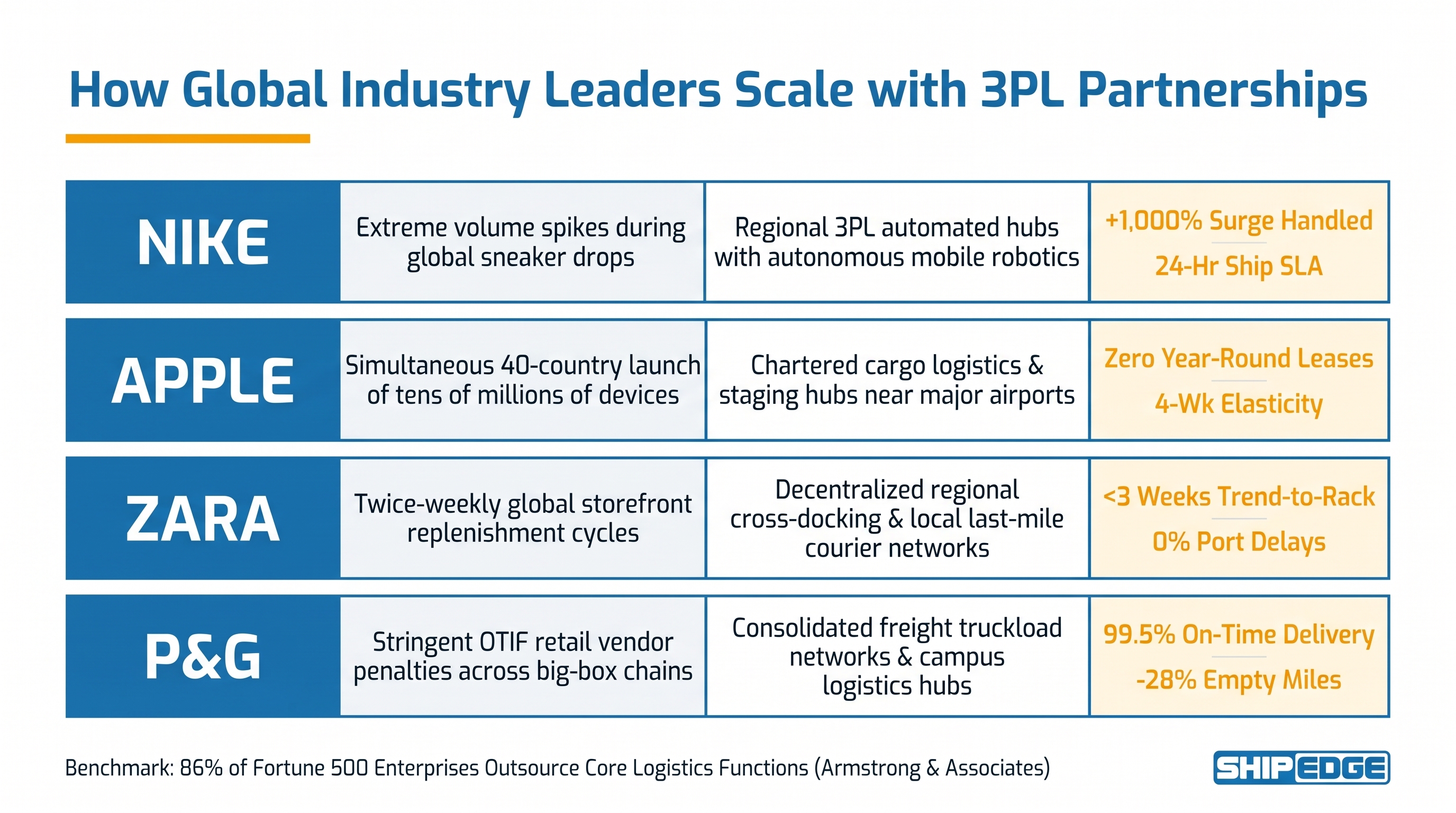
Examining tangible enterprise case studies illustrates why the world's most profitable corporations rely on third-party partners. These companies that use 3pl prove that market leadership stems from marketing, product engineering, and customer engagement—not warehouse ownership.
According to supply chain industry benchmarks from Armstrong & Associates, approximately 86% of Fortune 500 companies utilize 3PL services for at least one critical supply chain function. The following real-world corporate models demonstrate how different industries execute this strategy.
Nike designs athletic footwear and apparel worn across the globe, yet the company does not manage the physical transit of every sneaker box. To support international direct-to-consumer (DTC) digital sales alongside thousands of wholesale retail partners, Nike contracts regional logistics partners worldwide.
Nike contracts specialized 3PLs across North America, Europe, and Asia to operate regional mega-hubs. These facilities utilize robotic picking systems and automated carton erectors configured to Nike's exact specifications. During high-heat sneaker drops, order volumes surge by 1,000% within minutes. Third-party logistics facilities absorb this demand spike by reallocating shared warehouse labor, ensuring sneakers ship within 24 hours without disrupting retail store replenishment.
Apple represents one of the premier 3pl examples of operational precision. While Apple exercises complete vertical control over hardware engineering, proprietary silicon, and retail store design, it outsources international freight and warehousing to global logistics leaders.
When Apple launches a new iPhone lineup each autumn, tens of millions of devices must arrive simultaneously on customer doorsteps and retail shelves across 40 countries. Apple partners with enterprise freight forwarders and 3PL networks to secure chartered cargo flights, establish secure airport sorting zones, and stage localized stock close to metropolitan centers. Outsourcing enables Apple to scale logistics capacity to monumental heights for four weeks every autumn, then contract back down without maintaining year-round warehouse overhead.
Spanish retail giant Inditex, the parent company of Zara, revolutionized fast fashion through responsive inventory cycles. While Zara coordinates central production and design near its automated headquarters in Arteixo, Spain, its worldwide storefront replenishment relies on deeply integrated 3PL networks.
To guarantee that storefronts receive fresh apparel assortments twice weekly, Zara contracts local logistics partners across the Americas, Asia, and the Middle East. These local providers handle customs clearance, regional cross-docking, and last-mile store deliveries. By combining centralized internal planning with decentralized 3PL execution, Zara avoids international shipping delays and maintains a trend-to-rack turnaround time of less than three weeks.
Consumer packaged goods titan Procter & Gamble manufactures essential household goods including Tide, Pampers, and Gillette. Supplying major big-box retailers such as Walmart, Target, and Costco requires immaculate on-time, in-full (OTIF) shipping performance to avoid severe vendor chargeback penalties.
P&G partners with nationwide asset-based 3PL carriers and contract logistics providers to orchestrate massive freight movements. These logistics partners manage regional distribution campuses located near major interstate freight corridors. By consolidating P&G truckloads with complementary consumer goods shipments, 3PL partners reduce empty transport miles, optimize fuel consumption, and guarantee stringent retailer delivery windows.
Logistics outsourcing is no longer restricted to multi-billion-dollar conglomerates. Fast-growing consumer brands generating between \$5 million and \$100 million in annual revenue regularly use modern 3pl warehouse services to compete directly with legacy industry giants.
Consider digitally native brands selling apparel, nutritional supplements, or specialty home goods. By distributing inventory across a 3PL network with warehouses in California, Texas, Pennsylvania, and Illinois, an emerging DTC brand can offer 2-day ground shipping to 95% of continental US customers. This decentralized footprint eliminates expensive air freight surcharges, lowers cart abandonment rates by up to 25%, and frees the internal executive team to focus on customer acquisition.
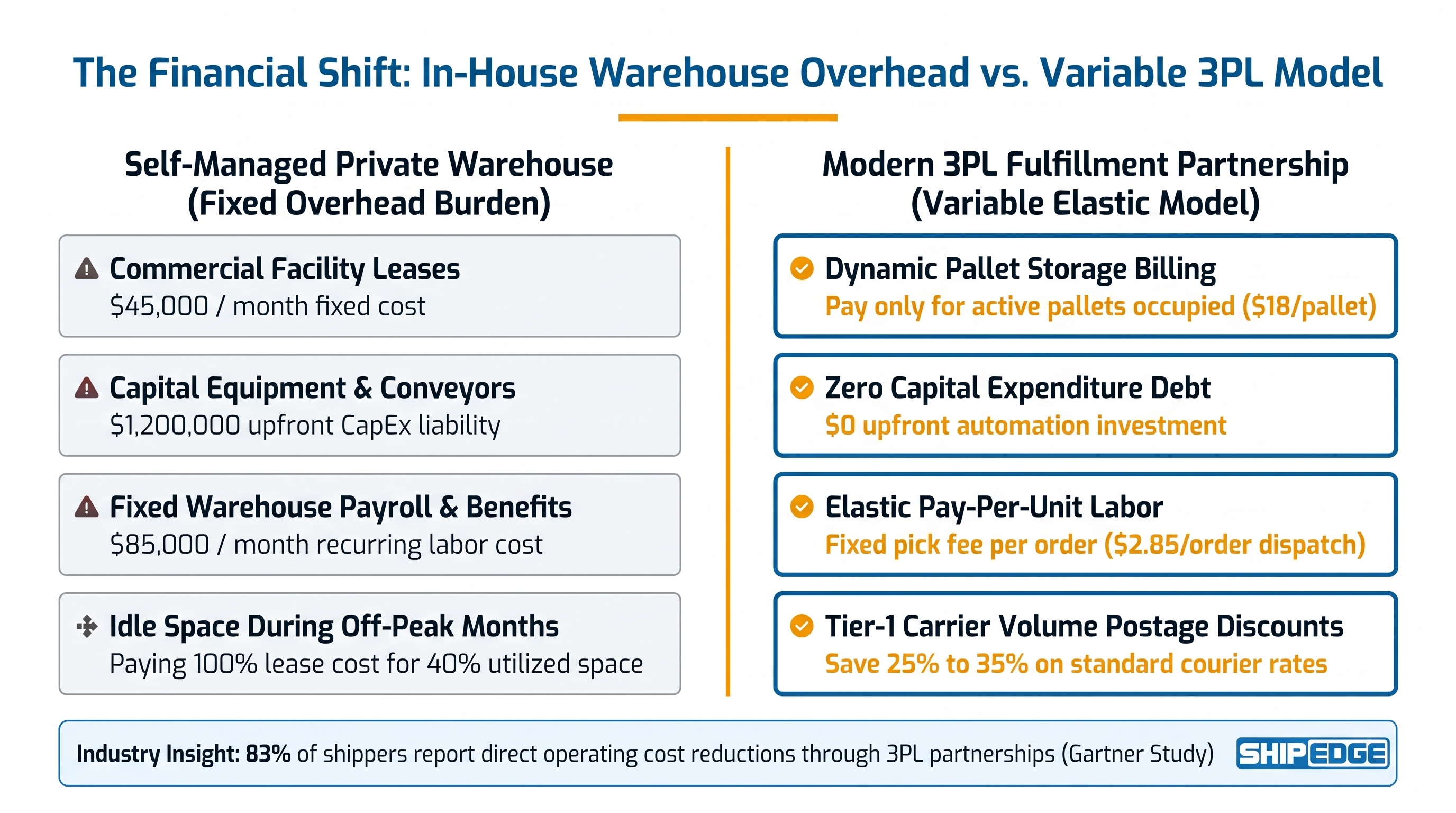
Outsourcing physical operations provides measurable competitive advantages that compound as shipping volumes scale. A high-performing 3pl provider acts as a strategic growth catalyst, transforming physical logistics from an operational vulnerability into a revenue driver.
According to the 2026 Third-Party Logistics Study conducted by Gartner, 91% of enterprise shippers report that their 3PL partnerships directly improved overall customer service levels, while 83% reported significant reductions in overall logistics costs.
Operating a private warehouse involves substantial hidden expenses: worker's compensation insurance, property taxes, material handling maintenance, packing materials, and utility bills. When shipping volumes decline during seasonal lulls, these fixed commitments drain working capital.
Contracting an external order fulfillment provider instantly converts rigid overhead into predictable unit economics. Brands pay transparent fees per pallet stored, per item picked, and per parcel delivered. Furthermore, because large 3PLs ship tens of millions of parcels annually, they secure Tier-1 carrier volume discounts that individual merchants could never negotiate independently, directly reducing per-package postage expenses.
Modern fulfillment efficiency requires sophisticated hardware and software infrastructure. Autonomous mobile robots (AMRs), automated guided vehicles (AGVs), automated carton-sizing machinery, and pick-to-light picking walls cost millions of dollars to implement and maintain.
Partnering with a technology-driven logistics provider grants immediate access to modern warehouse automation without balance sheet debt. These systems eliminate human picking errors, optimize wave batching, and accelerate order processing cycles. Brands achieve same-day order fulfillment cutoffs as late as 4:00 PM local warehouse time, drastically outperforming what manual internal fulfillment teams can achieve.
E-commerce order volume rarely follows a flat, predictable trajectory. Promotional events like Prime Day, flash sales, and Q4 holiday shopping sprees routinely generate 400% to 600% spikes in daily order velocity. An internal warehouse staff of ten workers quickly drowns under a sudden backlog of twenty thousand orders.
A scaled logistics partner absorbs seasonal surges effortlessly. Facilities balance labor across multiple client accounts, shifting shared picking crews to accounts experiencing promotional spikes. By utilizing established 3pl logistics benefits, brands capitalize on peak seasonal demand without recruiting, training, and eventually laying off temporary warehouse personnel.
Consumer expectations around shipping speed have been fundamentally transformed by marketplace delivery standards. Studies show that over 60% of modern online shoppers abandon their carts when standard delivery estimates exceed three business days. Fulfilling orders from a single central facility makes coast-to-coast ground delivery slow and air shipping prohibitively expensive.
Established 3PLs operate interconnected warehouse networks spanning major regional transport hubs. By analyzing historical customer geographic data, brands distribute inventory across multiple regional facilities. When an order is placed, automated software routes the order to the closest regional warehouse, cutting shipping transit times to 1–2 days and slashing shipping zone postage costs. Maintaining real-time inventory visibility across these regional hubs ensures that stock never sits stranded in distant facilities.
The most valuable resource inside any growing business is leadership attention. When founders, chief operating officers, and marketing directors spend their afternoons troubleshooting carrier delays, negotiating packaging contracts, and managing warehouse staffing turnover, core business growth stagnates.
Outsourcing physical fulfillment liberates internal teams to focus on activities that generate enterprise value: product development, brand storytelling, paid acquisition, and customer retention. Relinquishing daily warehouse oversight allows leadership teams to build market share while logistics specialists handle physical execution.
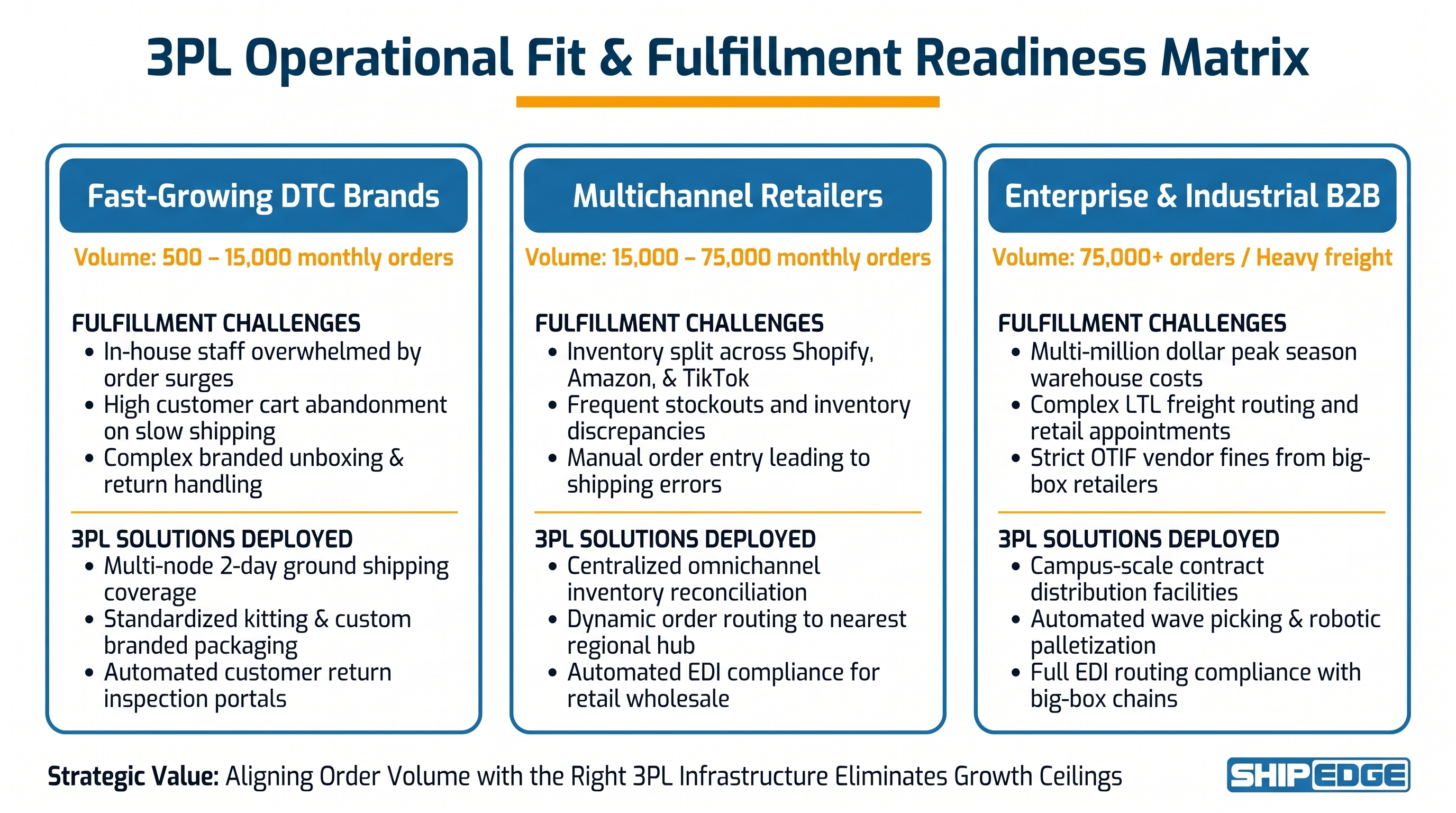
While third-party fulfillment provides broad operational advantages, specific business models achieve extraordinary returns on investment by outsourcing. Understanding operational triggers helps leadership teams determine when the transition to a 3PL becomes urgent.
The following commercial profiles gain immediate strategic leverage from third-party logistics:
Brands scaling from hundreds of monthly orders to tens of thousands face rapid fulfillment complexity. Fragile inventory, custom unboxing packaging, branded inserts, and high return rates quickly overwhelm in-house teams. A specialized 3pl for ecommerce provides the standardized workflows, kitting services, and automated return portals required to scale DTC operations gracefully. Outsourcing order processing allows consumer brands to focus entirely on acquisition marketing and creative brand storytelling.
Selling across Shopify, Amazon FBA, Walmart Marketplace, TikTok Shop, and wholesale EDI accounts creates massive inventory reconciliation headaches. Stock allocated to physical retail cannot sit locked away while online customer orders stock out. Modern 3PLs synchronize inventory pools across all digital and physical sales channels, preventing overselling and chargeback fines. Executing coordinated multichannel fulfillment ensures unified stock allocation across every digital cart and wholesale storefront.
Manufacturing companies managing heavy freight, raw component storage, and palletized B2B shipments require specialized material handling. Dedicated 3PL providers offer specialized yard management, heavy-duty forklift capabilities, and LTL/FTL freight coordination tailored to strict commercial delivery appointments and retail compliance routing guides. Commercial manufacturers avoid capital-intensive real estate expansion by utilizing industrial contract logistics partners.
Businesses whose annual revenue concentrates heavily around specific calendar periods—such as sporting goods, outdoor living, holiday decor, and school supplies—face extreme operational whiplash. Maintaining private warehouse square footage year-round to support eight weeks of peak sales destroys annual profit margins. Outsourcing to an agile 3PL provides immediate elasticity. When seasonal volume contracts, storage costs drop automatically, preserving crucial cash reserves.
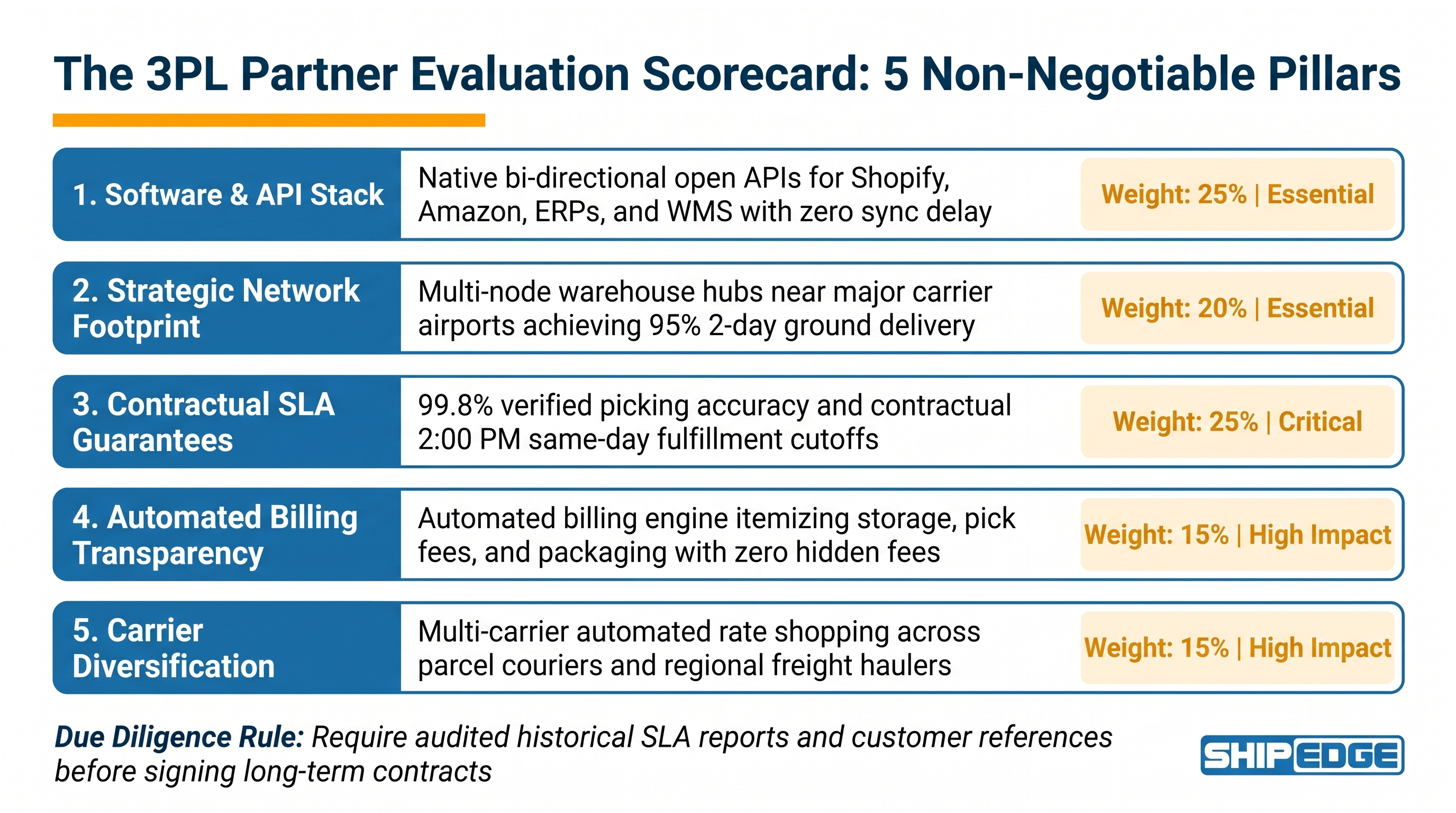
Not all logistics facilities deliver equal performance. The commercial landscape includes everything from legacy storage warehouses relying on paper clipboards to tech-forward fulfillment campuses powered by automated robotics and open APIs. Selecting the wrong partner can jeopardize customer retention and damage brand reputation.
When evaluating prospective logistics providers, operations leaders must inspect four non-negotiable operational capabilities:
The foundation of modern logistics is software connectivity. A dependable 3PL must offer native, pre-built integrations with your primary e-commerce shopping carts, ERP platforms, and electronic data interchange (EDI) retail networks. Ensure their technology stack supports real-time, bi-directional data exchange for order creation, inventory stock levels, tracking numbers, and cancellation triggers. Continuous inventory visibility allows your team to monitor stock movements without manual spreadsheets.
Relying on a single regional warehouse leaves your fulfillment vulnerable to localized weather disruptions, regional carrier rate hikes, and regional labor shortages. Choose a provider with strategically distributed nodes near major carrier logistics hubs (such as Louisville, Memphis, Dallas, Columbus, and Reno). Furthermore, ensure the facility maintains relationships with multiple regional and national parcel carriers rather than relying on a single courier contract.
Vague operational promises inevitably lead to fulfillment disputes. Demanding contractually binding Service Level Agreements (SLAs) is essential. High-performing facilities commit to concrete metrics, including:
Logistics invoices are notoriously complex, often containing unexpected line items for fuel surcharges, cardboard carton fees, barcode relabeling, and split shipments. Prioritize providers that provide clear, automated billing portals where every invoice ties directly to transparent contract rate cards. Automated billing prevents surprise monthly reconciliation disputes.
Behind every successful logistics partnership lies a sophisticated digital technology infrastructure. A physical warehouse without robust software is merely a storage room. In contrast, modern fulfillment hubs operate as data-driven digital operations hubs.
To deliver rapid execution, modern facilities deploy integrated software layers that coordinate every movement of labor and merchandise across the entire supply chain logistics network.
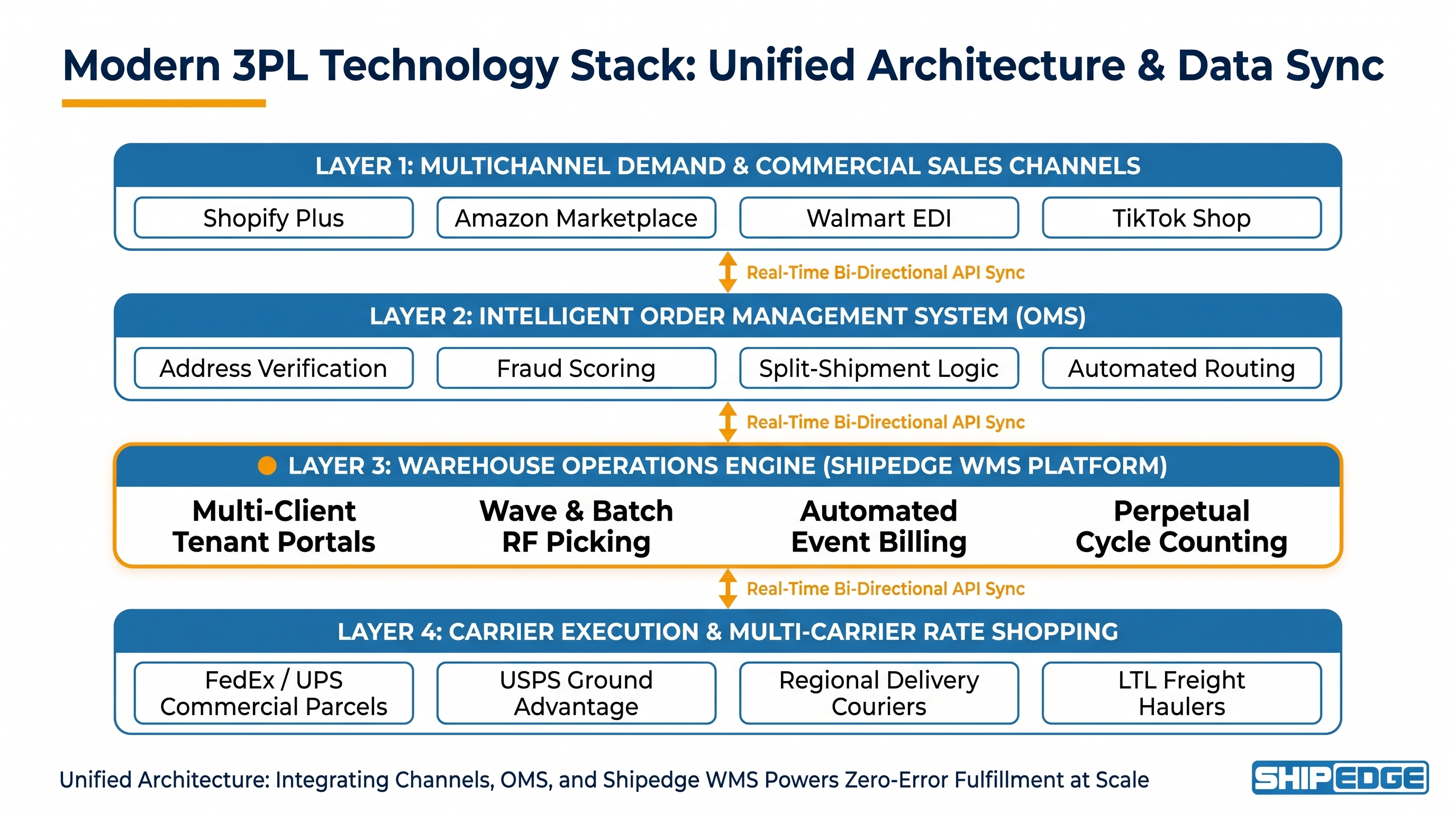
The core operational nervous system of any fulfillment center is the warehouse management system. A modern 3pl warehouse management system coordinates inbound receiving dock schedules, directs optimized wave and batch picking paths, tracks lot numbers and expiration dates, and executes perpetual cycle counting routines. Implementing an advanced 3pl warehouse management system eliminates manual stock counting and guarantees picking precision across thousands of active SKUs.
For warehouse operators seeking dedicated, nimble inventory tracking, platforms like BinLogic demonstrate how focused WMS architecture eliminates legacy software bloat while maximizing floor productivity. By equipping warehouse teams with mobile RF scanners and intuitive handheld interfaces, modern WMS platforms ensure that physical shelf inventory matches digital sales channel counts with absolute precision.
Managing order flow across diverse sales channels requires sophisticated order orchestration. An enterprise Order Management System (OMS) ingests orders from multiple online storefronts, cleans shipping addresses, validates fraud checks, and applies intelligent business logic to determine optimal fulfillment routing. Executing coordinated multichannel fulfillment requires automated rules that balance stock across warehouses while minimizing customer transit times.
Similarly, solutions such as OmniOrders provide growing multichannel brands with automated order routing across fragmented sales channels before routing shipments downstream. Intelligent order management ensures that split shipments are minimized, backorders are handled automatically, and international customs documentation is generated instantaneously.
At the center of high-growth third-party logistics stands Shipedge. Shipedge delivers an all-in-one software ecosystem combining advanced 3PL software with an enterprise-grade warehouse management system designed specifically for multi-client fulfillment operations. Choosing proven 3pl software gives growing warehouses the exact operational control needed to compete with industry titans.
Shipedge empowers modern 3PL facilities to operate as a premier order fulfillment provider, managing hundreds of independent merchant clients within a single unified platform. Key operational capabilities include:
By powering warehouses with Shipedge, logistics providers achieve exceptional operating speed, eliminate manual administrative data entry, and scale merchant client revenues effortlessly.
The real-world 3pl examples demonstrated by global enterprises like Nike, Apple, and Zara highlight a fundamental business truth: sustainable market expansion requires operational elasticity. Owning physical warehouses and managing internal delivery fleets locks up vital capital, exposes companies to volatile overhead risks, and diverts executive attention away from core business growth.
By partnering with an experienced third-party logistics provider, modern businesses transform rigid fulfillment liabilities into a flexible, scalable competitive advantage. Brands gain access to world-class warehouse automation, nationwide 2-day delivery footprints, and substantial carrier volume postage discounts from day one. Whether preparing for explosive Q4 holiday sales surges or expanding into omnichannel retail distribution, 3PL partnerships provide the physical backbone required to scale without operational limits.
Ready to optimize your fulfillment network and scale operations seamlessly? Shipedge equips high-performing 3PLs and growing brands with the industry's most advanced warehouse and order management technology. Book a demo today and see firsthand how our unified platform powers profitable, scalable fulfillment operations.
3PL stands for third-party logistics. In commercial supply chain management, 3PL refers to outsourcing operational logistics functions—such as warehousing, inventory control, pick and pack fulfillment, and transportation—to an external specialized service provider. Partnering with a 3PL allows growing commercial businesses to scale physical operations dynamically without purchasing commercial real estate, leasing equipment, or managing internal warehouse labor forces. This operational model frees executive teams to focus on core growth.
A 3PL warehouse is a specialized distribution facility that stores, manages, and fulfills inventory for multiple commercial clients under one roof. These multi-tenant facilities operate using advanced warehouse management systems and automated material handling equipment. When client sales occur across digital stores or retail networks, warehouse teams pick, pack, and hand off packages to commercial freight carriers for rapid delivery. Shared warehouse infrastructure significantly lowers per-order fulfillment costs for participating merchants.
In practical terms, 3PL means delegating physical product storage and fulfillment to an outside partner. Operationally, you ship bulk inventory from manufacturers directly to the 3PL facility. The provider inspects and logs stock into digital inventory systems. When customers purchase products, order data automatically routes to the warehouse, where staff fulfill shipments according to strict service level agreements. Real-time carrier tracking information pushes back to your digital storefront instantly.
3PL fulfillment encompasses the complete operational journey of an order once placed by a customer. Standard fulfillment services include freight receiving, cross-docking, inventory storage, pick and pack execution, customized unboxing packaging, carrier rate shopping, kitting and assembly, and reverse logistics return processing. Leading facilities also offer temperature-controlled storage, lot number tracking, and B2B retail compliance routing. These comprehensive services ensure smooth omnichannel distribution across all retail channels.
While a 3PL focuses directly on executing physical logistics operations (warehousing, fulfillment, and transportation), a fourth-party logistics (4PL) provider acts as a high-level supply chain integrator. A 4PL oversees and coordinates an enterprise's entire logistics ecosystem, often managing multiple 3PL providers, freight forwarders, and software systems on behalf of the client to optimize the complete global supply chain. In essence, 3PLs manage daily physical operations, whereas 4PLs orchestrate overarching strategy.
Companies integrate with modern 3PLs via direct API connections or pre-built software plugins connecting their e-commerce storefronts, ERPs, or EDI networks to the 3PL's warehouse management system. Once integrated, order data transmits automatically to the warehouse floor in real time. The 3PL dispatches orders and automatically pushes carrier tracking numbers back to the client platform, keeping end customers continuously updated. Regular reporting audits maintain operational transparency and alignment.
Selecting the ideal 3PL requires evaluating software connectivity, geographic warehouse locations, contractual service level agreements, and industry specialization. Brands should verify that prospective providers support their specific product dimensions, shipping volume thresholds, and retail compliance requirements. Requesting client references, auditing inventory accuracy guarantees, and confirming transparent billing structures without hidden fees ensures a dependable, long-term operational partnership. Taking time to inspect facility technology upfront prevents costly fulfillment migrations later.
Modern 3PL facilities rely on an interconnected digital software stack. Core components include a multi-tenant Warehouse Management System (WMS) for inventory tracking and wave picking, an Order Management System (OMS) for multi-channel order routing, and automated carrier rate-shopping software. Advanced facilities also deploy autonomous mobile robots, automated conveyor sorters, and digital client portals that display real-time analytics. These integrated systems eliminate manual human error and accelerate order turnaround.