EN │ ES
Supply Chain
August 27, 2026
Shipedge
12 min read
As August draws to a close and the all-important Q4 peak season approaches, e-commerce brands and third-party logistics (3PL) providers are gearing up for the most critical period of the retail calendar. Starting in early September, order volumes begin their steep, unrelenting climb toward major shopping events like Black Friday, Cyber Monday, and the final holiday shipping deadlines in December. This massive surge in demand presents an incredible opportunity for revenue growth, but it also places unprecedented stress on fulfillment infrastructure. If your warehouse supply chain management processes are not comprehensively optimized before the first wave of holiday orders hits, the resulting operational bottlenecks will severely impact your profitability, customer satisfaction, and long-term brand reputation.
During peak season, the margin for error within logistics operations shrinks to near zero. A delay in receiving inventory can cascade into delayed shipments, stockouts on popular items, and a surge in negative customer reviews. An efficient, well-oiled warehouse truly serves as the beating heart of a successful supply chain ecosystem. Without it, even the most sophisticated marketing campaigns and well-designed storefronts will fail to deliver value to the end consumer. This comprehensive guide explores how to thoroughly prepare your operations, leverage the right automated technology, and implement proven best practices to conquer the Q4 surge with confidence.
A warehouse manager optimizing warehouse supply chain management for Q4 peak season
Warehouse supply chain management bridges the critical gap between broader global supply chain strategy and day-to-day tactical fulfillment execution on the warehouse floor. While traditional macro-level supply chain management encompasses sourcing raw materials from overseas, coordinating global manufacturing processes, and overseeing international transportation across multiple disparate nodes, the warehouse component focuses specifically on what happens inside the four walls of the distribution center. It is the crucial junction where inbound logistics transforms into outbound fulfillment, making it the most visible and impactful phase of the supply chain for the end consumer.
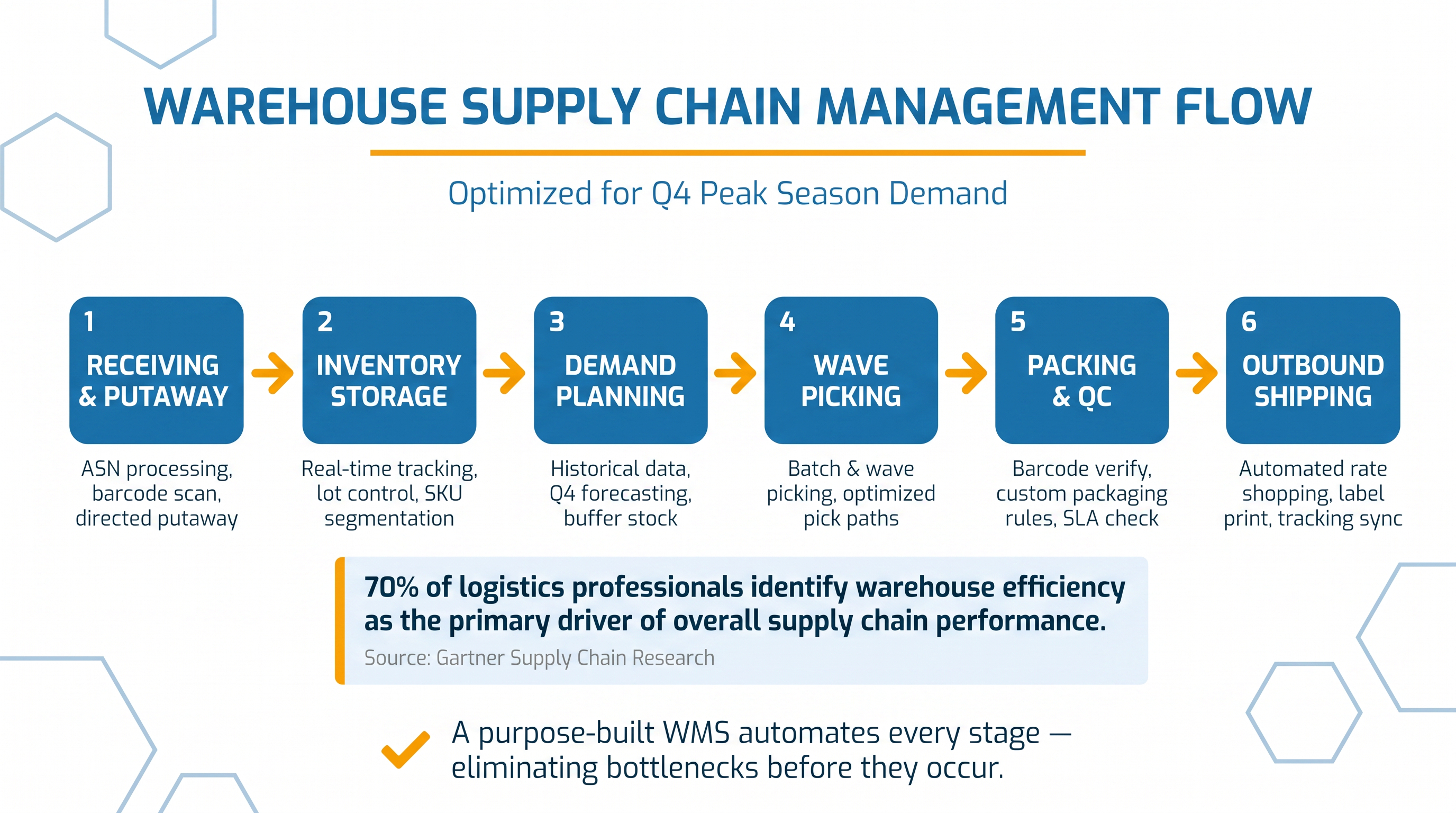
According to recent Gartner research on supply chain resilience, over 70% of logistics professionals identify warehouse efficiency as the primary driver of overall supply chain performance and customer satisfaction. Effective management involves meticulously orchestrating a complex sequence of interconnected events: receiving inbound shipments, organizing putaway routing, maximizing inventory storage density, executing precise picking strategies, optimizing packing workflows, and managing outbound shipping logistics. Every single touchpoint within this sequence must be monitored, measured, and optimized to reduce waste and increase throughput.
When these intricate processes align perfectly, overall supply chain coordination improves drastically. Products flow seamlessly from suppliers, through the distribution center, and directly to end consumers. This high-velocity movement significantly reduces lead times, minimizes expensive inventory carrying costs, and improves cash flow for e-commerce merchants. In modern logistics environments, achieving this level of coordination relies heavily on implementing a robust, cloud-based Warehouse Management System (WMS) to automate repetitive workflows, eliminate manual data entry errors, and provide real-time data visibility across all operational channels. Without a modern WMS, managing a warehouse at scale becomes an exercise in controlled chaos.
The Q4 holiday season consistently tests the absolute limits of every logistics network, exposing vulnerabilities that remain hidden during slower periods of the year. The National Retail Federation (NRF) continually reports that a massive percentage of total annual retail sales occur in the compressed window between November and December. For warehouses, this concentrated consumer spending translates directly into massive, unpredictable spikes in order volume, significantly tighter delivery service-level agreements (SLAs), and intense pressure on both human labor resources and automated systems.
Without a highly resilient, proactive strategy in place, supply chain operations quickly break down under this immense pressure. Typical symptoms of a failing strategy include widespread stockouts on highly advertised items, systemic delays in order processing, a surge in backorders, and an exponential increase in costly picking errors. These operational failures lead directly to immediate lost revenue, but more importantly, they result in devastating negative customer reviews and irreparably damaged brand reputations that can hinder growth long after the holiday season ends.
Furthermore, the broader manufacturing supply chain often experiences its own compounding delays during the late summer and early fall, as factories struggle to meet the synchronized demands of retailers worldwide. If overseas suppliers deliver inventory later than anticipated, warehouses are forced to process massive inbound shipments at the exact same time that outbound order volumes begin to peak. This creates severe congestion on the loading docks and strains receiving personnel. A resilient warehouse strategy builds strategic buffers into the system, utilizing real-time inventory tracking, dynamic labor allocation, and predictive analytics to handle these overlapping, compounding challenges seamlessly without disrupting the core fulfillment workflow.
Flowchart illustrating warehouse supply chain management from receiving to shipping during peak volume
Surviving and thriving during the Q4 rush requires proactive, meticulous planning rather than relying on reactive firefighting once the volume hits. Implementing these foundational best practices in early September ensures your warehouse infrastructure, technology, and personnel are fully prepared for the imminent surge.
Historical data is undeniably your most valuable asset when preparing for peak season. By thoroughly analyzing previous peak seasons, you can accurately predict which specific SKUs will move fastest, identify typical order volume curves, and anticipate regional demand shifts. This granular data allows you to optimize your warehouse layout dynamically, positioning high-velocity items in easily accessible "golden zones" closer to the packing stations. This strategic slotting drastically reduces picker travel time, which is typically the most time-consuming and labor-intensive aspect of the fulfillment process.
Furthermore, effective forecasting aligns your physical inventory levels precisely with anticipated consumer demand, effectively preventing both revenue-killing stockouts and margin-eroding overstocking scenarios. E-commerce merchants that fail to forecast accurately often find themselves paying exorbitant expedited freight fees to restock fast-moving inventory at the last minute, destroying their Q4 profit margins entirely.
You simply cannot manage what you cannot see. Implementing comprehensive barcode scanning protocols and real-time inventory tracking is non-negotiable for maintaining 100% visibility across all storage locations, bins, and staging areas. Knowing exactly how much inventory you have on hand, exactly where it is located, and its current status prevents the disastrous scenario of overselling on integrated e-commerce channels.
This continuous, real-time visibility is the absolute foundation of any successful supply chain management strategy during high-volume periods, as it ensures that your sales channels are always perfectly synchronized with your actual physical warehouse capacity. Additionally, real-time tracking enables proactive replenishment of forward pick locations, ensuring that pickers are never waiting for a forklift driver to drop a pallet from reserve storage.
You must optimize your picking and packing processes aggressively before the holiday volume hits its peak. Implement advanced picking methodologies such as batch picking, wave picking, or zone picking to exponentially increase efficiency and minimize redundant movement across the warehouse floor. Ensure that all packing stations are ergonomically designed to reduce physical strain and are fully stocked with the correct boxes, dunnage, tape, and labels at the start of every shift.
The overarching goal is to maximize hourly throughput while minimizing the physical fatigue and cognitive load on your warehouse staff, which in turn reduces the likelihood of costly packing errors. Providing pickers with mobile scanners or wearable devices further streamlines the workflow, allowing them to remain hands-free and completely focused on accuracy.
Labor shortages are a chronic issue in the logistics industry, particularly during Q4. Relying solely on a static workforce is a recipe for failure. To maintain peak efficiency, warehouses must adopt dynamic labor management strategies. This involves cross-training employees so they can seamlessly shift from receiving to picking or packing based on real-time bottlenecks.
Additionally, integrating temporary or seasonal labor requires simplified, intuitive technology interfaces—like mobile picking apps—that drastically reduce the onboarding and training time required for new hires to reach full productivity. A well-managed temporary workforce is critical for absorbing the shock of Black Friday and Cyber Monday volume spikes without burning out your core, full-time warehouse team.
Even the most experienced operators and established 3PLs can stumble significantly during the chaotic holiday rush. Recognizing these common pitfalls early is the first step toward preventing them.
One of the most frequent and detrimental pitfalls is failing to scale labor effectively and efficiently. Hiring seasonal workers too late in the quarter results in an untrained, overwhelmed workforce struggling to meet aggressive fulfillment quotas just as volume peaks. When temporary workers lack the necessary training and make frequent errors, the core team is forced to spend valuable time correcting mistakes rather than processing orders, creating a vicious cycle of delays and frustration.
Another incredibly common mistake is relying on outdated, rigid technology stacks. Legacy systems that require manual data entry, batch-process inventory updates overnight, or cannot integrate seamlessly with multiple modern sales channels will inevitably bottleneck your entire supply chain operations. When a fragile WMS crashes under the load of a Black Friday sale, or syncs inventory levels too slowly resulting in thousands of backorders, the operational and financial consequences can cripple a business for months.
Finally, poor communication between the warehouse floor and the broader manufacturing supply chain consistently leads to logistical disaster. If the warehouse management team does not know that a massive, delayed inbound shipment is arriving on Tuesday morning, they cannot proactively allocate the necessary dock space or labor to receive it. This creates a severe backlog that cascades through the entire week's operations, delaying putaway and ultimately preventing popular items from being available for picking.
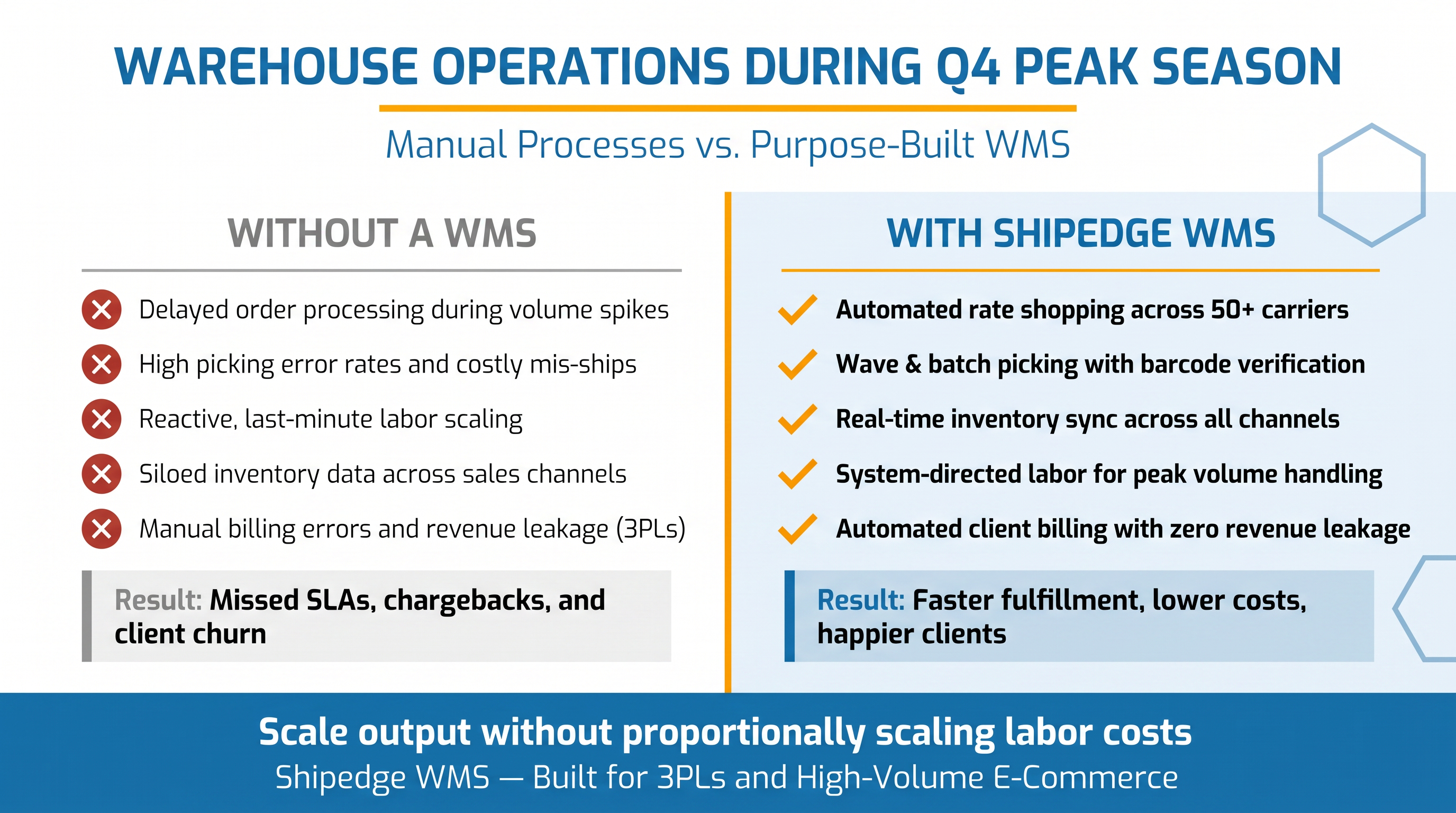
Comparison of manual warehouse operations versus Shipedge WMS during Q4 peak season
To truly master warehouse supply chain management during the intense pressure of peak season, you need highly specialized, purpose-built technology that is designed to scale effortlessly. Shipedge provides a comprehensive, cloud-native Warehouse Management System designed specifically to handle the incredibly complex, high-velocity needs of modern 3PL software providers and rapidly growing omnichannel e-commerce brands.
Shipedge intelligent software automates the critical, time-consuming supply chain operations that typically bog down manual warehouses and legacy systems. From algorithmic intelligent routing and highly optimized wave picking logic to automated, rules-based rate shopping for outbound carrier shipments, the platform is engineered to maximize efficiency at every single step of the fulfillment journey. Real-time, continuous inventory syncing across all connected sales channels definitively prevents the nightmare of overselling, while the seamlessly integrated Order Management System ensures that every single order is processed accurately, routed to the correct facility, and shipped on time, every time. By strategically implementing Shipedge before the Q4 rush begins, modern warehouses can exponentially scale their operational output without proportionally scaling their expensive labor costs.
Warehouse supply chain management involves comprehensively overseeing all operations within a physical distribution center, including receiving inbound freight, inventory storage and slotting, order picking, packing, and outbound shipping. It is a highly critical, execution-focused component of the broader global supply chain that ensures products are fulfilled accurately and delivered to end customers on time, directly impacting brand reputation and profitability.
A supply chain job involves managing the complex flow of physical goods, critical data, and financial transactions from initial raw material procurement all the way to final product delivery to the consumer. Roles within this expansive field vary widely and include warehouse managers, logistics coordinators, demand forecasting planners, inventory optimization analysts, and strategic procurement specialists, all working together to ensure efficiency.
Managing a supply chain during the intense pressure of peak season requires highly accurate demand forecasting, continuous real-time inventory visibility, aggressively optimized warehouse workflows, and highly scalable, cross-trained labor plans. Utilizing a robust, modern Warehouse Management System (WMS) is absolutely essential to automate repetitive processes, reduce human error, and handle exponentially increased order volumes efficiently.
A WMS fundamentally improves supply chain operations by providing real-time, granular inventory tracking, automating complex order routing, algorithmically optimizing picking paths to reduce travel time, and virtually eliminating manual data entry errors. This massive increase in operational efficiency directly leads to significantly faster order fulfillment, substantially lower operational labor costs, and consistently higher customer satisfaction rates.
Peak season in the supply chain refers to the concentrated period of highest consumer demand and maximum order volume, typically occurring in Q4 (October through December). This surge is driven by major holiday shopping events like Black Friday, Cyber Monday, and Christmas, requiring logistics networks to operate at maximum capacity.
Accurate demand forecasting is critical because it allows warehouse managers to proactively align their physical inventory levels and labor schedules with anticipated order volumes. By analyzing historical data and market trends, warehouses can optimize storage slotting for high-velocity SKUs and prevent devastating stockouts during critical sales periods.
Third-party logistics (3PL) providers handle fulfillment for multiple distinct brands simultaneously, making their operations exponentially more complex than a single-brand warehouse. Specialized supply chain software automates complex billing, seamlessly integrates with dozens of disparate shopping carts, and provides multi-tenant inventory visibility, allowing 3PLs to scale their client base profitably without operational chaos.
Mastering the intricacies of warehouse supply chain management is the absolute key to not just surviving, but actively conquering the Q4 peak season. By implementing proactive, data-driven strategies right now—such as highly accurate demand planning, aggressively optimizing physical fulfillment workflows, and ensuring complete, real-time inventory visibility—you can transform the typically chaotic holiday rush into a highly organized, highly profitable period of accelerated growth.
The fundamental difference between a wildly successful peak season and an incredibly stressful, unprofitable one almost always comes down to the quality of the technology running your daily operations. A robust, modern, cloud-based system effectively eliminates hidden bottlenecks, empowers your workforce to operate at peak efficiency, and ensures that every single customer receives their important holiday orders accurately and on time.
Ready to comprehensively optimize your warehouse supply chain management for Q4 and beyond? Shipedge gives ambitious e-commerce brands and modern 3PLs the powerful technological tools they need to scale efficiently, reduce operational costs, and completely dominate peak season. Book a demo today and see exactly how our platform works to streamline your fulfillment.