EN │ ES
Supply Chain
October 15, 2026
Shipedge
13 min read

A fuel surcharge rate is a dynamic percentage fee added by parcel and freight carriers to baseline shipping rates to offset fuel market volatility. Carriers calculate this fee weekly by indexing contract matrices against the U.S. Energy Information Administration (EIA) national on-highway diesel fuel price report.
A sudden energy supply contraction is rattling commercial shipping networks. On October 15, 2026, the EIA reported a massive draw in commercial eia crude oil inventories, dropping by 8.557 million barrels for the week ending October 9. This contraction follows a 3.186 million barrel draw reported seven days earlier. These consecutive inventory declines caught commodity markets off guard, tightening distillate availability as holiday fulfillment ramps up.
For logistics providers and e-commerce merchants, this disruption represents an immediate financial threat. Your carrier fuel surcharge rate is not static. FedEx, UPS, and freight carriers adjust fuel matrices weekly based on federal fuel indices. When upstream refinery inventories drop, diesel crack spreads widen quickly, hitting shipping invoices two weeks later.
The timing creates serious friction for holiday fulfillment budgets. Shippers already face peak surcharges and tariff increases. Now, an escalating shipping fuel surcharge compounds costs across every outbound parcel. Shippers who understand how carriers calculate surcharges can implement automated routing to protect operating margins before Q4 holiday billing peaks.
To manage volatile transportation costs, carriers rely on dynamic pricing mechanisms. A carrier's fuel surcharge rate is a variable percentage applied to baseline transportation charges and select accessorial fees. Instead of continuously modifying base contracts when oil fluctuates, carriers use dynamic index tables to shift volatile fuel expenses directly to shippers.
The current price pressure originated in physical distribution hubs. According to official data from the U.S. Energy Information Administration, the drop in eia crude oil inventories totaled 8.557 million barrels in early October. Analysts projected a build as refineries entered maintenance. Instead, heavy demand triggered the sharpest single-week drop recorded in late 2026, severely constraining regional diesel storage.
Transportation networks consume massive quantities of refined petroleum daily. Fleets cannot absorb sudden price spikes without compromising cash flow. Consequently, carriers link fuel surcharge tables to audited federal price indices to automate cost recovery. Spot crude supplies tighten at regional storage hubs, wholesale diesel climbs as refiners pass through feedstock costs, and carriers update their operational carrier fuel surcharge index to adjust customer billing schedules.
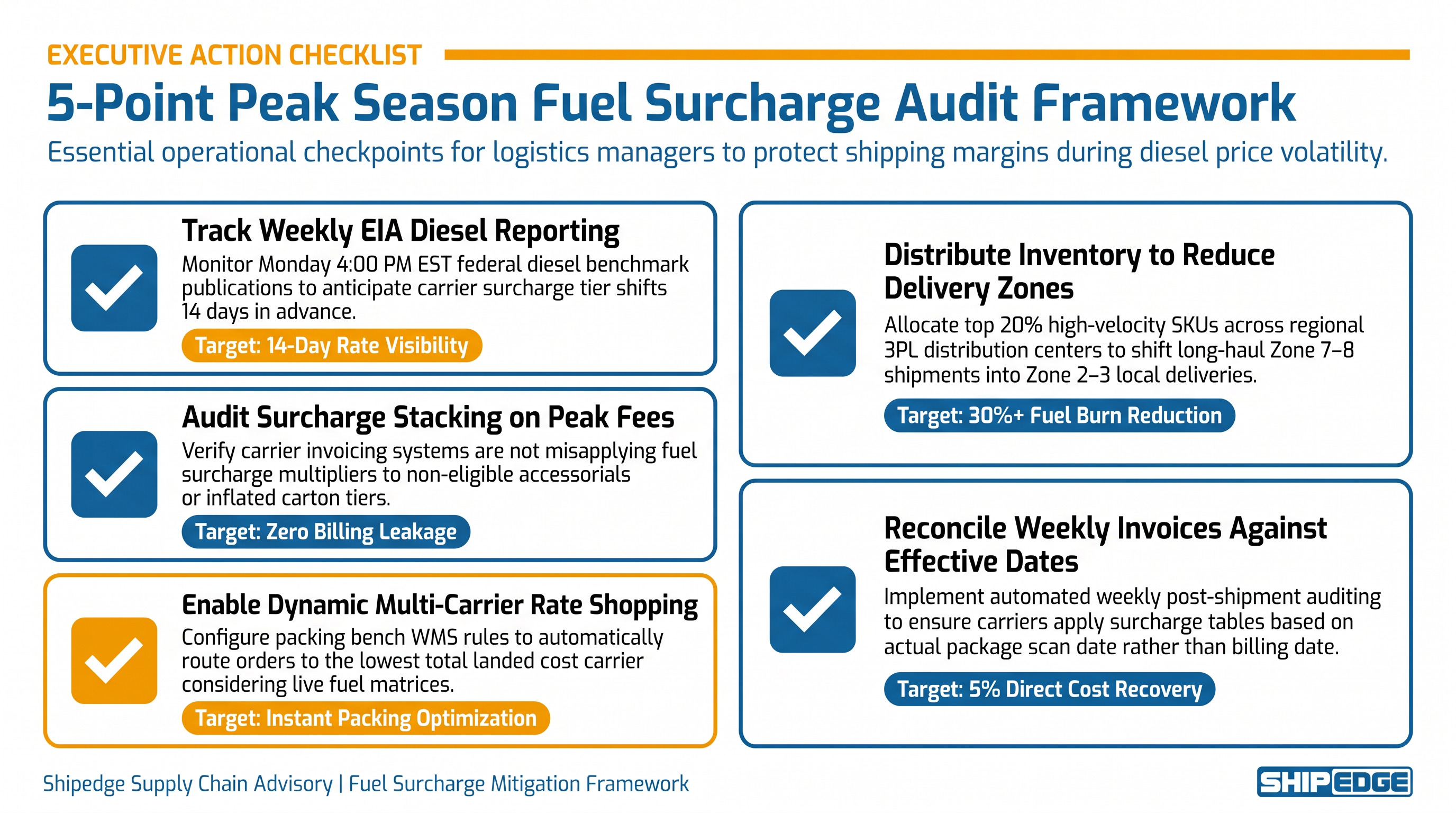
Every Monday, the EIA publishes its National U.S. On-Highway Diesel Price index, representing the average retail price per gallon across domestic truck stops. Carriers do not assess literal dollar fuel increases on parcels. Instead, they apply a tiered percentage table to total transportation invoices. If the on-highway diesel fuel price increases by twenty cents, the lookup table triggers an automatic upward bracket shift, increasing the active diesel fuel surcharge applied to subsequent billing cycles based on the published carrier fuel surcharge index.
Carrier pricing structures appear straightforward on paper, but underlying formulas favor carriers during inflationary periods. Shippers must examine published schedules to understand how baseline movements compound.
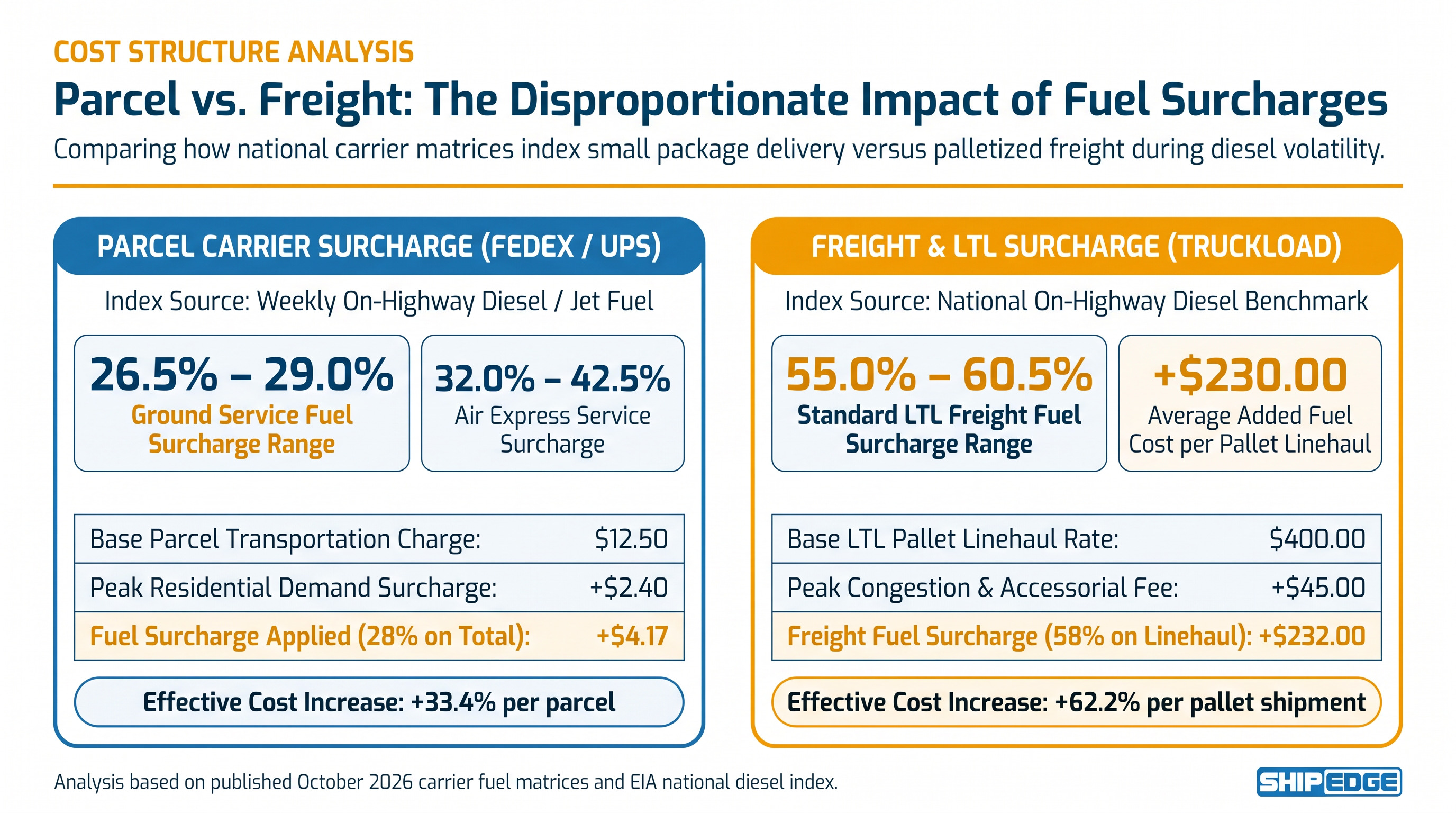
The published fedex fuel surcharge operates across distinct index tiers depending on transport mode. FedEx Ground ties surcharge percentages to weekly diesel averages, whereas FedEx Express pegs to jet fuel spot prices. The standard FedEx fuel surcharge table reveals significant divergence: Ground surcharges fluctuate between 26.5% and 29.0%, Express domestic services range between 32.0% and 42.5%, and FedEx Freight LTL shipments absorb surcharges near 58.6%. Crucially, FedEx applies fuel percentages to dimensional weight charges and residential delivery fees.
The standard ups fuel surcharge follows a similar index mechanism, but its trigger thresholds feature subtle matrix adjustments. UPS Ground aligns with the EIA national diesel benchmark, updating weekly schedules every Monday. Over recent quarters, carriers have compressed trigger bands. Understanding each carrier's proprietary fuel surcharge formula is critical for high-volume shippers moving thousands of packages weekly. Shippers must dissect this fuel surcharge formula to identify where tier jumps occur.
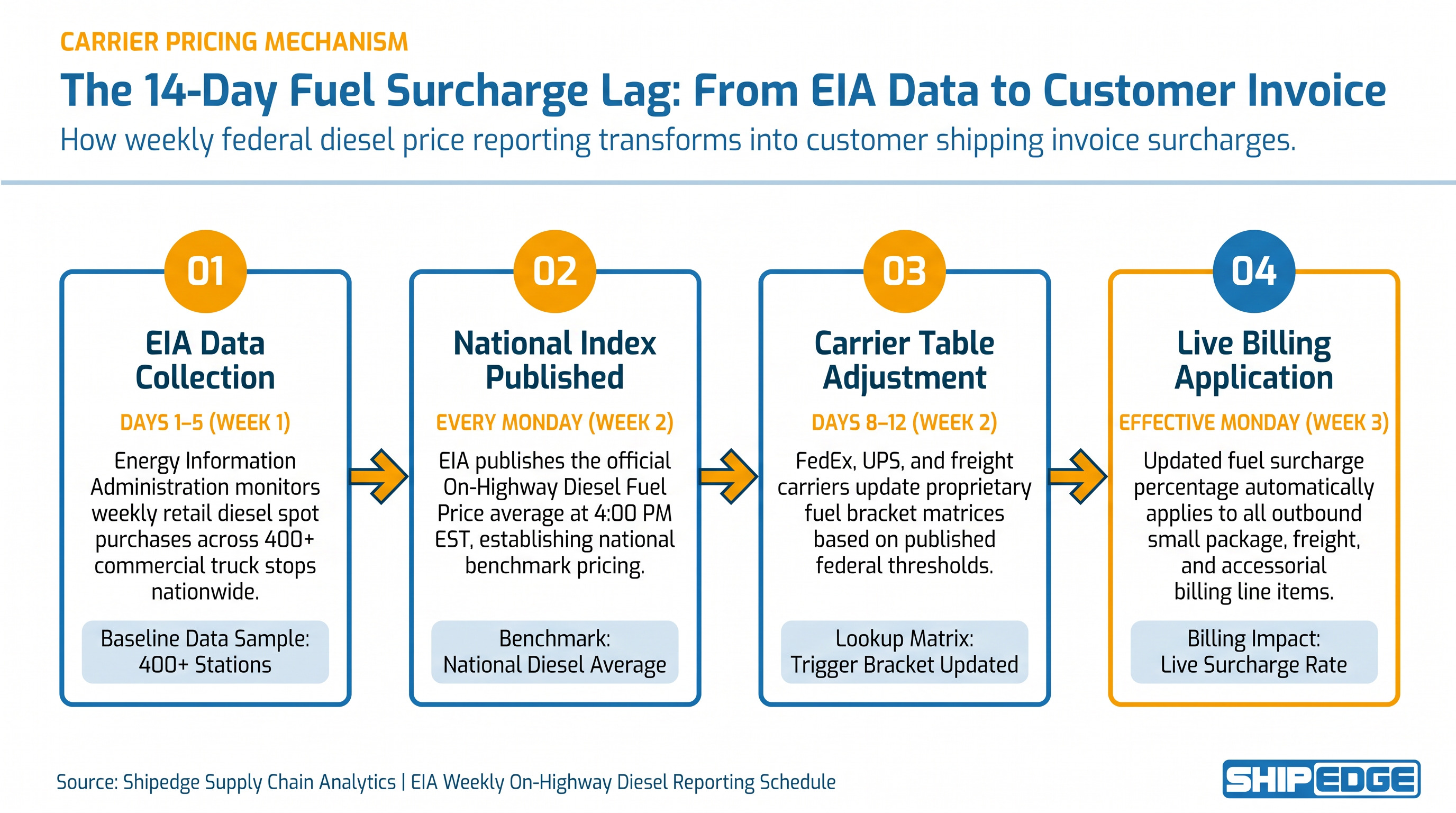
Shippers often wonder why invoices do not immediately reflect daily fuel price jumps. Major carriers utilize a deliberate two-week reporting delay for every fuel surcharge calculation: Week One involves EIA data collection, Week Two brings federal publication, and Week Three applies the rate to customer billing matrices. Performing a proactive fuel surcharge calculation allows logistics directors to prepare fulfillment budgets before carrier invoice tables officially reset.
Rising transportation surcharges are painful during normal operational months. However, an unexpected spike in October creates an unprecedented financial hazard because it coincides with peak holiday fulfillment.
Carrier fuel surcharges are mathematically multiplicative, calculating against both the base rate and accessorial fees. During Q4, parcel networks assess peak season demand surcharges across residential deliveries. Carriers determine the base rate, add the peak surcharge, and apply the active 28% fuel surcharge rate against the combined subtotal. As documented by analysts at Supply Chain Dive, this surcharge stacking mechanism inflates landed costs, forcing shippers to pay elevated fuel percentages on seasonal peak season demand surcharges.
While parcel shippers face margin pressure, palletized freight faces steeper escalations. The standard freight fuel surcharge climbs at nearly double the rate of parcel delivery. Truckload and LTL carriers consume significantly more fuel per revenue-mile. When diesel climbs, freight tables frequently exceed 55% to 60%. A distribution pallet costing $400 in baseline freight can incur $230 in fuel fees alone. Shippers moving inventory to fulfillment hubs absorb this freight cost increase before retail orders are picked.
Third-party logistics providers operate under tight service agreements. Cost-plus billing passes carrier fees directly to brand clients, causing friction when merchant bills climb, whereas bundled models force fulfillment providers to absorb unexpected invoice increases. Modern fulfillment providers using dedicated 3PL software maintain transparent, automated billing rules that accurately reflect carrier price index movements in real time, preventing administrative reconciliation disputes.
Logistics managers cannot control global crude inventory levels or alter carrier corporate pricing policies. However, high-volume shippers can deploy proven operational strategies to reduce shipping costs and protect profitability.
Relying exclusively on a single national parcel carrier leaves enterprises vulnerable to unilateral tariff changes. Shippers with blended carrier portfolios consistently achieve lower net expenses during fuel spikes. By splitting volume across multiple providers, organizations gain operational leverage. Major carriers compete on customized fuel discount tables during contract reviews. Furthermore, regional parcel carriers maintain lower fuel index baselines than national carriers, helping companies secure more competitive 3pl shipping rates across core lanes.
Regional carriers such as OnTrac, LaserShip, and GLS operate clustered sorting networks with shorter average linehauls, keeping fuel consumption per package lower. Diverting Zone 2 and Zone 3 packages to regional networks creates instantaneous relief against steep national fuel matrices.
Transit distance directly dictates fuel consumption. Packages moving across eight zones burn exponentially more fuel than shipments delivered locally. To offset an aggressive shipping rate increase, smart supply chains position fast-moving inventory across regional fulfillment nodes. Palletized freight moves via consolidated truckload to regional distribution centers before peak season, allowing final orders to ship locally via short-haul ground services and eliminating expensive air express surcharges.
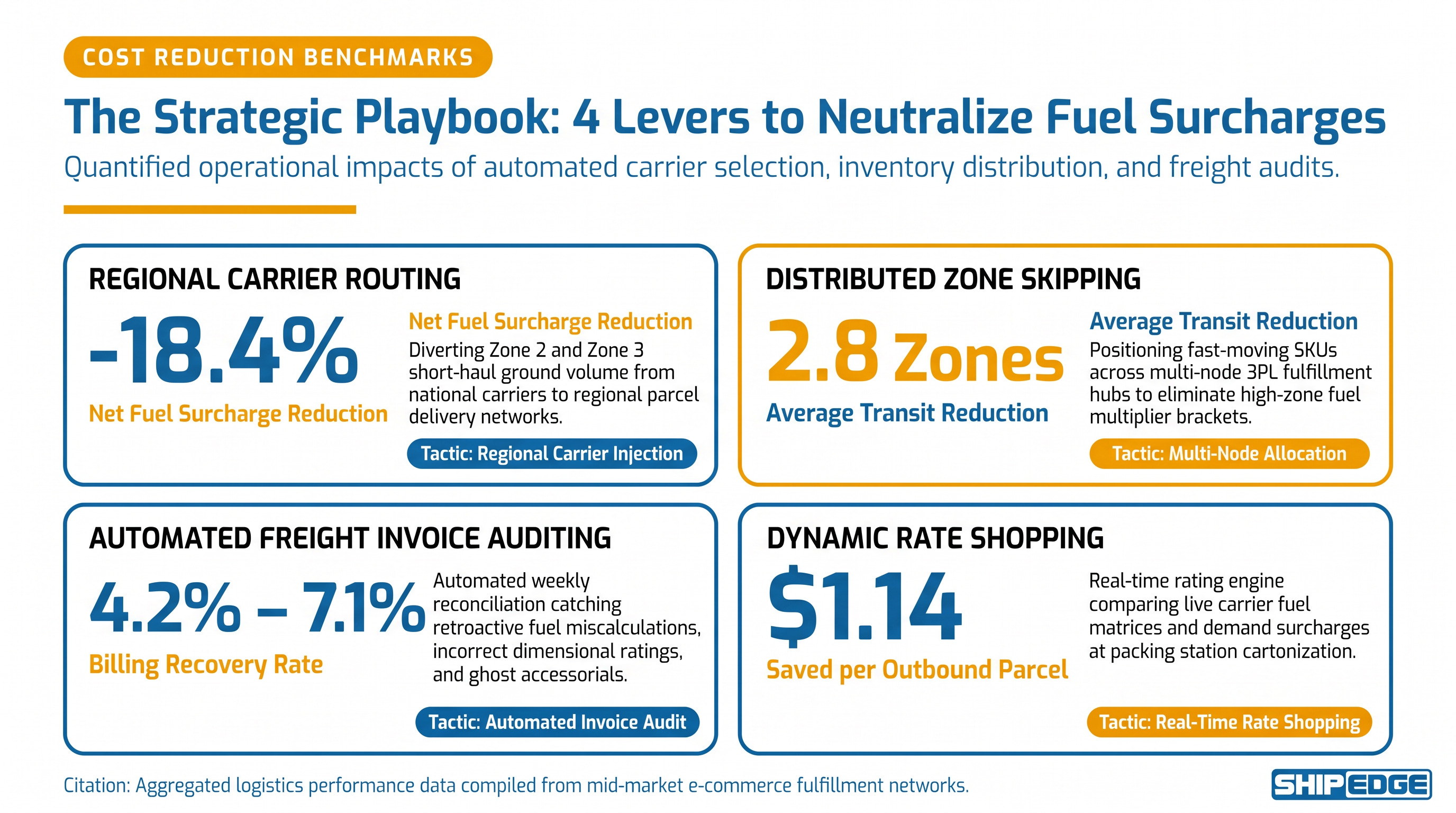
Carrier billing errors are remarkably frequent during high-velocity shipping periods. Fuel surcharges are frequently misapplied due to incorrect dimensional weighting or erroneous zone assignments. Shippers should implement weekly automated freight audits to verify that carriers applied the correct weekly fuel percentage corresponding to the actual ship date, recovering capital to reduce shipping costs.
Manual rate evaluation cannot keep pace with weekly carrier fuel updates across thousands of daily orders. Forward-thinking fulfillment operations leverage integrated software to automate cost-containment rules.
Modern logistics execution requires dynamic rate shopping software embedded directly within packing workflows. When an order reaches the pack station, an intelligent warehouse management system calculates landed shipping costs across every integrated carrier account in real time. Crucially, modern rating engines evaluate the base rate, active peak surcharges, dimensional weight rules, and current fuel surcharge rates simultaneously. If FedEx Ground incurs an elevated surcharge this week while a regional carrier offers equivalent transit at a lower rate, the system prints the regional label, protecting bottom-line margins through intelligent multi-carrier shipping.
In modern multi-channel fulfillment environments, solutions such as OmniOrders provide specialized order routing across channels, ensuring orders route to the warehouse closest to the customer, shortening delivery zones before shipping labels are printed.
Fulfillment networks operating multiple warehouse facilities rely on algorithmic order allocation to reduce zone transit costs. When an order drops from an online storefront, the routing engine checks inventory across network facilities and calculates transit distance and carrier commitments. The order routes to the facility that fulfills delivery promises at the lowest combined zone and fuel rate. For growing operations requiring granular stock allocations, platforms like BinLogic offer purpose-built warehouse management tools that help mid-market facilities track stock levels across multiple nodes without enterprise overhead, providing an effective barrier against escalating carrier fuel tariffs.
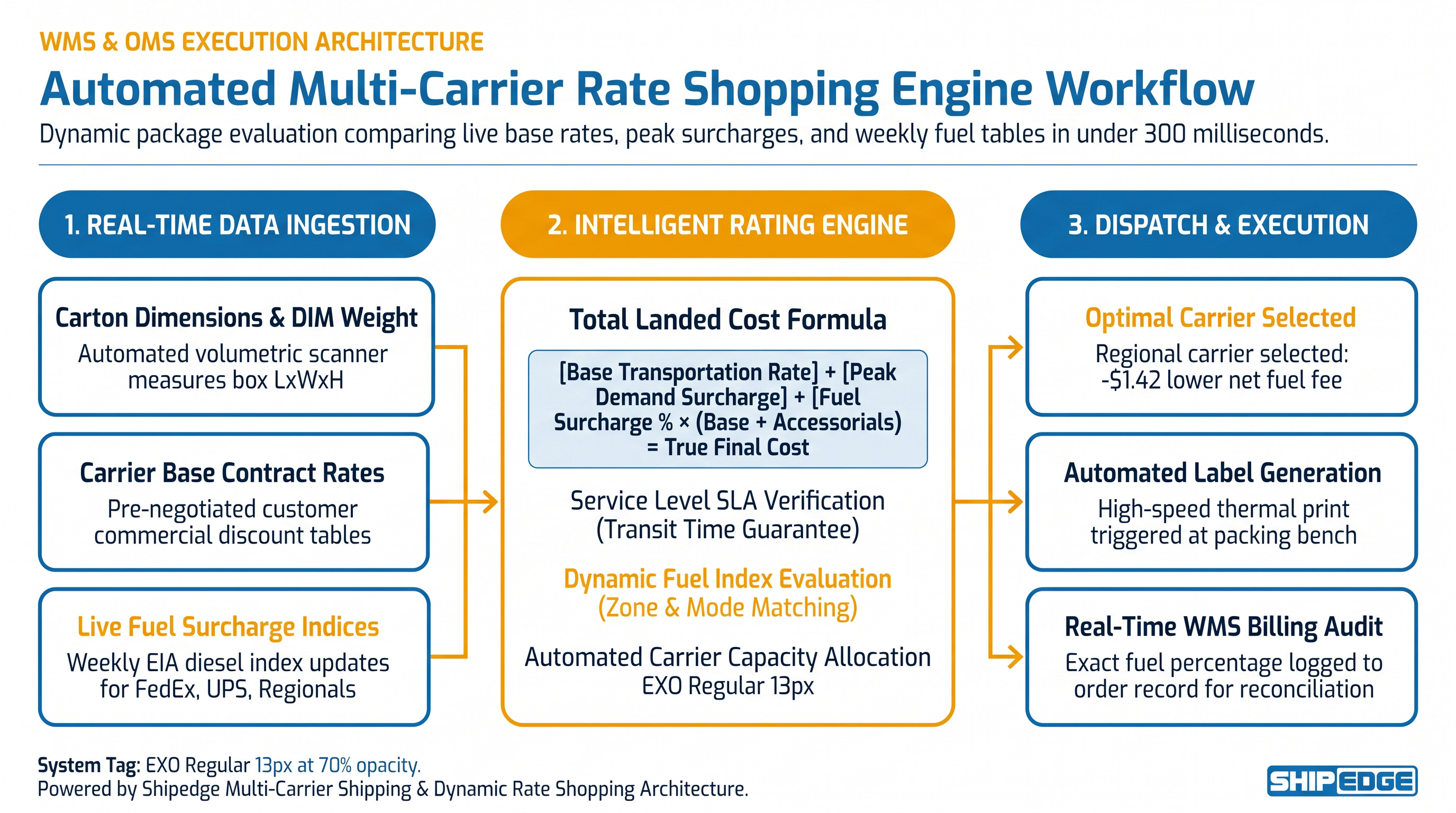
Enterprise agility requires tight coordination between inventory storage, cartonization algorithms, and multi-carrier shipping execution. Automated cartonization features within advanced WMS platforms calculate precise box dimensions before picking begins, preventing oversized packaging that triggers punitive dimensional weight surcharges. Pairing every carton with real-time rate shopping software insulates high-volume warehouses from petroleum shocks, transforming unpredictable carrier surcharges into a managed operational variable.
The October 15, 2026 crude oil inventory report is a clear market signal: fuel cost volatility will remain a defining challenge throughout Q4 peak season. When petroleum reserves drop unexpectedly, carriers adjust their pricing matrices, and shippers absorb the financial fallout.
Protecting your fulfillment margins requires proactive operational adjustments rather than passive acceptance. Shippers who diversify carrier partnerships, shorten shipping zones through distributed fulfillment, and automate rate shopping at the packing station consistently outperform competitors who remain locked into single-carrier duopolies.
Now is the time to evaluate your shipping architecture before holiday delivery volumes peak. Analyze your carrier invoices, review your dimensional cartonization rules, and integrate intelligent shipping software that shops for optimal rates on every single parcel.
Ready to protect your fulfillment margins from rising carrier surcharges? Shipedge gives e-commerce brands and 3PLs the complete omnichannel software to automate multi-carrier rate shopping, eliminate packaging waste, and maintain total inventory visibility across your network. Book a demo today and see how our integrated platform keeps your fulfillment operations profitable.
A fuel surcharge rate is a dynamic percentage fee added by parcel and freight carriers to standard transportation charges. Carriers utilize this surcharge to offset fluctuating fuel expenses without continuously altering baseline contract tariffs. The fee fluctuates weekly or monthly based on published federal petroleum indices, shifting petroleum market volatility directly to commercial shippers and merchants.
Carriers calculate fuel surcharges by cross-referencing national fuel price indices with proprietary contractual fuel tables. For ground transportation, carriers monitor the weekly national on-highway diesel fuel price published by the Energy Information Administration. For air services, carriers reference regional jet fuel spot prices. The carrier identifies the published price bracket and applies the matching percentage to eligible invoice charges.
FedEx and UPS update their published fuel surcharge percentages weekly, with changes taking effect every Monday. Both major carriers apply a two-week reporting lag between the EIA diesel price collection date and the invoice implementation date. This predictable schedule allows attentive logistics managers to forecast upcoming surcharge adjustments fourteen days in advance.
Parcel fuel surcharges apply to small packages and typically fluctuate between 25% and 35%, indexed against diesel or jet fuel. In contrast, freight fuel surcharges apply to Less-Than-Truckload and Full Truckload shipments, frequently reaching 55% to 60%. Freight operations consume substantially more fuel per pound transported, resulting in significantly steeper surcharge percentages for heavy palletized cargo.
High-volume shippers and third-party logistics providers can negotiate custom fuel surcharge schedules during annual contract reviews. Carriers frequently agree to customized fuel tables, modified index thresholds, or percentage discounts off published fuel matrices in exchange for guaranteed volume commitments. Shippers who regularly audit their shipping profiles hold substantial leverage during carrier contract negotiations.
Shippers can immediately reduce shipping costs by deploying automated multi-carrier rate shopping software at the packing bench. Integrating regional parcel carriers, optimizing box dimensions to prevent dimensional weight penalties, and distributing inventory across regional nodes to shorten shipping zones deliver instant savings. Conducting weekly freight invoice audits also recovers significant capital from incorrectly applied carrier fees.