EN │ ES
Shipping
October 15, 2026
Shipedge
16 min read
Commercial carrier rates are tiered pricing schedules negotiated between volume shippers and logistics providers, determined by annual freight spend, package density, delivery zones, and accessorial surcharges. While single-carrier loyalty programs promise steep volume discounts, automated multi-carrier rate shopping consistently delivers superior cost savings by eliminating carrier tier penalties.
Southwest Airlines just rewrote the playbook on customer loyalty. By announcing the retirement of its iconic Rapid Rewards tiers—replacing the familiar A-List structure with a corporate three-tier hierarchy of Silver, Gold, and Platinum—the carrier sent shockwaves through both consumer travel and enterprise procurement circles. For logistics directors, warehouse executives, and e-commerce brand founders, this announcement represents far more than changes to boarding groups or seat selection.
The structural overhaul at Southwest signals a massive, cross-industry transformation in how transportation giants price access, reward loyalty, and protect operating margins. Whether moving passengers at 35,000 feet or moving parcel freight through national ground networks, transportation networks operate on identical economic principles. Carriers design tiered loyalty programs to capture 100% of your shipping volume while steadily raising the cost of secondary services.
As supply chains enter peak shipping season, businesses face intense margin pressure from annual General Rate Increases and escalating accessorial fees. Relying on paper discounts from a single provider is no longer a viable financial strategy. Understanding how corporate tier restructuring influences real-world carrier rates gives supply chain leaders the competitive leverage required to protect bottom-line profits.
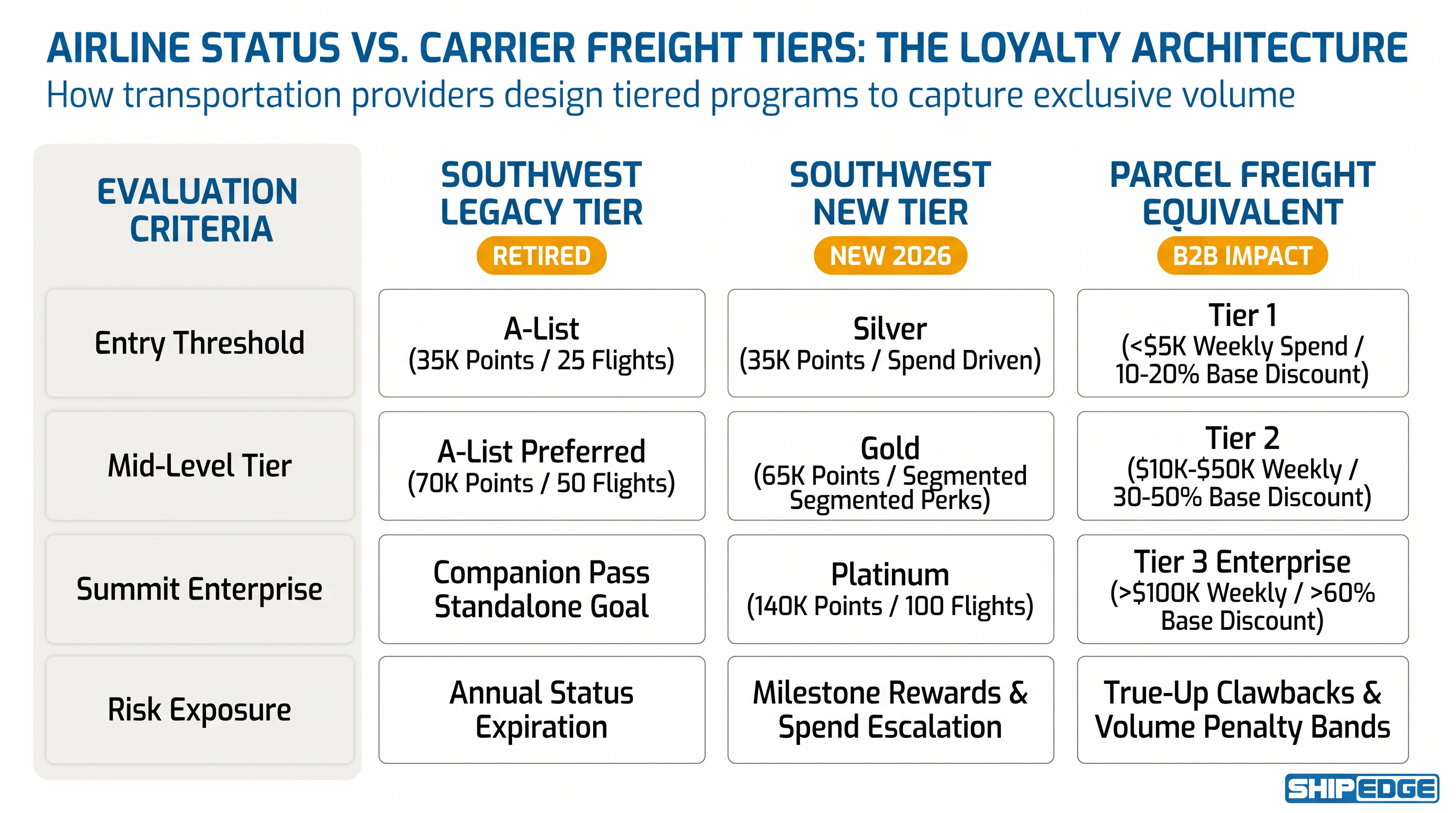
Southwest Airlines built an industry-leading reputation on simplicity, flexibility, and customer-first policies. For decades, business travelers relied on straightforward qualification metrics to secure perks like priority check-in and standby privileges. The newly unveiled framework completely restructures that relationship, establishing higher spending thresholds and introducing segmented corporate milestones that fundamentally alter traveler economics.
The airline is officially phasing out its traditional tier names to establish a standardized Silver, Gold, and Platinum structure. Under the revised framework, reaching Silver requires 35,000 Tier Qualifying Points or 25 flights, mapping roughly to the former entry tier. Meanwhile, Gold status now demands 65,000 points or 50 flights, establishing a direct equivalent to the legacy a list preferred level.
The true disruption sits at the top tier: Platinum status. Unlocking Platinum requires an unprecedented 140,000 qualifying points or 100 flights within a calendar year. Travelers who once relied on a list preferred standing must now double their travel activity or accept a diminished status tier. This aggressive tiering creates a wide gulf between casual business travelers and enterprise road warriors.
To keep travelers engaged between tiers, Southwest introduced incremental milestone rewards. Reaching 95,000 points unlocks interim travel passes, dangling tangible incentives well before full status achievement. At the summit, Platinum status unlocks unlimited companion passes, priority boarding, and premium seating access.
These structural incentives borrow heavily from freight and parcel contracts. Transportation providers intentionally dangle extraordinary perks at the highest volume brackets to discourage shippers from splitting volume across competing networks.
This restructuring reflects a structural shift toward revenue-based qualification over operational frequency. By linking point accumulation directly to premium fare classes and co-branded credit card expenditure, the airline prioritizes yield over simple volume.
Industrial parcel carriers employ identical tactics across enterprise agreements. Shippers frequently discover that volume tier thresholds quietly drift upward each contract cycle, demanding greater annual revenue just to maintain existing baseline discounts and competitive business shipping rates.
At first glance, airline passenger programs appear completely separate from parcel fulfillment operations. Yet both sectors rely on the exact same mathematical revenue management systems. When transportation carriers modify their status architecture, they are stress-testing how much friction enterprise customers will tolerate before seeking competitive alternatives.
Both passenger airlines and freight carriers manage finite network capacity constrained by fixed departure schedules and physical vehicle dimensions. To maximize yield per cubic foot, carriers implement tiered shipping rates that reward enterprise consistency while penalizing operational variance.
A corporate procurement team purchasing domestic airline tickets operates under the same volume-tier mechanics as a 3PL routing forty thousand weekly parcel cartons. In both scenarios, carriers promise substantial upfront rebates in exchange for exclusivity covenants, applying tiered shipping rates that lock shippers into rigid commitments.
Single-carrier loyalty creates an insidious psychological trap for logistics managers. Shippers consolidate package volume with a primary national carrier, chasing an elusive top-tier shipping discount on base transport fees.
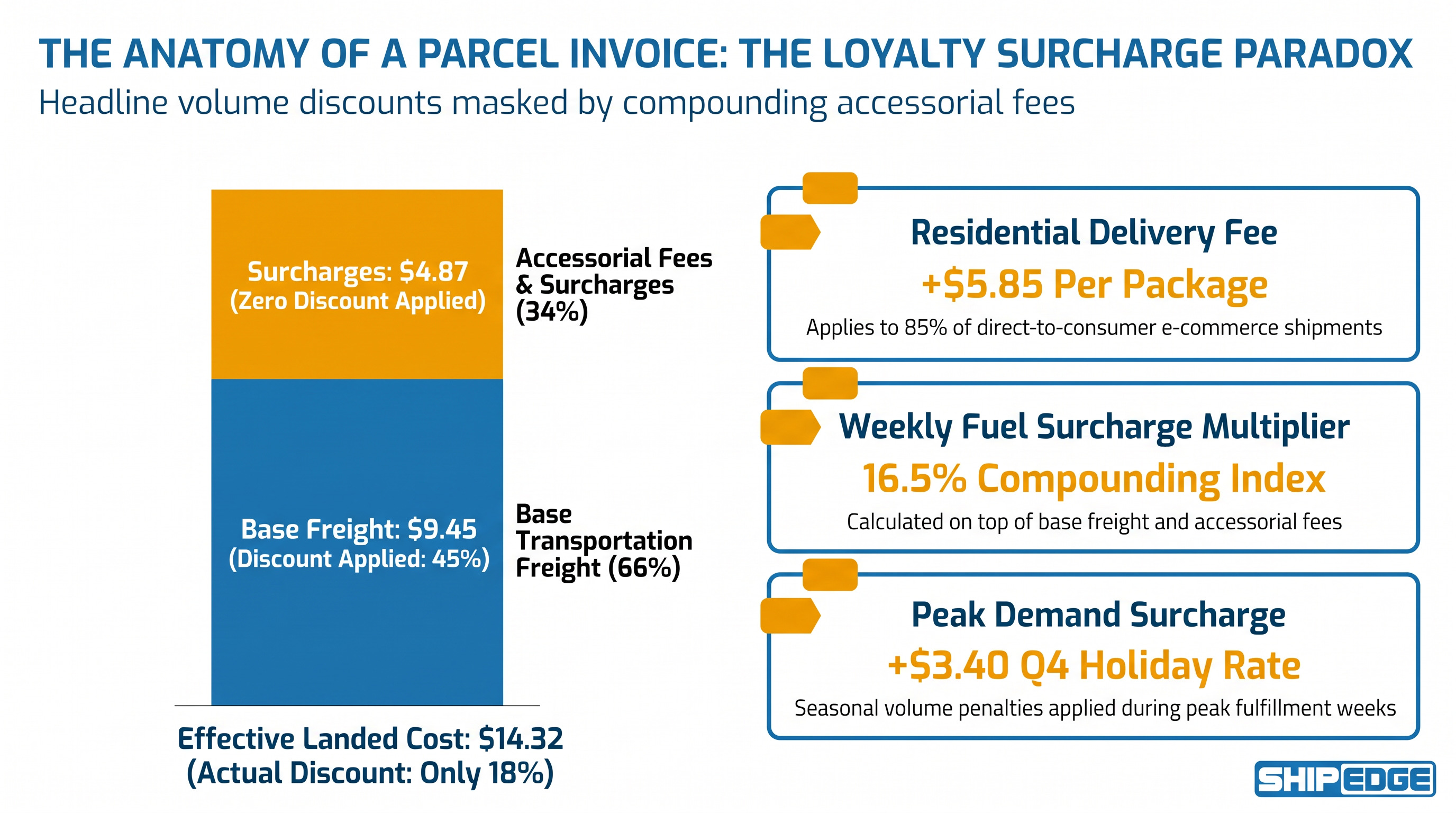
However, industry data consistently shows that accessorial fees and fuel surcharges now account for 25% to 40% of total invoice costs for parcel shippers — with direct-to-consumer operations reporting the highest surcharge exposure due to residential delivery fees alone. Carriers routinely grant an attractive shipping discount on base freight while quietly clawing back revenue through residential delivery fees, delivery area surcharges, and peak handling fees. Shippers fixate on headline discount percentages while their actual landed costs surge.
Volume-tiered carrier agreements carry severe contractual traps. If seasonal volume dips or an inventory disruption causes your weekly spend to drop below contract thresholds, carriers trigger revenue-band adjustments.
Falling from a top freight tier to a lower bracket can instantly increase your baseline transportation costs — shippers commonly report increases ranging from 8% to 15% or more across all service levels when tiers drop mid-contract. Even worse, several national contracts include retrospective true-up clauses that bill businesses retroactively for missed revenue targets. Chasing corporate prestige—whether celebrating southwest elite status on flights or touting top-tier carrier status—frequently blinds decision-makers to the compounding financial liability of single-carrier dependence. Just as losing southwest elite status resets travel perks overnight, dropping a freight tier instantly spikes landed transport costs.
Navigating commercial parcel pricing requires dissecting how major logistics carriers construct their base tariffs. Unlike commercial airline tickets with visible price tags, parcel contracts consist of opaque rate schedules obscured behind customized discount matrices, minimum spend requirements, and fluctuating index charges.
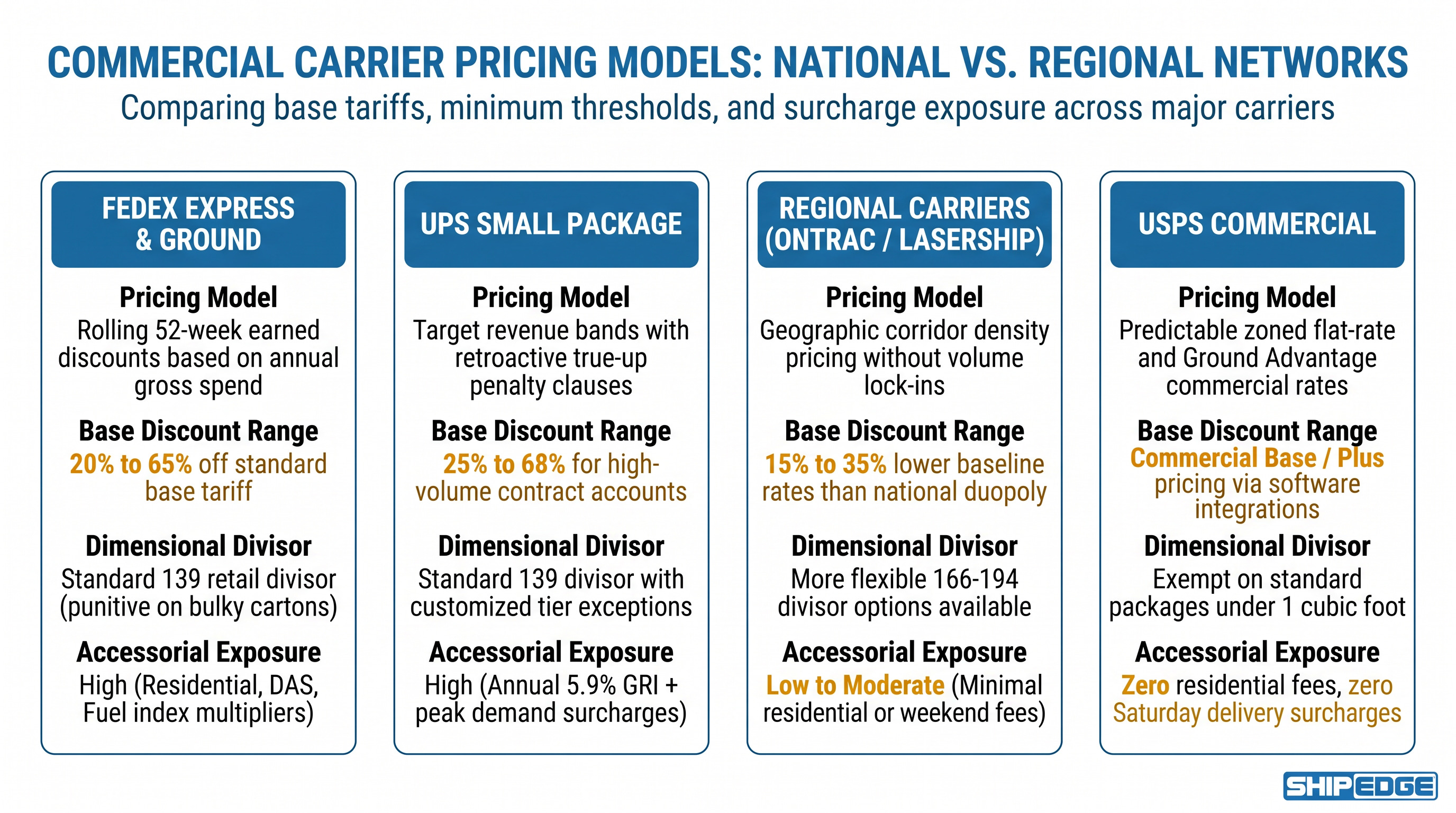
The pricing models of FedEx and UPS rest upon weekly earned discount tiers. Each carrier establishes a master list of standard retail rates, known as the base tariff, published annually.
Shippers receive discounts determined by their rolling 52-week gross shipping spend. While exact contract terms vary, industry negotiation benchmarks generally show:
Crucially, these earned discounts apply almost exclusively to base transportation rates. Securing optimal business shipping rates requires auditing beyond surface tariffs to address package density, delivery zones, and accessorial fees.
Every autumn, parcel giants issue their annual general rate increase, typically averaging between 5.9% and 6.9% across standard services. However, independent shipping cost analyses consistently show that the true financial impact on commercial shippers reaches 7% to 10% or more once accessorial adjustments take effect — because surcharges are applied on top of the base tariff, not instead of it.
Carriers continually adjust fuel surcharge trends, matching weekly diesel and jet fuel indices with aggressive internal multipliers. Tracking shifting fuel surcharge trends is essential because index adjustments compound on top of base transportation tariffs. During fourth-quarter fulfillment, carriers layer on peak season demand surcharges that add several dollars per package during critical holiday fulfillment windows. Unmanaged peak season demand surcharges rapidly wipe out annual margin projections for fast-growing merchants.
To avoid the volatility of national duopoly contracts, forward-thinking shippers increasingly incorporate regional parcel carriers and United States Postal Service programs into their routing mix. Regional carriers operate dense local distribution networks within specific geographic corridors, offering lower base rates and minimal accessorial surcharges.
Meanwhile, USPS commercial ground pricing provides predictable flat rates and exempts shippers from common fees like residential delivery and weekend delivery surcharges. Contrasting national carrier tier requirements against regional carrier capabilities reveals substantial opportunities for immediate cost reduction.
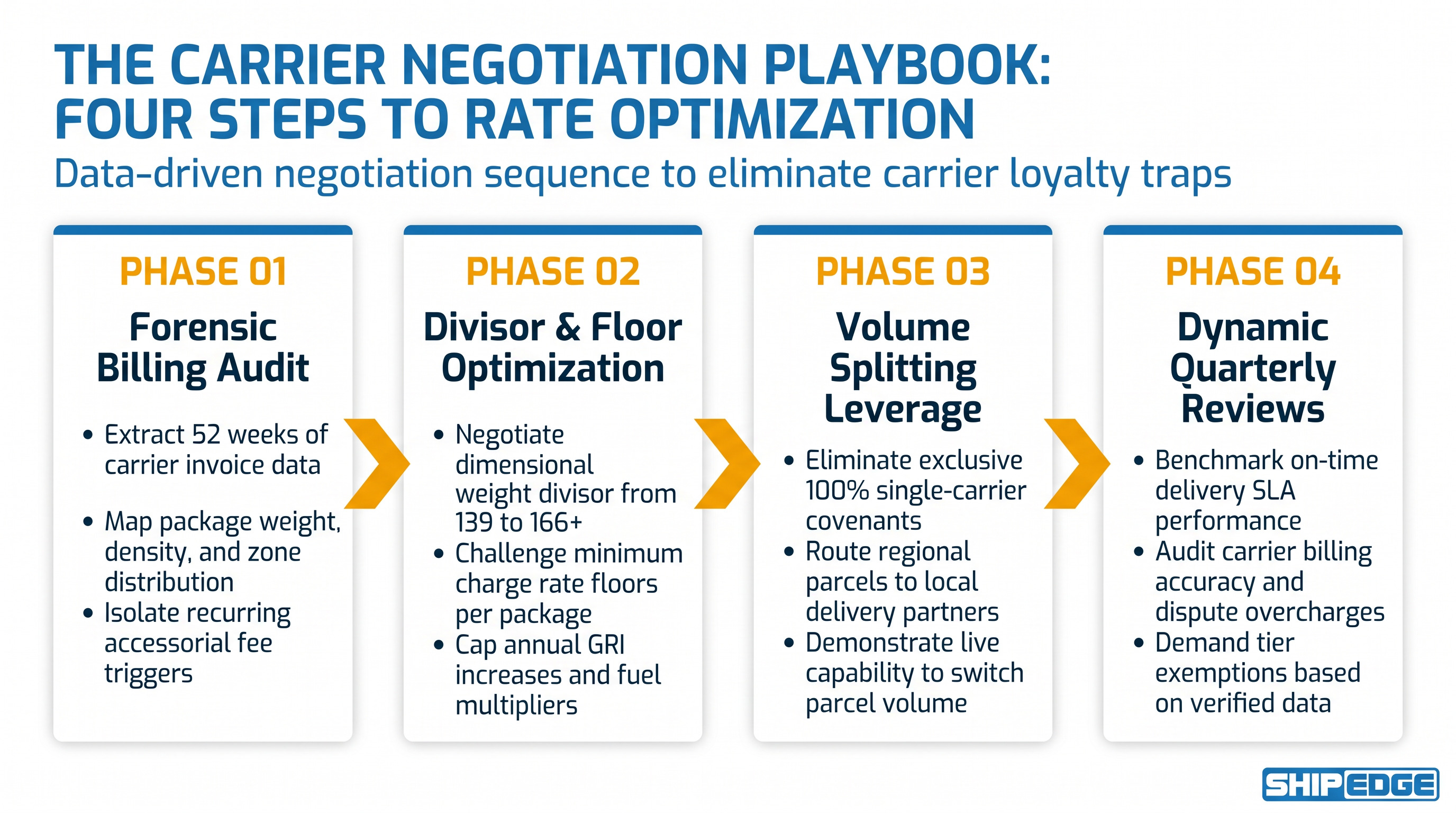
Achieving meaningful reductions in commercial freight expenses requires methodical preparation and comprehensive data analysis. Entering carrier contract talks without granular operational intelligence leaves your organization at a distinct disadvantage. By executing structured carrier rate negotiation, enterprise shippers secure premier tier pricing without accepting restrictive contractual exclusivity.
Effective negotiating shipping rates begins with an exhaustive forensic audit of historical billing invoices. You cannot negotiate effectively until you understand your exact distribution characteristics down to the individual package level.
Identify your core shipping metrics across several operational dimensions:
Armed with this data, your procurement team gains unmatched clarity when negotiating shipping rates with carrier account representatives.
Carriers calculate billable weight using either scale weight or volumetric space, dictated by the contractual dimensional weight divisor. The standard retail divisor is 139, which heavily penalizes lightweight, bulky goods.
Negotiating an improved dimensional weight divisor of 166 or 194 significantly decreases the billable weight of your packages, generating immediate savings on every outbound carton. Similarly, scrutinize contractual minimum charge rules during every carrier contract negotiation. A generous 50% discount provides zero economic value if contract terms dictate a $9.50 minimum package floor on every domestic shipment.
The most powerful tactic in parcel rate negotiation is eliminating carrier complacency. When a carrier recognizes that they hold an exclusive 100% share of your supply chain volume, their incentive to offer aggressive rate concessions vanishes.
Carriers understand that enterprise switching costs are substantial. Demonstrating an active operational capability to route regional freight or lightweight parcels to alternative carriers creates immediate pricing leverage. Executing targeted parcel rate negotiation across discrete service modes proves that your business will dynamically divert volume whenever SLA targets or price points fail.
Modern contract negotiations should never function as a static, multi-year ritual. Instead, institute quarterly carrier business reviews backed by transparent performance scorecards during every ongoing carrier contract negotiation.
Track carrier on-time delivery percentages, billing accuracy rates, and lost shipment claim settlements. Presenting documented carrier service failures provides concrete justification for demanding custom tier exemptions, waived peak surcharges, and expanded volume shipping discounts. When carriers realize that future volume shipping discounts depend on verified performance, service levels improve dramatically.
Chasing top-tier carrier status provides emotional validation, but automated multi-carrier diversification provides financial security. Just as smart investors maintain diversified asset portfolios, sophisticated logistics operations distribute transport volume across a resilient network of national, regional, and postal providers.
Single-carrier dependence exposes your business to catastrophic operational bottlenecks. National parcel networks regularly face severe winter weather disruptions, localized sorting hub backlogs, and aggressive peak season volume caps.
When your warehouse relies exclusively on a single carrier partner, network outages immediately halt outbound customer order shipments. Executing an agile multi carrier shipping strategy allows operations teams to instantly shift distressed volume to unaffected regional networks, maintaining strict customer delivery deadlines without interruption. A well-designed multi carrier shipping strategy also forces carriers to compete aggressively for your daily dispatch volume.
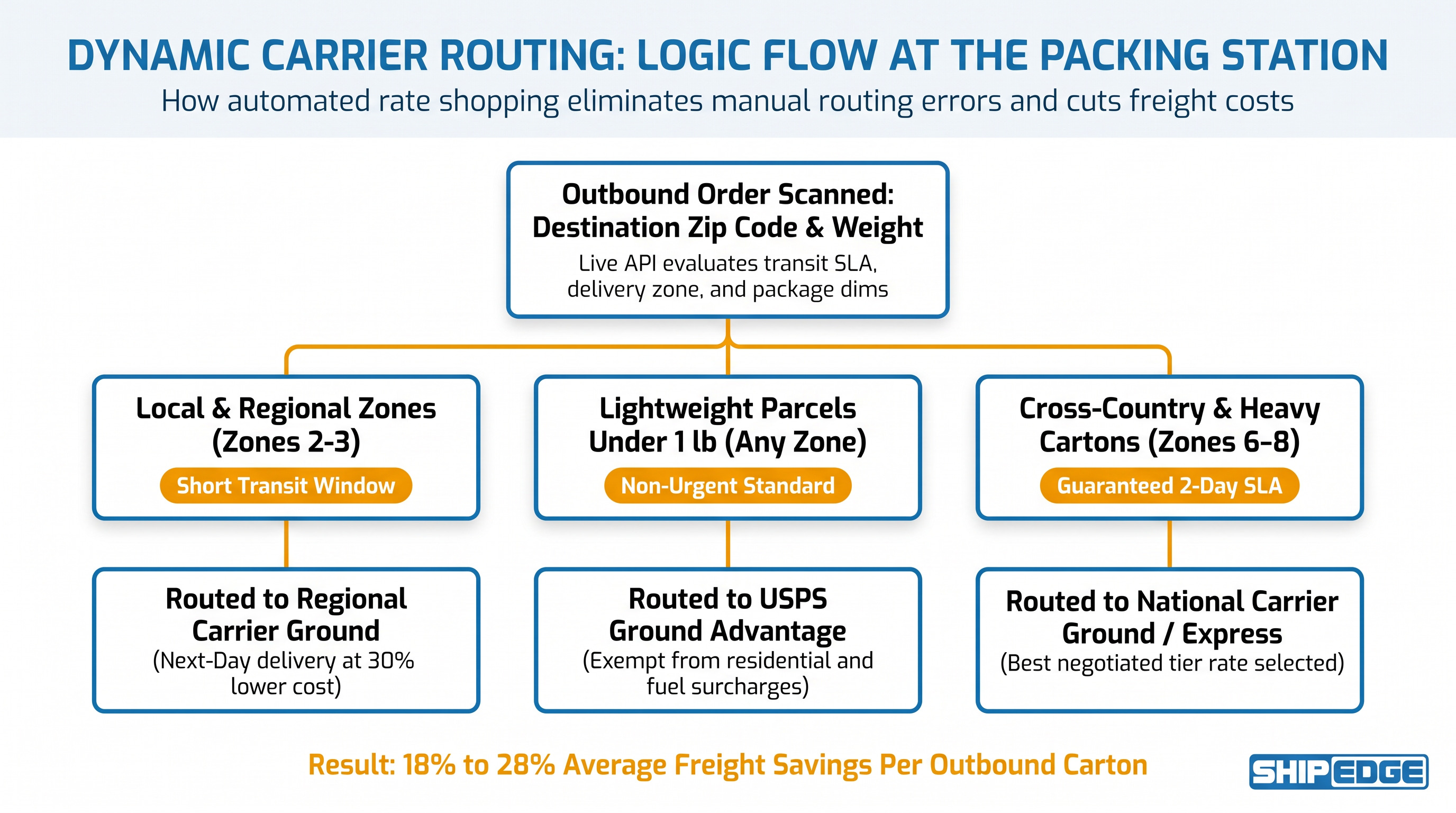
Traditional shipping procedures frequently waste substantial capital by over-purchasing express transit. Because carrier networks overlap geographically, standard ground shipping from a regional facility frequently delivers within the same one-to-two-day delivery window as expedited air transport.
Dynamic carrier selection engines evaluate destination zip codes in real time, routing parcels through cost-effective ground networks whenever transit times match express service standards. This precision matching eliminates unnecessary premium fees while consistently meeting delivery commitments. Shippers adopting intelligent shipping management infrastructure consistently achieve significant operational efficiency gains and lasting shipping cost optimization.
True shipping cost optimization requires seamless communication between fulfillment systems and carrier distribution pipelines. When warehouse management operates in isolation from order routing, fulfillment delays and misallocated inventory inflate transportation expenses.
Purpose-built WMS platforms like BinLogic focus specifically on warehouse operations—inventory tracking, receiving, put-away, and cycle counting—without the overhead of a full ERP system. Meanwhile, modern platforms like OmniOrders are built specifically for multichannel sellers who need real-time order visibility across multiple storefronts and marketplaces.
Connecting warehouse inventory visibility with dynamic rate comparison ensures that orders ship from the optimal fulfillment location using the lowest-cost carrier service available.
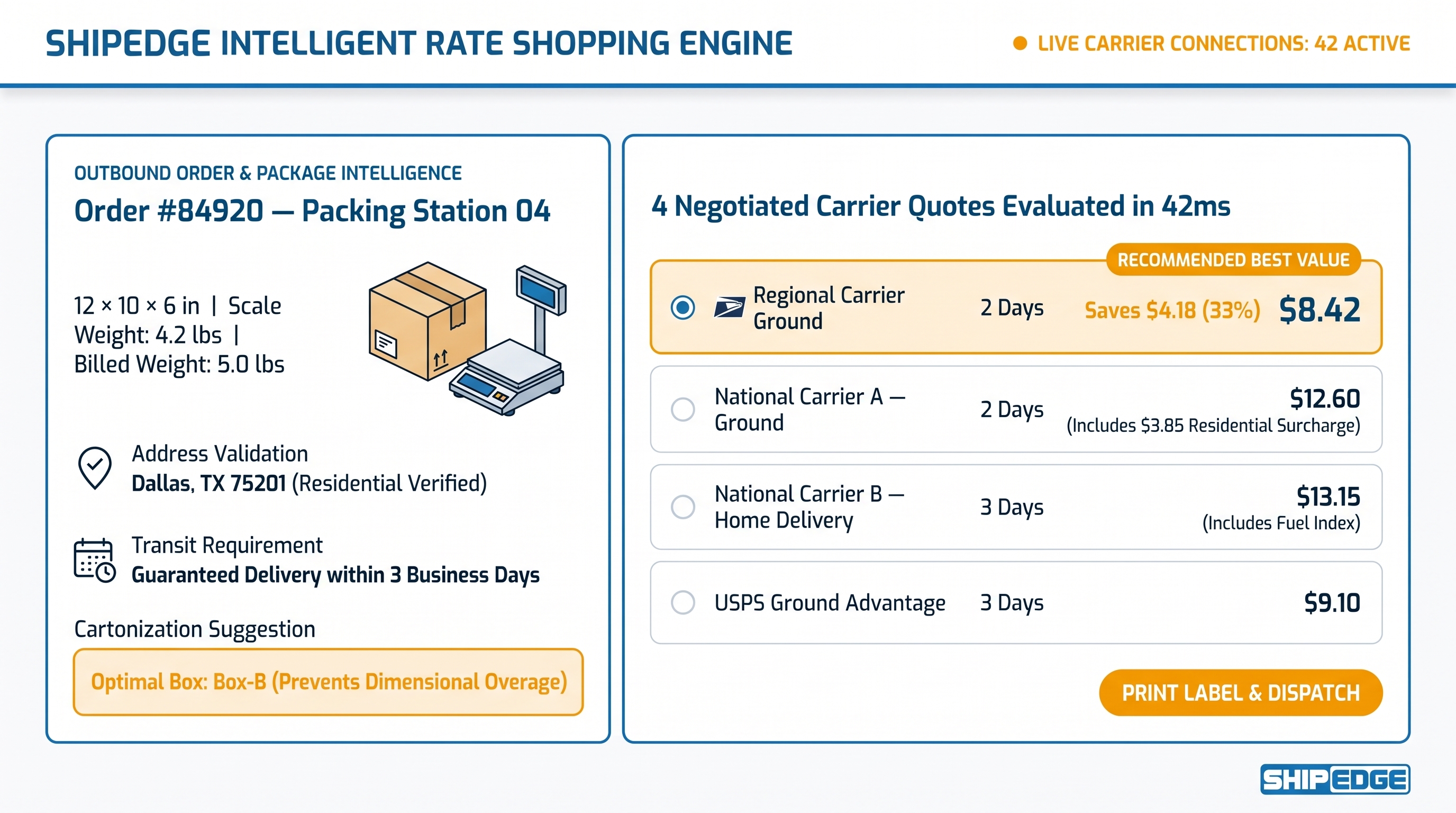
Securing competitive carrier rates is only half the battle; the true operational challenge lies in executing optimal carrier selection on the warehouse floor at enterprise speed. Manual rate comparisons create crippling operational friction during peak fulfillment surges. Shipedge delivers the high-speed automation and algorithmic intelligence required to maximize cost savings across every outbound shipment.
Shipedge's advanced rate shopping engine connects directly to your negotiated carrier contracts, commercial accounts, and regional delivery services through robust carrier integrations. As pack stations scan outbound orders, the platform evaluates package dimensions, scale weight, destination address verification, and delivery transit requirements in milliseconds.
The system automatically selects the lowest-cost compliant carrier service, printing the appropriate shipping label instantly. This automated execution eliminates human routing errors and guarantees that your business captures the absolute best rate on every carton, turning high-stakes carrier rate negotiation into daily warehouse savings.
Beyond lane-by-lane rate shopping, Shipedge empowers shippers to execute sophisticated cost-saving distribution models like zone skipping. By consolidating regional parcel volume into full truckloads and injecting freight directly into destination carrier hubs, businesses bypass costly intermediate transit zones.
Furthermore, Shipedge's cartonization algorithms calculate optimal box dimensions prior to packing, preventing oversized packaging that triggers punitive dimensional weight penalties. Combining dimensional protection with automated zone skipping reduces landed freight expenses substantially across national fulfillment networks.
Every label generated through Shipedge enriches your operational data repository. The platform logs precise shipping expenditures, average transit speeds, delivery success rates, and accessorial surcharges across all integrated providers.
When contract renewal periods arrive, your team possesses comprehensive, audit-verified data documenting your shipping characteristics. Instead of relying on carrier estimates, you present factual volume profiles that empower your negotiators to demand superior tier discounts, lower minimum thresholds, and tailored contractual terms.
Southwest Airlines' dramatic loyalty program transformation delivers an essential masterclass for modern logistics leaders: transportation networks continually restructure rules to optimize their own revenue yields. Corporate loyalty programs are explicitly engineered to encourage emotional attachment while trapping commercial spend inside a single proprietary ecosystem.
In the fast-moving worlds of e-commerce fulfillment and 3PL operations, blind brand loyalty is an expensive liability. As carriers introduce aggressive General Rate Increases and volatile peak surcharges, businesses cannot afford to surrender operational agility for paper discounts that evaporate under accessorial scrutiny. True logistics resilience demands multi-carrier optionality, real-time rate transparency, and automated fulfillment execution.
By establishing automated multi-carrier rate shopping, auditing carrier contracts methodically, and integrating intelligent fulfillment technology, your business eliminates dependency on any single carrier tier. You protect customer delivery promises, lower landed parcel costs, and maintain total control over your fulfillment bottom line.
Ready to optimize your carrier rates and eliminate shipping inefficiencies? Shipedge gives high-growth brands and 3PLs the automated rate shopping, multi-carrier integrations, and warehouse management tools required to cut shipping costs and scale fulfillment effortlessly. Book a demo today and see how our intelligent shipping engine transforms your logistics operations.
Carrier discount tiers operate on rolling weekly or annual gross shipping revenue thresholds established during contract negotiations. As your business shipping volume increases across eligible domestic and international service lanes, carriers apply predetermined percentage discounts against their baseline retail tariffs. However, failing to maintain minimum contractual volume targets triggers automatic tier downgrades. These downgrades immediately reduce your earned discount percentages and sharply raise your outbound shipping expenses across all operational accounts.
Yes, small businesses, growing e-commerce brands, and third-party logistics providers can negotiate custom carrier rates. While national carriers publish standardized pricing tiers, account executives possess substantial discretion to adjust baseline discounts, reduce dimensional weight divisors, and waive residential delivery surcharges. Demonstrating organized shipping volume data and maintaining active operational integrations with alternative regional carriers provides the critical leverage needed to secure institutional-grade discounts during parcel contract talks.
Dimensional weight reflects package density by calculating parcel length multiplied by width multiplied by height divided by a contractual divisor, typically 139. Carriers compare a package's dimensional weight against its actual scale weight and bill customers using whichever number is greater. Negotiating an increased divisor, such as 166 or 194, substantially lowers billable weight on lightweight, bulky products, protecting your business from aggressive shipping rate penalties.
FedEx and UPS announce comprehensive General Rate Increases annually, typically taking effect each January across ground and express services. While carriers publicly advertise standard average rate increases between 5.9% and 6.9%, the true financial impact on commercial shippers regularly exceeds 10%. This compounding expense results from concurrent increases to fuel surcharge multipliers, delivery area surcharges, additional handling fees, and peak season demand surcharges that inflate final invoices.
Relying entirely on a single parcel carrier creates severe supply chain vulnerabilities for any growing brand. If that carrier experiences network congestion, labor strikes, winter weather disruptions, or peak season capacity caps, your fulfillment operations freeze completely. Furthermore, single-carrier dependency leaves your business vulnerable to unmitigated price increases, since the carrier recognizes you lack immediate operational alternatives to route emergency parcel volume through competing networks.
Automated rate shopping software connects directly to multiple carrier accounts via live APIs to evaluate transit costs for every order in real time. The software assesses package dimensions, actual scale weight, destination delivery zone, and customer delivery speed expectations. It instantly identifies and selects the lowest-cost compliant carrier service, eliminating manual selection mistakes and maximizing contract savings across your entire multi-carrier fulfillment network.
Airline elite status changes reflect the same revenue-management strategy employed by national parcel carriers. Both industries design tiered loyalty structures to capture exclusive customer spend through alluring top-tier perks. However, unbundling services, raising tier thresholds, and increasing ancillary fees regularly erodes baseline discount value. This dynamic proves that maintaining multi-carrier flexibility and automated rate shopping delivers far superior long-term financial results over blind single-provider brand loyalty.