EN │ ES
Order Management
September 23, 2026
Shipedge
16 min read
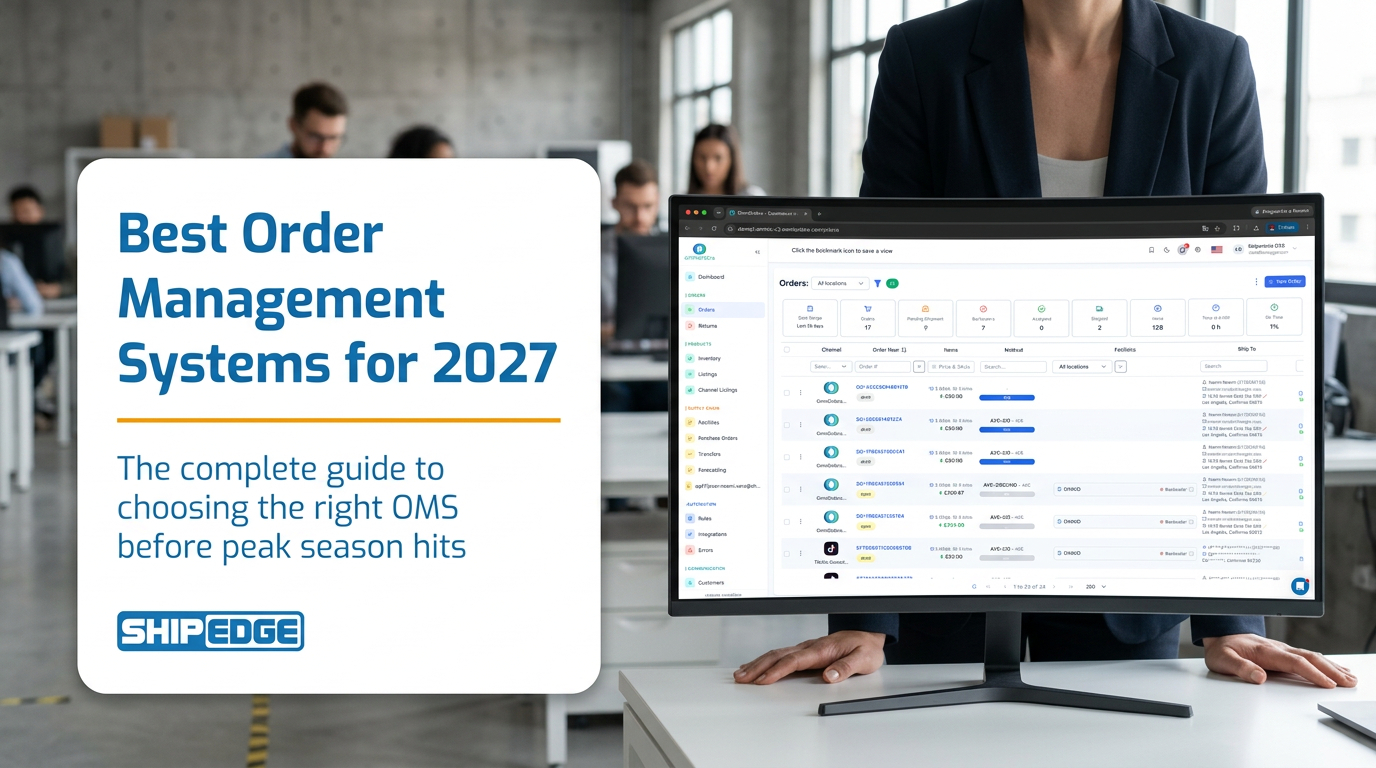
The best order management systems for 2027 include Shipedge, OmniOrders, Brightpearl, Linnworks, Veeqo, Order Desk, and Skubana. These platforms automate order routing, synchronize multichannel inventory in real time, and scale fulfillment operations seamlessly.
As e-commerce continues to accelerate, relying on manual processes or outdated technology to process orders is a direct threat to your business. When Black Friday and Cyber Monday arrive, an unexpected surge in volume can quickly overwhelm a warehouse that lacks the right software foundation. The best order management systems are designed specifically to handle these intense demand spikes. They act as the central nervous system of your fulfillment operation, ensuring that every order is captured, routed, and fulfilled with absolute precision.
With 2027 fast approaching, the logistical landscape is more complex than ever. Customers expect faster delivery times, error-free shipments, and seamless returns. Meeting these expectations requires a platform that unifies all of your sales channels into a single, cohesive interface. If your team is still exporting spreadsheets from Shopify to manage daily fulfillment, you are inherently limiting your growth.
This comprehensive guide explores the best order management systems available for 2027. We will break down exactly what an OMS is, why modern operations require advanced automation, and how to evaluate the top platforms on the market. By the end of this article, you will have the clarity needed to upgrade your infrastructure before the holiday rush begins.
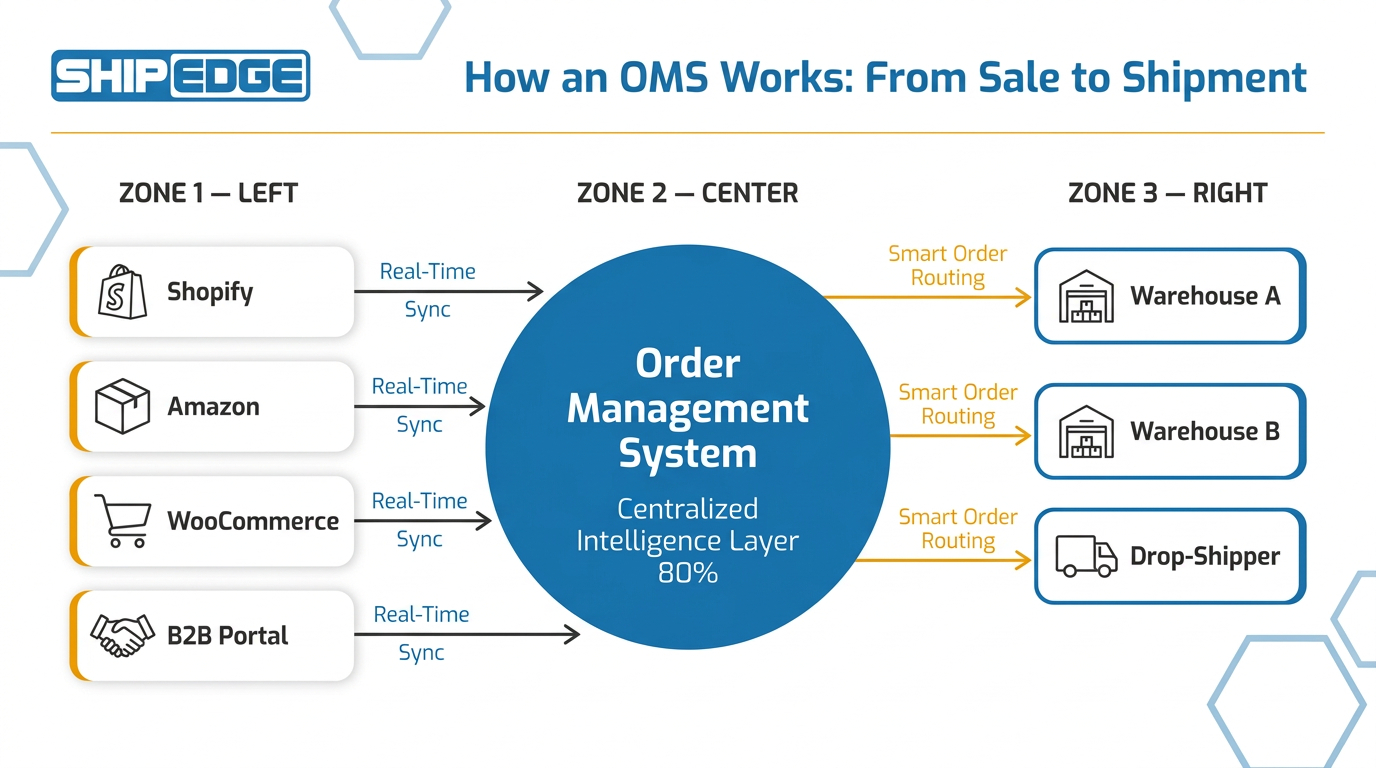
At its core, an order management system (OMS) is a digital platform that tracks sales, manages inventory visibility, and orchestrates the fulfillment process from the moment a customer clicks buy until the package arrives at their door. It consolidates data from multiple sales channels, creating a single source of truth for your entire operation. By replacing disconnected tools with a unified platform, an OMS fundamentally changes how a business handles its logistics.
In the modern retail environment, very few successful brands sell through a single storefront. Multichannel order management is no longer a luxury; it is a fundamental requirement. An effective order management system for ecommerce seamlessly pulls orders from Shopify, Amazon, WooCommerce, and wholesale B2B portals into one centralized dashboard. This consolidation prevents operations teams from constantly logging into different platforms to verify shipments. When you operate across multiple channels, synchronization is the key to preventing catastrophic stockouts.
According to recent McKinsey supply chain research, automation is the primary driver of logistics efficiency over the next decade. The best order management systems leverage advanced automation to route orders instantly based on predefined business logic. Instead of a human deciding which warehouse should ship an item, the software evaluates inventory levels, proximity to the customer, and shipping costs to make the optimal decision in milliseconds. This level of automated order processing is what allows high-volume merchants to scale rapidly.
The most significant benefit of implementing an OMS is the alignment it creates between your sales data and your physical operations. When marketing launches a flash sale, the warehouse needs real-time visibility into the incoming volume. An OMS provides this bridge, translating frontend sales into backend operational workflows. It ensures that the fulfillment team always knows exactly what needs to be picked, packed, and shipped without relying on manual communication.
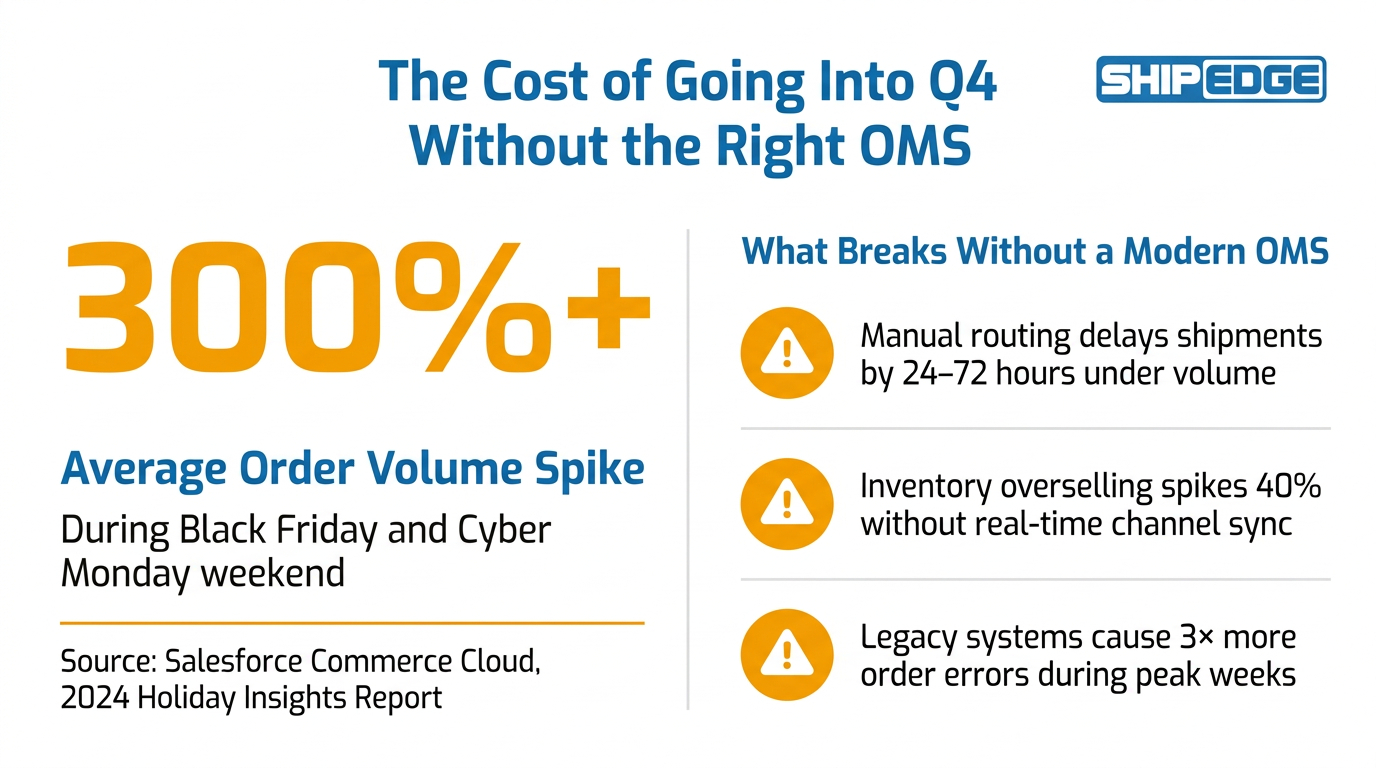
The fourth quarter is the ultimate stress test for any e-commerce operation. During Black Friday and Cyber Monday, order volumes can increase by more than three hundred percent overnight. Attempting to manage this surge with legacy software or manual processes guarantees missed shipping deadlines and frustrated customers. A modern OMS is the only way to safeguard your brand's reputation during peak season.
Manual order routing is inherently slow and prone to human error. When an order drops, someone must manually verify inventory, select the appropriate fulfillment center, and generate the picking instructions. A robust OMS automates this entire sequence. By applying intelligent order routing rules, the system instantly directs the order to the most efficient facility. This automation saves hundreds of hours of labor every week and ensures that orders begin processing the moment they are placed.
There is nothing more damaging to customer trust than selling an item that is actually out of stock. When orders are pouring in from five different channels simultaneously, manual inventory tracking will inevitably fail. An OMS continuously syncs inventory levels across all connected storefronts. If the last unit of a product sells on Amazon, the software immediately updates Shopify to reflect zero available stock, effectively eliminating the risk of overselling during critical sales events.
One of the most profound impacts of automated order processing is the ability to handle massive volume spikes without proportionally increasing your administrative headcount. Because the software handles the heavy lifting of data entry and routing, your existing team can manage five times the typical volume. This scalability drastically improves your profit margins during peak season, as revenue increases without a corresponding explosion in operational costs.
Consumers have been conditioned to expect two-day shipping as the standard baseline. Achieving this speed requires extreme operational efficiency. The moment an order is placed, the fulfillment process must begin. By cutting out manual review periods, an OMS accelerates the entire fulfillment lifecycle, allowing your warehouse team to get packages onto outbound carrier trucks hours or even days faster than traditional methods allow.
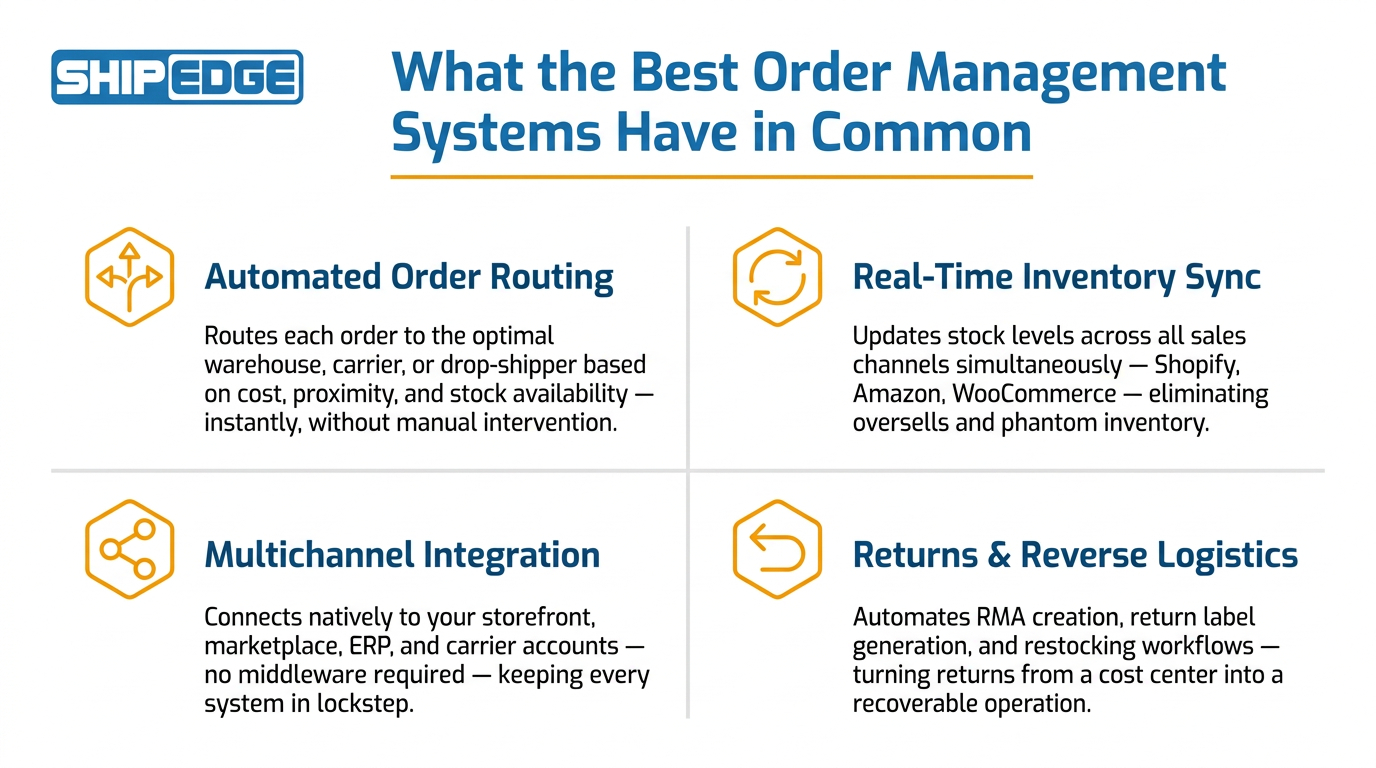
Not all software platforms are created equal. When evaluating the best order management systems for 2027, you must look beyond basic integrations and examine the specific capabilities that drive operational excellence. The most effective systems share several critical features that distinguish them from entry-level tools.
The defining feature of a top-tier OMS is its routing engine. This engine allows you to build complex rules based on your unique business needs. For example, you can program the system to always route orders to the warehouse closest to the customer to minimize shipping zones. Alternatively, you can route specific SKUs to a specialized facility. This flexibility is what enables sophisticated fulfillment strategies like distributed inventory and drop-shipping.
Accurate inventory tracking is the bedrock of order fulfillment software. The system must provide absolute visibility into what is in stock, what is currently being picked, and what is in transit. This real-time data prevents overselling and allows purchasing teams to make informed replenishment decisions. Without it, your entire operation operates in a state of constant uncertainty.
A powerful OMS must seamlessly connect with every platform where you sell products. This includes major e-commerce platforms like Shopify, marketplaces like Amazon and eBay, and retail EDI connections for B2B wholesale. The integration must be bidirectional, pulling down sales data while pushing up tracking numbers and inventory updates. This connectivity forms the foundation of modern multichannel order management.
Returns are an unavoidable reality of e-commerce, but they do not have to be a logistical nightmare. A comprehensive OMS handles reverse logistics just as efficiently as outbound shipping. It automates the generation of return labels, tracks the inbound package, and updates inventory levels once the item is inspected and restocked. This streamlines the customer experience while recovering valuable inventory quickly.
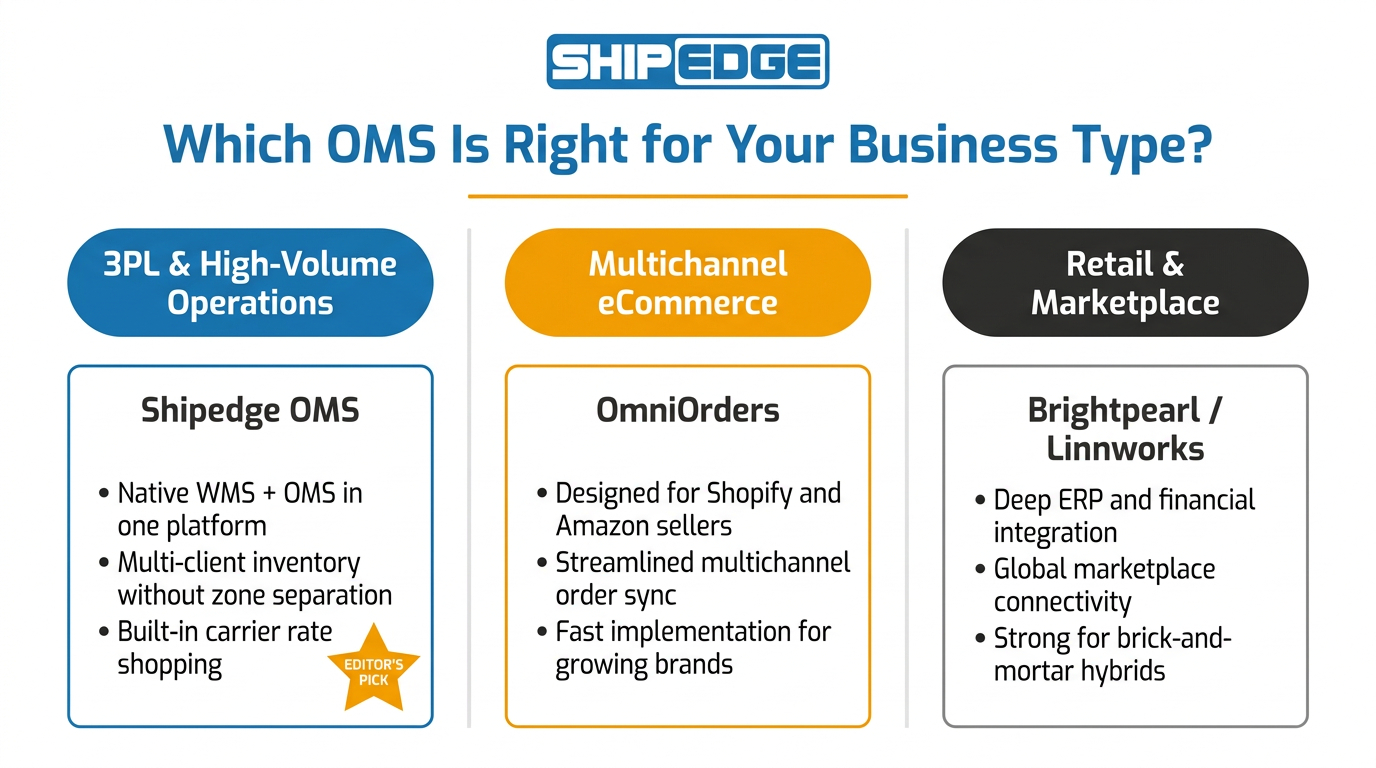
Selecting the right platform is a critical decision that will impact your logistics for years to come. Based on market presence, feature depth, and scalability, here is a detailed breakdown of the seven best order management systems positioned to dominate 2027.
Shipedge is a powerhouse platform engineered specifically for high-volume e-commerce brands and third-party logistics providers. It combines robust OMS capabilities with a native Warehouse Management System, eliminating the need for disconnected software stacks. Shipedge excels at complex order routing, multi-warehouse inventory management, and deep integration with dozens of sales channels. By unifying both the order logic and the physical warehouse operations, Shipedge delivers unparalleled efficiency for scaling businesses.
Platforms like OmniOrders are built specifically for multichannel sellers who need real-time order visibility across Shopify, Amazon, and WooCommerce without the complexity of enterprise systems. It provides a highly intuitive dashboard that simplifies the process of syncing inventory across multiple storefronts. For growing brands that need to quickly implement automated order processing before a major sales event, it serves as a highly reliable and focused tool.
Brightpearl is an operating system designed for retail brands that need tight financial integration. It combines order management with accounting and purchasing features, making it a strong choice for businesses that want an ERP-lite solution. It performs very well in wholesale and B2B environments, though its complexity can require a longer implementation timeline compared to more specialized platforms.
Linnworks is heavily focused on marketplace integration. If your primary strategy involves selling across Amazon, eBay, Walmart, and other global marketplaces, Linnworks offers deep connectivity. It automates inventory updates across these channels to protect your seller metrics and prevent stockouts. It is a solid choice for marketplace-dominant merchants looking to streamline their multichannel order management.
Acquired by Amazon, Veeqo offers a streamlined OMS with a strong emphasis on shipping automation. It is particularly attractive for smaller brands because it offers powerful features with minimal upfront costs, subsidizing its platform through shipping label revenue. Veeqo is highly accessible, though it may lack the advanced multi-warehouse routing logic required by enterprise-level fulfillment operations.
Order Desk is a highly flexible, developer-friendly platform. It acts as an integration hub, connecting hundreds of different shopping carts, shipping carriers, and fulfillment providers. It relies heavily on a robust rules engine, allowing you to build highly customized workflows. While its interface is less modern than others, its sheer flexibility makes it a favorite for businesses with highly unique or complex routing requirements.
Skubana, now part of Extensiv, is designed for high-growth merchants managing complex logistics networks, including 3PLs, Amazon FBA, and owned warehouses. It offers advanced analytics and demand planning tools, helping businesses optimize their supply chain. It is a powerful system, though it is typically priced for larger mid-market enterprises rather than emerging brands.
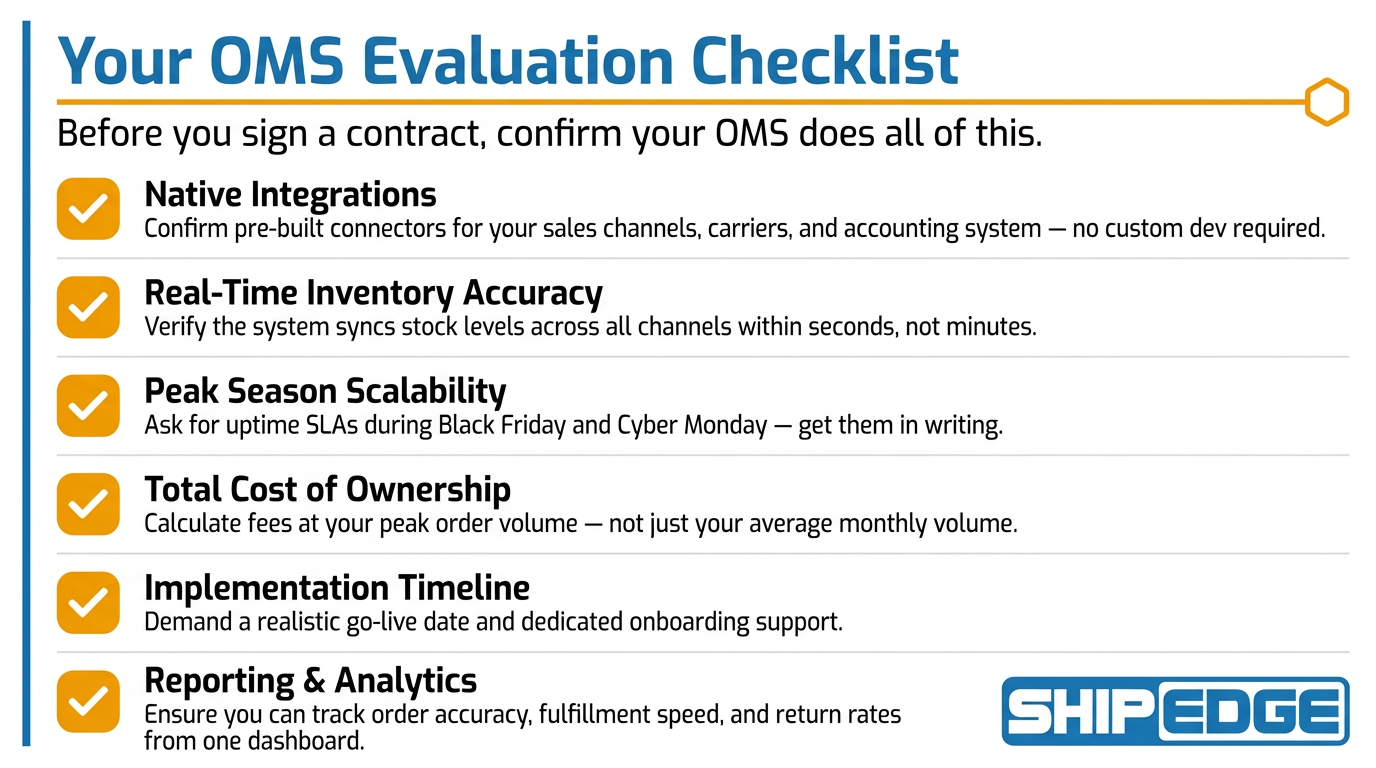
With so many excellent options available, choosing the right system requires a strategic approach. You must look beyond the marketing materials and evaluate how the software aligns with your specific operational reality. Here is how to navigate the selection process effectively.
The most powerful OMS is useless if it cannot communicate with your existing tech stack. Before making a decision, audit every sales channel, shipping carrier, and accounting software your business currently uses. The chosen platform must support all of these integrations natively. Relying on custom development or third-party middleware to connect core systems introduces fragility and technical debt into your logistics network.
Pricing models for order fulfillment software vary wildly. Some charge a flat monthly fee, while others charge a fraction of a cent per order processed. You must calculate the total cost of ownership based on your projected Black Friday volume, not just your slow months. Additionally, factor in the cost of implementation, employee training, and ongoing technical support to ensure the software fits within your long-term financial model.
Your business needs a system that can handle your worst-case scenario. When evaluating vendors, ask specific questions about their server uptime and system performance during Q4. A system that lags or crashes during Cyber Monday will cost you exponentially more than the software itself. Ensure that the platform's architecture is built to process thousands of orders per hour without degradation in performance.
Software transitions are inherently disruptive. You must evaluate how quickly the new system can be deployed and adopted by your team. Complex enterprise systems can take six to twelve months to implement properly. If you are looking to upgrade your systems before the holiday season, you must choose a platform with a streamlined onboarding process and a highly responsive customer success team.
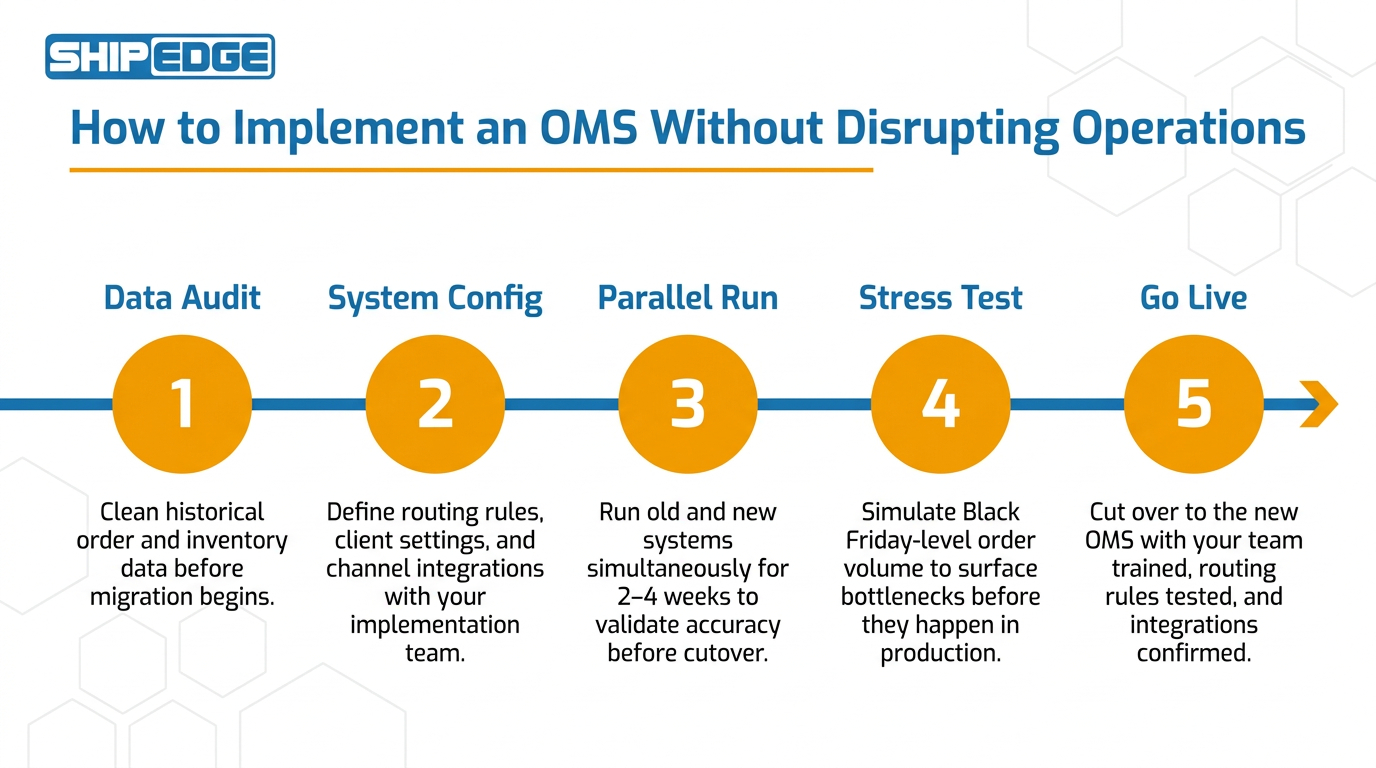
Even the best software will fail if the implementation is poorly managed. Transitioning to a new order management system for ecommerce requires careful planning and execution. Avoiding these common mistakes will ensure a smooth rollout and immediate operational improvements.
Software is only as effective as the people using it. A frequent mistake is rolling out a new system without dedicating sufficient time for warehouse staff training. Your team needs to understand the new workflows deeply before peak volume hits. Schedule hands-on training sessions and create internal documentation to ensure everyone is comfortable with the new interface.
Transferring historical data, SKU catalogs, and active inventory counts into a new system is fraught with risk. If your initial data import is flawed, the system will generate inaccurate routing decisions from day one. You must conduct rigorous data cleaning before the migration and run extensive validation checks afterward to guarantee that the new system reflects reality accurately.
Never launch a new OMS without testing every possible order scenario. You must simulate split shipments, international orders, out-of-stock scenarios, and complex returns. Testing these edge cases ensures that your automated order processing rules function exactly as intended. Discovering a flaw in your routing logic during Black Friday is a catastrophic failure that must be avoided at all costs.
While automation is the goal, you must also plan for exceptions. What happens when an address is invalid? What happens if an item is damaged in the warehouse? Your new system must have clear, easily accessible queues for orders that require manual intervention. Ignoring exception handling creates bottlenecks that will quickly grind your fulfillment operations to a halt.
The logistics landscape in 2027 will be defined by speed, accuracy, and automation. As customer expectations rise and sales channels multiply, relying on manual processes is no longer a viable strategy. The best order management systems provide the critical infrastructure needed to unify your sales data and automate your physical operations. Whether you are preparing for the intense volume of Black Friday or simply looking to scale your daily operations, upgrading your OMS is the highest-leverage investment you can make.
By implementing a robust platform, you eliminate manual routing errors, prevent catastrophic stockouts, and drastically improve your delivery speeds. Do not wait until your current systems break under the pressure of peak season. Evaluate your integrations, understand your total cost of ownership, and choose a platform that is engineered for scale.
Ready to optimize your multichannel order management? Shipedge gives e-commerce brands and 3PLs the tools to automate fulfillment and scale effortlessly. Book a demo and see how it works.
An order management system is a software platform that tracks sales, manages inventory, and automates the fulfillment process across multiple channels. It consolidates data from various storefronts into a single dashboard, ensuring accurate routing and real-time inventory visibility.
Order management works by automatically capturing sales data from an e-commerce storefront, verifying available inventory, and applying routing rules to send the order to the most efficient warehouse. It then tracks the picking, packing, and shipping phases until delivery.
Order management is important because it prevents costly errors like stockouts and mis-shipments. It allows businesses to scale efficiently by automating manual tasks, ensuring faster delivery times and a better overall customer experience.
The primary benefits of an OMS include automated order processing, real-time inventory synchronization across multiple channels, reduced labor costs, faster shipping times, and the ability to seamlessly handle massive volume spikes during peak seasons.
The cost of an order management system varies significantly based on features and volume. Small business solutions may start at a few hundred dollars per month, while enterprise-grade systems can cost thousands of dollars monthly, often scaled based on order volume.
An ERP is a massive system that manages all business functions, including human resources, accounting, and manufacturing. An OMS is highly specialized software focused exclusively on managing inventory, order routing, and fulfillment logistics with much greater precision.