EN │ ES
News
October 29, 2026
Shipedge
17 min read
Logistics automation integrates artificial intelligence, automated fulfillment software, and intelligent physical infrastructure to orchestrate inventory, picking, and multi-carrier shipping. By removing manual touchpoints across warehouse operations, automation reduces fulfillment errors, lowers carrier costs, and accelerates order delivery cycles.
Anthropic's public market debut in October 2026 marks an undeniable turning point for global industry. When an artificial intelligence frontier research lab reaches public markets valued at tens of billions of dollars, the debate over whether machine intelligence is an experimental novelty officially closes. AI has officially graduated into core enterprise infrastructure.
While financial analysts examine ticker symbols and institutional market capitalization, operations leaders face a more urgent practical reality. What does the arrival of autonomous enterprise intelligence mean for daily fulfillment? Modern logistics automation has quietly shifted from rigid batch scripts to continuous cognitive decision-making across the distribution floor.
For supply chain executives, warehouse managers, and third-party logistics providers (3PLs), Anthropic's public milestone is far more than Silicon Valley business journalism. It represents a clear operational warning. Machine learning models are actively restructuring how distribution networks calculate storage locations, predict consumer demand, and dispatch freight. Facilities running fulfillment through disconnected spreadsheets and manual clerical oversight are already falling behind automated competitors.
As global supply chains brace for peak holiday shipping volume, enterprise intelligence is no longer an optional luxury. It is the defining operational dividing line in commercial fulfillment.
The October 2026 public listing of Anthropic represents a fundamental milestone in enterprise technology. Wall Street's institutional backing confirms that generative models and autonomous agents are no longer speculative research expenditures. They are now foundational utilities akin to cloud compute, relational database clusters, and enterprise telecommunications networks.
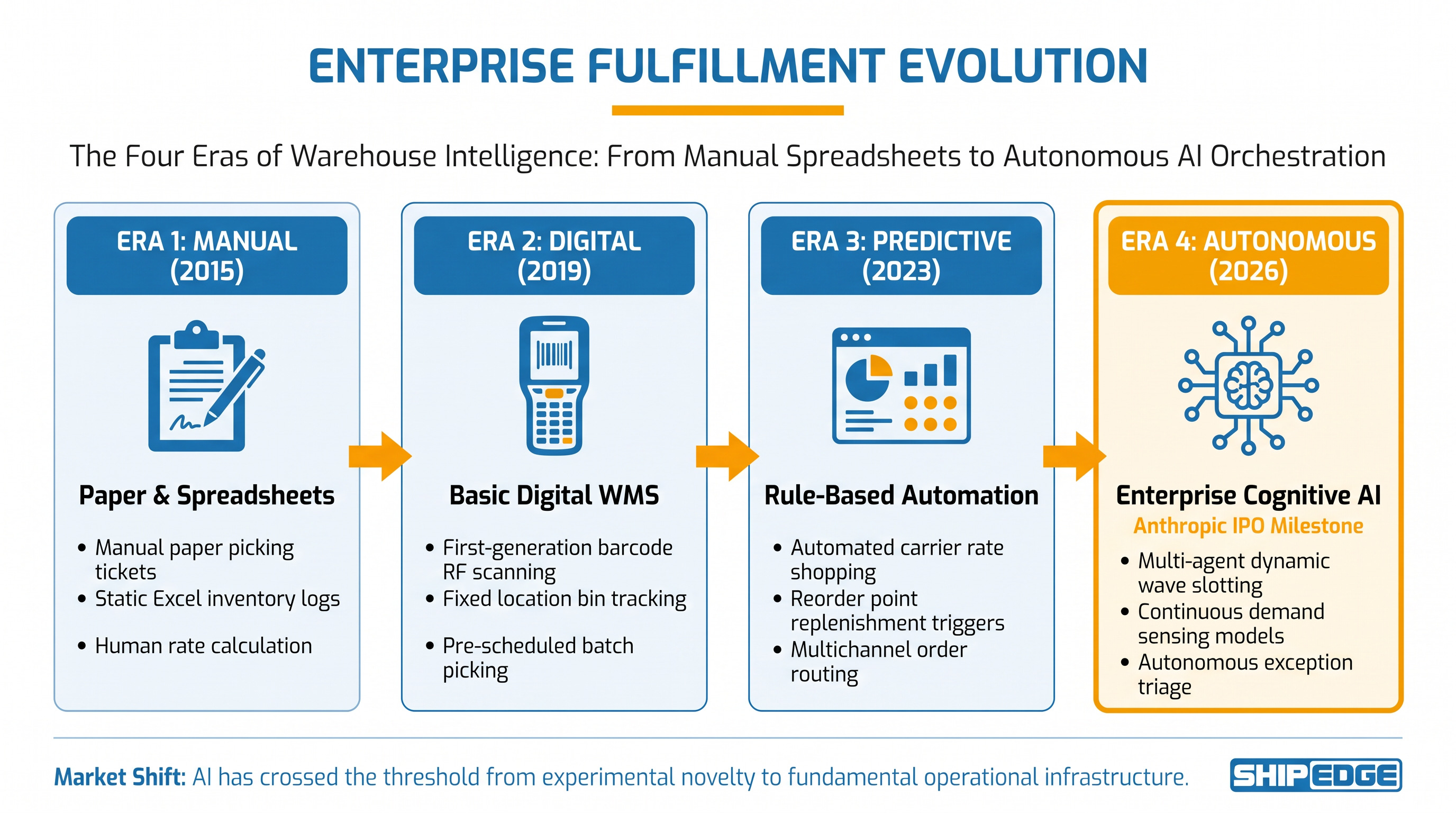
For the past several years, corporate executives treated machine learning models primarily as digital laboratory experiments. Organizations conducted isolated pilots, tested standalone conversational interfaces, and explored peripheral administrative tasks. Anthropic's transition to a publicly traded corporation reflects a profound economic evolution. Capital markets now value enterprise artificial intelligence based on recurring software subscription models, sustained compute demand, and measurable industrial productivity gains.
This economic validation directly impacts industrial supply chains. Enterprise software providers now embed autonomous agents directly into production operational workflows. Instead of treating intelligence as an optional plugin, modern software architectures incorporate real-time cognitive reasoning into their foundational codebases. In high-velocity fulfillment environments, this technological maturation shifts the conversation from theoretical capabilities to daily operational efficiency.
Public market accountability forces heightened security standards, uptime commitments, and dependable governance across the entire AI ecosystem. Enterprise logistics buyers who previously hesitated due to reliability, compliance, or regulatory concerns now see established market viability. When global supply chains manage billions of dollars in physical merchandise, technological stability is non-negotiable.
Consequently, enterprise procurement teams are accelerating logistics technology modernization timelines. Operations leaders recognize that automation in logistics is no longer a five-year strategic roadmap concept. The immediate challenge is determining how quickly advanced logistics technology can eliminate manual touchpoints across existing distribution centers.
Physical supply chains represent the ultimate proving ground for practical artificial intelligence. Unlike purely digital industries where software mistakes merely produce transient code errors, distribution networks move physical inventory across real-world geography. Because fulfillment operates under strict customer delivery windows and tight operating margins, operational inefficiencies produce immediate financial penalties.
Global commerce has grown increasingly volatile over the past decade. Erratic consumer purchasing habits, regional port bottlenecks, unpredictable weather disruptions, and shifting carrier surcharge schedules create an environment of continuous friction. Human dispatchers and warehouse supervisors cannot process thousands of real-time variables simultaneously during peak fulfillment cycles.
According to research from McKinsey & Company, organizations implementing AI-driven supply chain management reduce logistics costs by 5% to 20% while cutting total operating costs by up to 25%. These dramatic economic gains explain why physical distribution leads software adoption. When inventory moves through dynamic networks, machine learning logistics algorithms consistently outperform static human guesswork. Deploying an intelligent ai supply chain architecture allows operators to anticipate disruptions days before they impact warehouse docks.
Traditional warehouse automation relied heavily on rigid, predetermined rule scripts. A programmer established fixed parameters: if an order exceeds three items, assign it to a specific packing line. While functional under stable conditions, deterministic rules inevitably break whenever operational volumes change unexpectedly.
Modern intelligent logistics platforms leverage adaptive reasoning models. Instead of following rigid sequences, cognitive systems monitor real-time packing station congestion, inventory depletion velocity, and regional carrier transit interruptions. When unexpected bottlenecks emerge, the system autonomously redirects picking assignments and order queues without requiring manual human intervention.
This cognitive flexibility protects throughput during high-pressure fulfillment spikes. Forward-looking logistics operations use these autonomous capabilities to protect service level agreements during unexpected transportation delays.
Far from the futuristic hype of fully humanoid robot workforces, artificial intelligence delivers practical, measurable value in fulfillment facilities today. Software-driven intelligence coordinates the complex interactions between human labor, physical infrastructure, and distributed inventory.
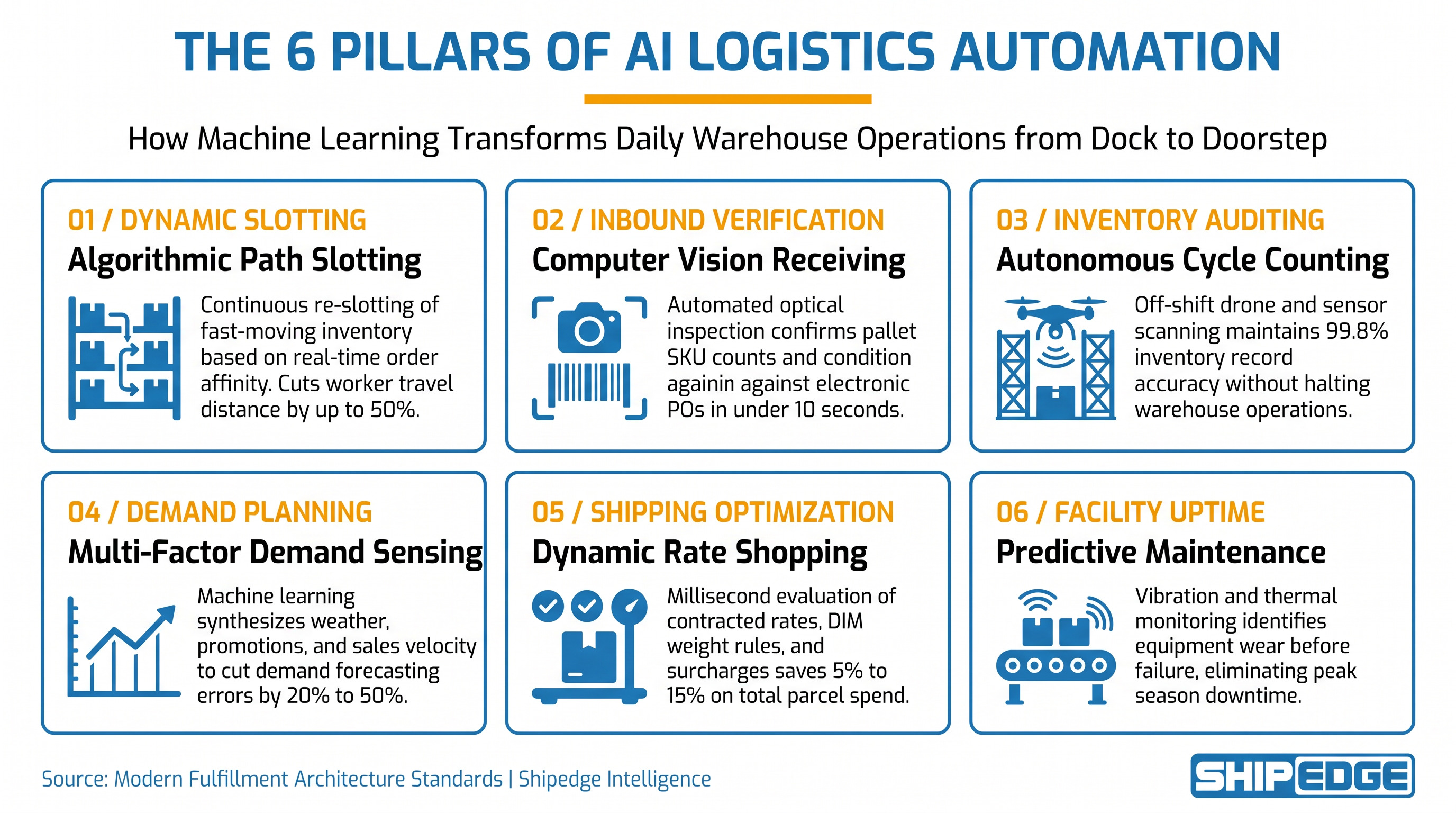
Travel time represents up to 50% of total warehouse labor hours during manual order picking. Traditional facilities assign static bin locations based on annual sales volume categories, leaving pickers to walk miles of inefficient warehouse aisles. In contrast, automated warehouse management engines dynamically analyze real-time order affinities and seasonal demand spikes.
The system continuously recalculates optimal storage locations, instructing floor teams to relocate fast-moving goods closer to packing stations. Purpose-built WMS platforms like BinLogic focus specifically on warehouse operations — inventory tracking, receiving, put-away, and cycle counting — without the overhead of a full ERP system. By coordinating picker travel paths in real time, intelligent warehouse systems double hourly pick rates while minimizing physical worker fatigue. Automated warehouse management turns spatial layout into an active throughput multiplier.
Manual receiving docks remain major sources of inventory distortion. Clerks scanning printed bills of lading often introduce data entry errors that cascade through fulfillment channels for months. Modern smart logistics facilities leverage computer vision and natural language processing to inspect inbound pallets instantly upon dock arrival.
Optical sensors verify carton counts, inspect packaging integrity, and confirm barcode accuracy against electronic purchase orders within seconds. During daily storage operations, autonomous drones and camera-equipped forklifts perform automated cycle counts during off-shift hours. Discrepancies between physical stock and software records are flagged and reconciled automatically, keeping inventory records at 99.8% accuracy. Applying practical ai in logistics transforms receiving docks into automated verification checkpoints.
Fulfillment operations encounter dozens of daily exceptions: damaged packaging, missing barcodes, unexpected stockouts, and mechanical conveyor jams. Historically, each exception required human investigation, stalling entire fulfillment waves. Modern machine learning logistics engines triage exceptions systematically by cross-referencing visual data against historical resolutions.
Simultaneously, predictive maintenance algorithms monitor mechanical vibration, operating temperatures, and motor current across automated sorting systems. By detecting mechanical wear before hardware components fail, facilities prevent unscheduled downtime during peak holiday shipping windows.
Accurate demand planning forms the operational backbone of profitable inventory management. For decades, warehouse operators relied on historical moving averages and seasonal guesswork to plan stock replenishment. These backward-looking spreadsheets consistently created painful cycles of product stockouts and expensive overstocking.
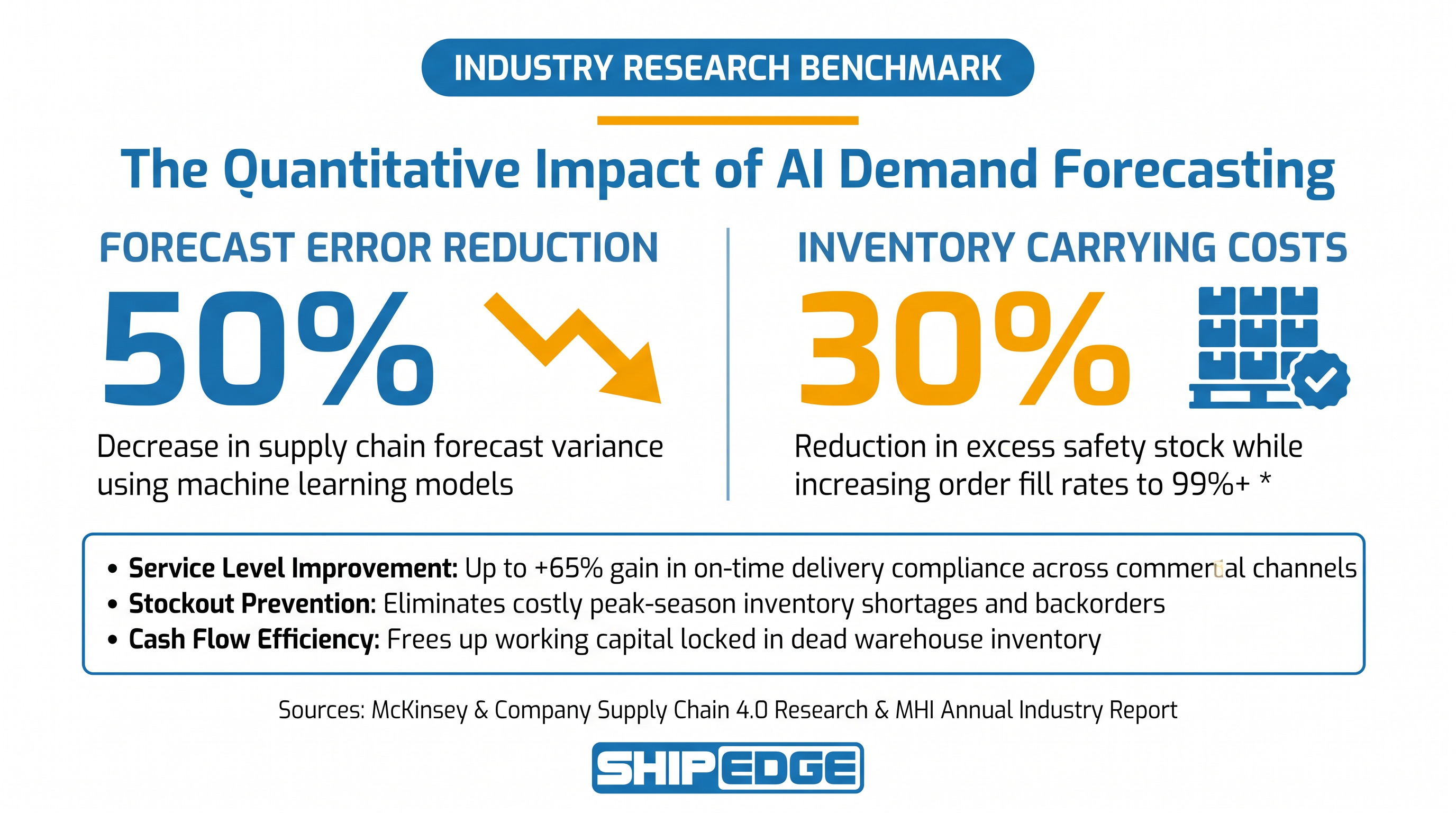
The bullwhip effect occurs when minor shifts in consumer retail demand trigger amplified inventory swings upstream among distributors and manufacturers. Artificial intelligence eliminates this volatility through continuous multi-factor demand sensing. Rather than examining internal sales receipts in isolation, predictive logistics models synthesize diverse macroeconomic indicators, regional weather forecasts, social engagement trends, and promotional schedules.
The MHI Annual Industry Report, produced alongside Deloitte, reveals that 48% of supply chain leaders now view AI disruption as significant or transformational, with demand and inventory optimization representing the single largest adoption use case. Advanced predictive algorithms cut forecasting errors by 20% to 50%, enabling brands to maintain high order fill rates with significantly leaner safety stock reserves. Integrating predictive intelligence into your broader ai supply chain shields your business from sudden demand shocks.
Moving beyond pure prediction, intelligent systems deploy prescriptive replenishment actions. The software calculates exact reorder quantities and lead times across every individual SKU, factoring in supplier manufacturing reliability and seasonal transit fluctuations.
By connecting directly to an automated inventory management architecture, the platform automatically generates supplier purchase orders before stock hits critical depletion thresholds. Warehouse operators avoid tying up valuable working capital in slow-moving inventory while ensuring top-selling products remain available during high-velocity promotional periods. Robust ai inventory management balances cash flow with flawless product availability.
Customer expectations for rapid, inexpensive delivery have never been higher. Yet commercial transportation costs, fuel surcharges, and regional accessorial fees continue to rise across all major carriers. Navigating these economic pressures requires automated order distribution and dynamic shipping intelligence.
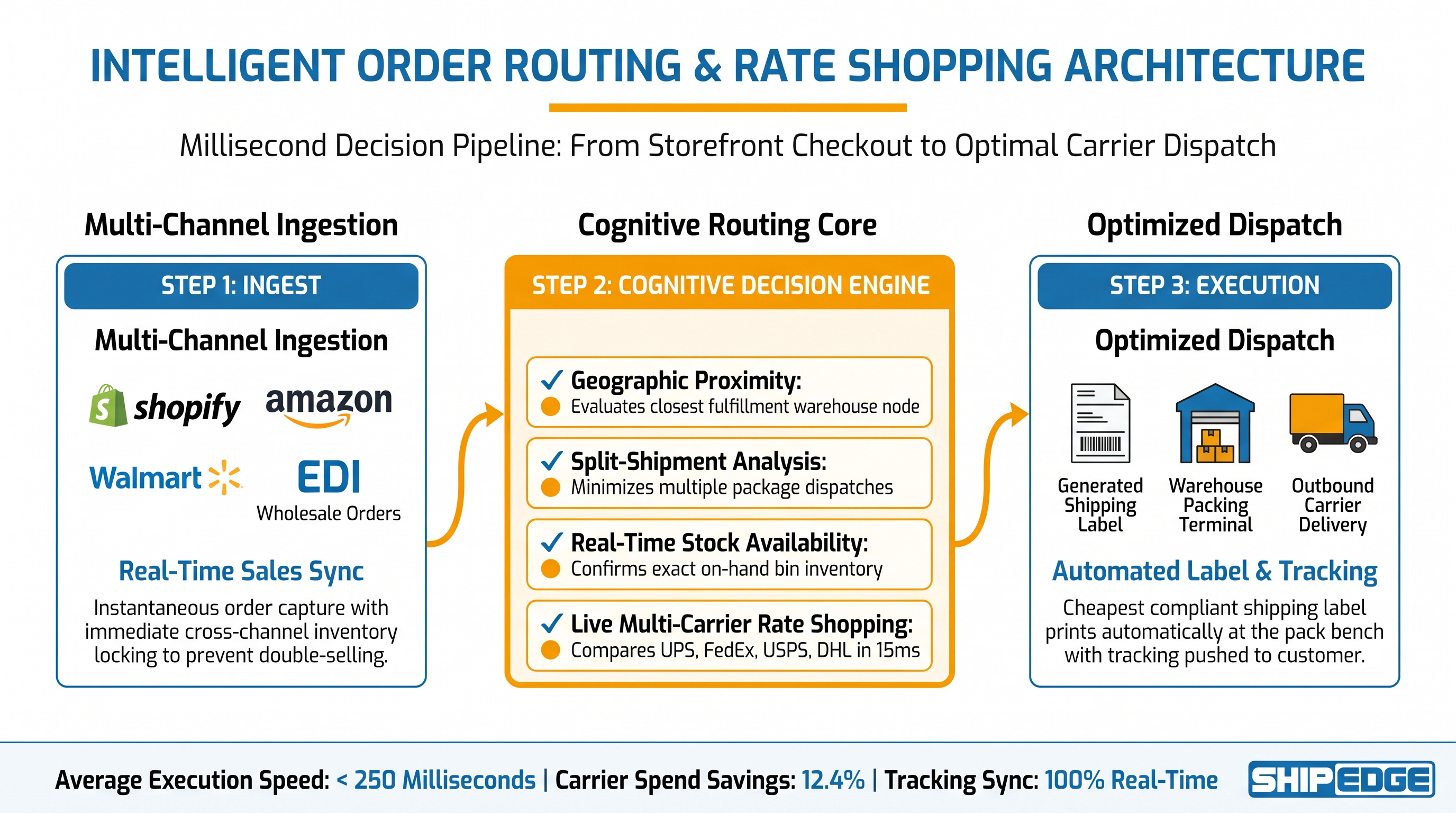
Manual carrier selection is entirely unviable for high-volume ecommerce. Human shipping clerks cannot cross-reference dozens of carrier rate tables, dimensional weight rules, delivery commitment windows, and zip-code surcharges for every outbound package.
Automated carrier rate shopping algorithms evaluate these parameters within milliseconds. The system cross-references package dimensions, real-time carrier performance data, and contracted discounts across UPS, FedEx, USPS, DHL, and regional parcel couriers. Connecting your fulfillment workflows to pre-built carrier integrations ensures that every single parcel ships via the most cost-effective service that satisfies customer delivery promises.
Integrating dynamic carrier rate shopping eliminates manual decision latency at the pack bench. Automated rate shopping saves high-volume fulfillment facilities thousands of dollars in carrier surcharges every week while ensuring on-time delivery.
For brands operating multiple fulfillment centers or collaborating with nationwide 3PL networks, order allocation dictates operational profitability. Intelligent ai order management algorithms evaluate every customer order at the moment of checkout.
Platforms like OmniOrders are built specifically for multichannel sellers who need real-time order visibility across Shopify, Amazon, and WooCommerce without the complexity of enterprise systems. Smart routing logic dynamically analyzes inventory availability, node proximity, split-shipment costs, and regional tax implications. By routing orders to the optimal distribution node automatically, retailers minimize shipping zone distances, cut parcel transit times, and reduce total packaging waste. Advanced ai order management bridges storefront demand with warehouse reality.
A profound competitive divide is widening across the fulfillment landscape. On one side stand digitally mature operations that leverage automated software to achieve continuous operational velocity. On the other side remain manual facilities burdened by clerical data entry, paper picking tickets, and reactive troubleshooting.
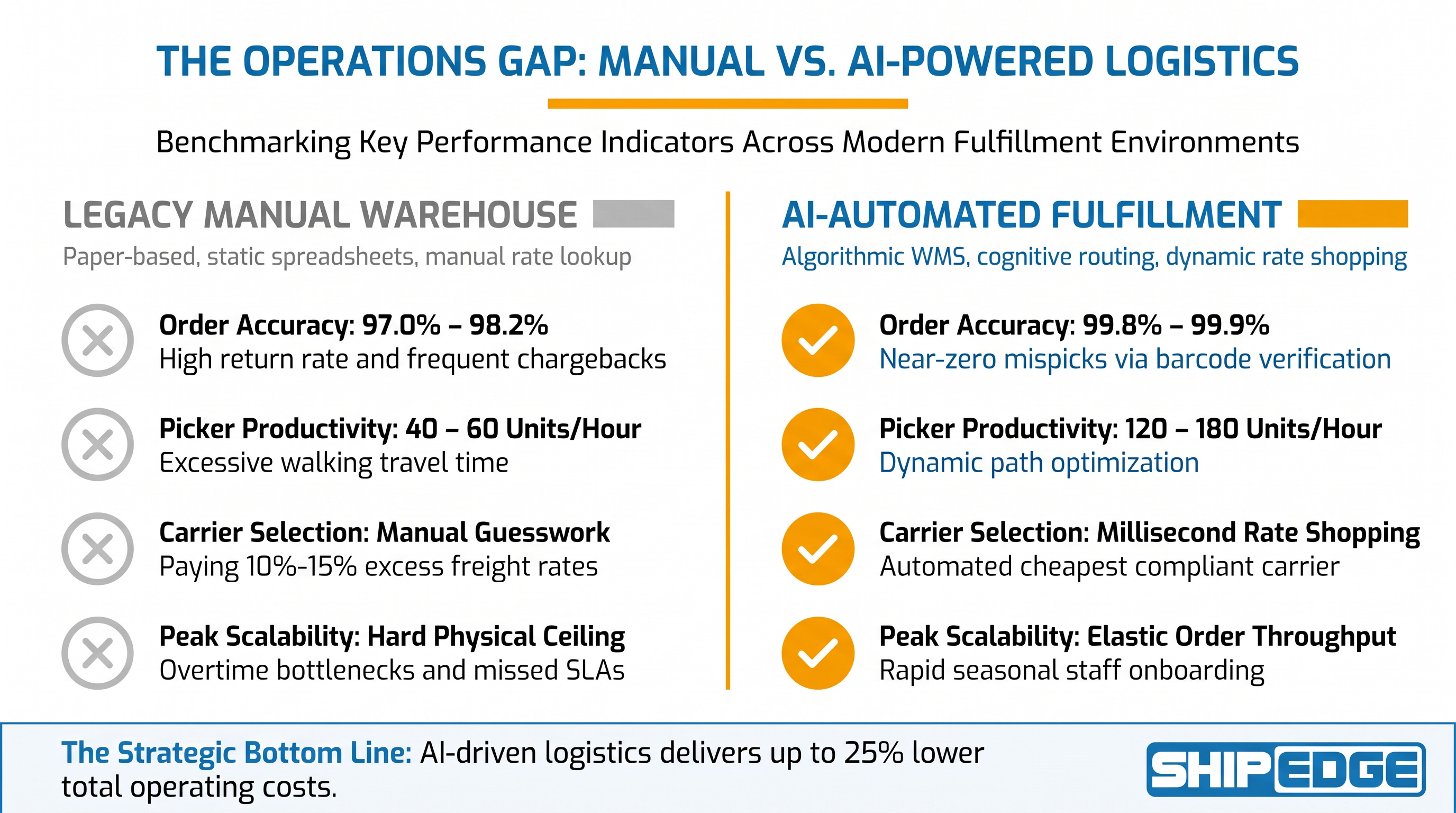
Warehouse labor shortages remain an enduring operational challenge. Industry surveys indicate that finding and retaining qualified warehouse associates ranks among the top operational headaches for logistics directors. During peak fourth-quarter fulfillment surges, manual facilities scramble to hire and onboard temporary seasonal workers.
Because manual picking workflows require extensive training, temporary associates suffer from high error rates and sluggish throughput. Conversely, automated facilities utilize guided mobile workflows and intuitive visual picking interfaces. New warehouse workers achieve full picking productivity within hours rather than weeks, allowing automated facilities to scale order volume effortlessly without proportional headcount expansion. Modern logistics operations thrive when software coordinates human effort intelligently.
The operational gap between automated and manual fulfillment translates directly to financial performance. Manual facilities endure significant margin erosion across several key metrics:
- Order Accuracy: Manual picking averages 97% to 98% accuracy, generating hundreds of costly customer returns and chargebacks. Automated operations consistently maintain 99.8% or higher order precision. - Labor Productivity: Manual pickers complete 40 to 60 units per hour. Facilities powered by dynamic path routing achieve 120 to 180 units per labor hour. - Fulfillment Cost per Unit: Disorganized inventory storage and manual rate shopping inflate average handling and shipping costs by \$1.50 to \$3.00 per package. - Peak Scaling Capacity: Manual warehouses hit a hard physical ceiling during holiday volume spikes, resulting in missed shipping cutoffs and damaged merchant reputations.
Facilities that fail to adopt modern automation in logistics inevitably watch their margins dissolve into labor overtime and shipping surcharges.
Modernizing your logistics operations does not require tearing down your facility or investing millions in experimental robotics hardware. The most impactful automation layer is the software engine coordinating your daily orders, inventory, and shipping workflows. Shipedge delivers an integrated ecosystem engineered specifically to bring cognitive intelligence to growing brands and 3PL warehouses.
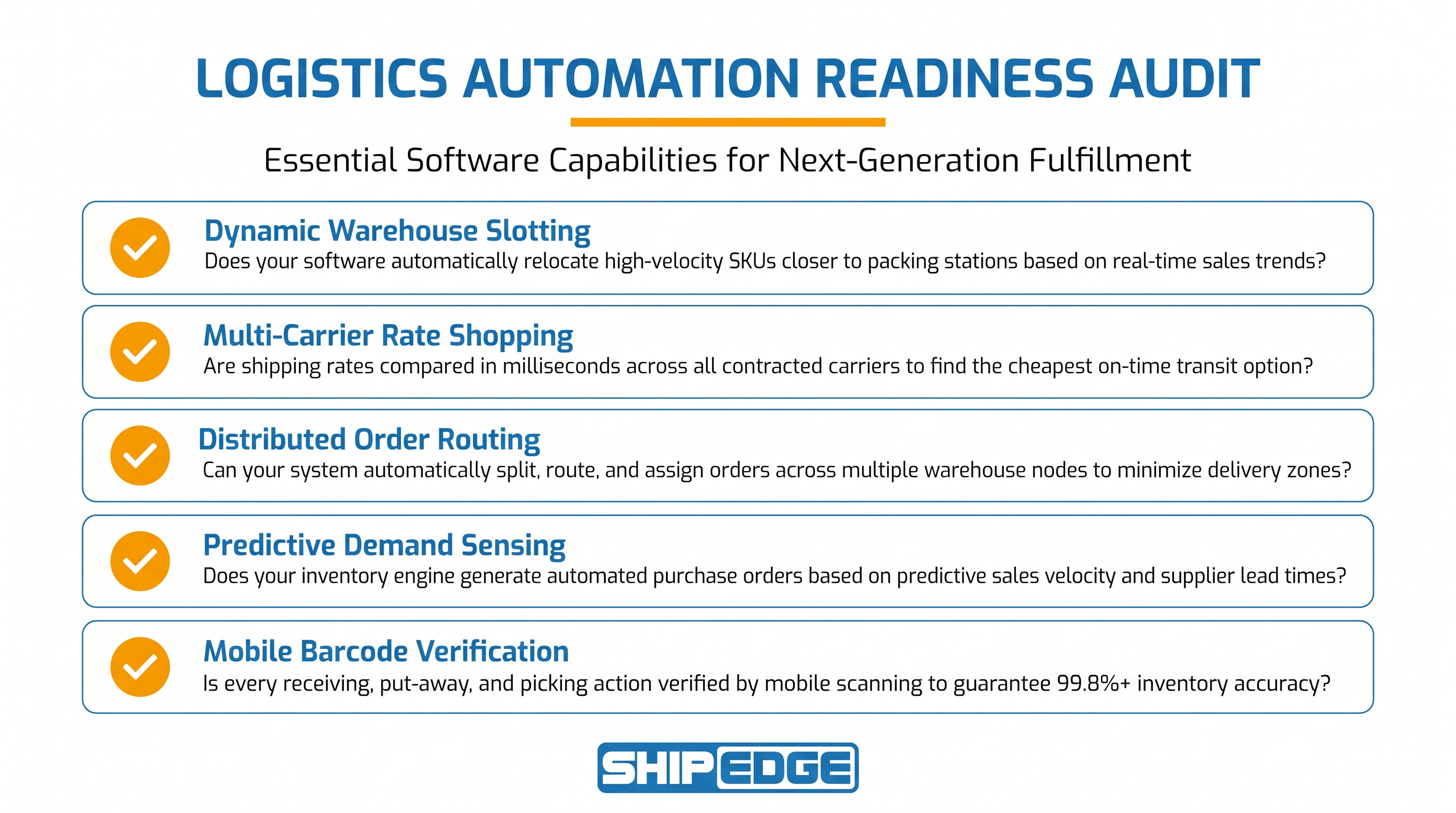
At the core of efficient warehouse execution sits the Shipedge warehouse management system. Engineered with decades of operational logistics expertise, Shipedge replaces disjointed paper processes with real-time digital intelligence.
The platform continuously optimizes warehouse bin locations through dynamic algorithmic slotting, organizes wave and batch picking assignments for maximum travel efficiency, and enforces barcode scanning verification at every touchpoint. Operations managers gain 360-degree visibility over labor performance, dock-to-stock turnaround times, and storage utilization through configurable real-time analytics dashboards. Deploying automated warehouse management through Shipedge delivers enterprise capabilities on an agile, modular infrastructure.
As brands expand across direct-to-consumer storefronts, digital marketplaces, and wholesale B2B channels, order synchronization becomes critical. The Shipedge order management system acts as the central neurological hub for distributed commerce.
The system aggregates sales orders across Amazon, Walmart, Shopify, BigCommerce, and EDI trading partners in real time, automatically preventing catastrophic stockout cancellations through continuous multi-channel inventory synchronization. Advanced routing rules evaluate inventory proximity across multi-warehouse networks, split orders intelligently when necessary, and automate backorder fulfillment the moment inbound purchase orders are received. Shipedge provides intelligent ai inventory management that protects brand reputation across every channel.
Shipping expenses represent the largest line item on most fulfillment balance sheets. Shipedge integrates native multi-carrier rate shopping directly into the packing station workflow.
As items are packed, the system compares live shipping rates across national carriers and regional couriers based on actual parcel dimensions and destination transit windows. Shipping labels, commercial customs documentation, and tracking notifications generate instantly, eliminating clerical delays and protecting your operating margins on every parcel. Implementing smart logistics through Shipedge ensures carrier selection is always optimized for cost and speed.
Anthropic's IPO will be remembered as the moment artificial intelligence officially became enterprise table stakes. The rapid maturation of cognitive technology makes one reality abundantly clear: the competitive advantage in physical fulfillment belongs entirely to automated, data-driven organizations.
Continuing to run warehouse operations on static spreadsheets, disconnected software tools, and manual shipping lookups is an unsustainable business risk. Facilities that embrace intelligent automation scale effortlessly, protect their margins against rising transportation costs, and deliver the flawless fulfillment experiences modern consumers expect.
The transition to intelligent fulfillment does not require years of custom systems development. By partnering with an enterprise platform built for modern commerce, you can bring predictive automation to your warehouse floor today.
Ready to modernize your fulfillment operations? Discover how Shipedge gives eCommerce brands and 3PLs the tools to automate inventory, coordinate order routing, and cut shipping costs. Request a demo today and see our intelligent platform in action.
### What is logistics automation in modern fulfillment? Logistics automation is the strategic application of artificial intelligence, specialized software, and physical equipment to orchestrate supply chain and fulfillment operations without manual intervention. It encompasses digital order management, inventory slotting, automated cycle counts, dynamic wave picking, and automated multi-carrier rate shopping. By digitizing these core touchpoints, warehouses achieve higher order velocity, eliminate picking errors, and drastically reduce overall unit handling expenses.
### How does Anthropic's IPO impact enterprise software and logistics? Anthropic's public market debut signals that artificial intelligence has transitioned from speculative venture capital research into reliable, mission-critical enterprise infrastructure. For logistics and supply chain software, this milestone accelerates the enterprise adoption of autonomous reasoning agents across production networks. Cloud software platforms now embed machine learning directly into warehouse and order management architectures, making cognitive decision-making standard across commercial fulfillment operations.
### What is the difference between physical automation and digital logistics automation? Physical automation involves machinery such as conveyor systems, automated guided vehicles (AGVs), and robotic picking arms designed to move physical goods. Digital logistics automation involves the intelligent software layer—such as a modern WMS or OMS—that analyzes operational data, routes orders, schedules pick waves, and selects shipping carriers. While physical automation requires extensive capital expenditures, digital automation can be implemented rapidly to deliver immediate operational ROI.
### How does AI improve demand forecasting accuracy in warehouses? Traditional forecasting models rely strictly on historical internal sales averages, which fails to predict sudden market changes. Artificial intelligence analyzes multi-source variables simultaneously, including macroeconomic indicators, regional weather patterns, promotional calendars, and real-time sales velocity. By identifying complex consumption patterns across diverse data streams, machine learning models reduce demand forecasting errors by 20% to 50%, preventing costly stockouts and excessive safety stock buildup.
### How does intelligent carrier rate shopping reduce fulfillment costs? Intelligent rate shopping software evaluates dozens of carrier rate cards, dimensional weight formulas, accessorial fuel charges, and transit delivery promises in milliseconds as packages are weighed and measured. Instead of warehouse workers manually guessing the cheapest carrier, the algorithm automatically selects the optimal service level across national and regional couriers. This automated comparison consistently cuts parcel shipping spend by 5% to 15% across enterprise shipping operations.
### Can mid-market 3PLs and eCommerce brands implement AI automation without massive budgets? Yes. Mid-market brands and independent 3PL warehouses do not need multi-million dollar robotics systems or custom software development teams to automate their operations. Cloud-native platforms like Shipedge deliver enterprise-grade automation features—such as algorithmic wave picking, dynamic slotting, and intelligent rate shopping—through modular software subscriptions. Facilities can deploy these intelligent workflows rapidly using standard mobile scanners and existing warehouse racking infrastructure.
### How much does it cost to automate warehouse and fulfillment processes? Digital logistics automation typically costs between \$1,000 and \$5,000 per month for growing brands and mid-sized 3PLs using cloud-based WMS and OMS platforms. Unlike physical robotics, which can require capital investments exceeding \$1 million, software automation delivers positive return on investment within 60 to 90 days by eliminating shipping errors, cutting labor hours, and reducing parcel shipping surcharges across daily operations.