EN │ ES
Inventory Management
October 23, 2026
Shipedge
14 min read
In late October 2026, supply chain teams across the United States faced an unsettling reality check. Three major product recalls made national headlines in rapid succession: thousands of cans of fruit cocktail recalled for lead risks, over 1.5 million pounds of ready-to-eat meats pulled after warehouse cooling failures, and more than 4 million toothpaste tubes withdrawn over manufacturing quality deviations.
For third-party logistics providers (3PLs) and brand operations directors, these headlines represent the ultimate operational stress test. When regulatory bodies issue an emergency recall, your warehouse must instantly isolate the exact affected pallets or freeze the entire facility. Without automated lot tracking, rapid product recall containment is virtually impossible.
As peak holiday shipping volumes strain facility throughput, having an airtight lot control architecture is the only barrier separating an orderly quarantine from commercial ruin. This comprehensive guide breaks down modern recall defense, from dockside batch capture to automated WMS lockouts and multi-location compliance reporting across facilities.
The sudden wave of safety recalls in late October 2026 highlights vulnerabilities across modern supply chains. Whether handling foods, meats, or personal care goods, warehouses hold inventory susceptible to unexpected defects. Regulators accept no excuses when defective items enter commerce.
Recent recalls illustrate diverse supply chain failures. Pacific Coast Producers recalled 44,000 fruit cocktail cans under lot code `6FCB 04 C2263`, Kayem Foods recalled 1.5 million pounds of meat, and Ashtel Studios withdrew 4 million toothpaste tubes. Establishing robust traceability in supply chain workflows ensures facilities isolate hazards without halting unaffected inventory.
Omnichannel fulfillment centers ship thousands of direct-to-consumer parcels hourly. This rapid velocity disperses contaminated items into consumer households within 48 hours. Pickers will unknowingly ship recalled stock unless modern lot tracking software actively blocks transactions at the barcode level.
Experiencing a recall in late October coincides with the Q4 holiday fulfillment rush. Facilities operate at maximum capacity with seasonal labor and peak throughput targets. Halting order processing for manual counts stops fulfillment across all accounts. Reliable product traceability systems prevent bottlenecks by automating lot validation across high-velocity workflows.
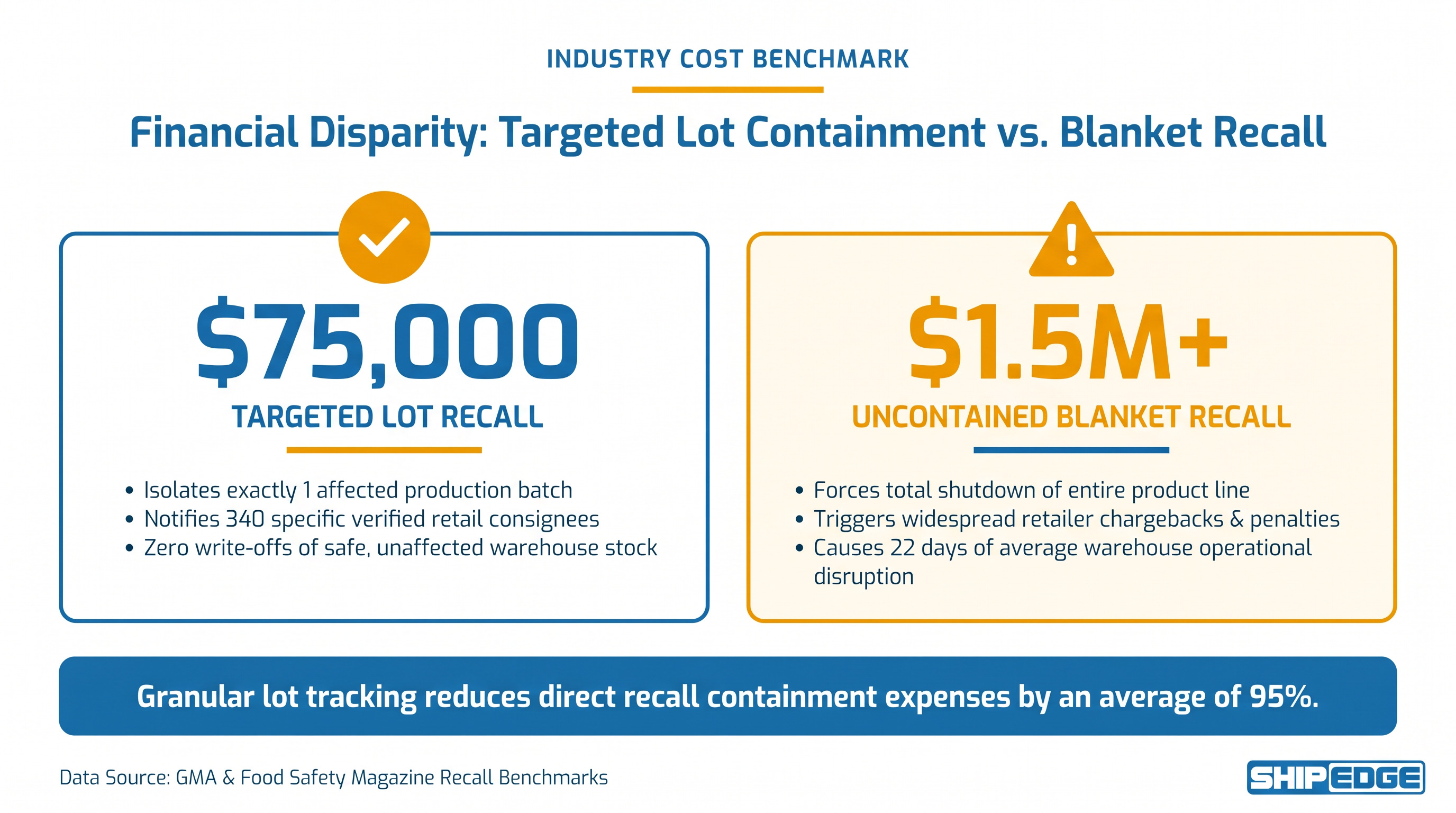
The financial damage of an uncontained recall extends far beyond wholesale inventory losses. Product recalls routinely cost millions in reverse logistics, disposal fees, and crisis communications. Without surgical lot isolation, these expenses multiply exponentially.
Executing an emergency recall requires specialized, high-cost procedures. Facilities pay premium rates to retrieve distributed products from retail hubs and consumer doorsteps. Structured recall management protocols help logistics providers contain freight surcharges, meet statutory deadlines, and avoid severe regulatory penalties.
The costliest consequence of poor traceability is the blanket recall. When a facility cannot prove which pallet holds a compromised lot, regulators mandate scrapping the entire SKU. If contamination impacts only 5,000 units ($75,000) of a 100,000-unit catalog ($1.5 million), targeted isolation preserves $1,425,000 in stock. Without precise lot number tracking, everything is destroyed.
Brand clients trust 3PLs to maintain regulatory custody. If a facility ships recalled goods due to poor tracking, the brand faces headlines, lawsuits, and retail delisting. Advanced batch tracking software protects distributor relationships by preventing non-compliant shipments and eliminating costly vendor chargebacks.
At its core, lot tracking groups finished goods sharing identical manufacturing parameters, production dates, and supplier inputs under a unique identifier. Lot control maintains an unbroken digital record of batch origin, storage location, and customer orders.
Lot numbers and batch codes group items produced under identical conditions, balancing tracking precision with rapid fulfillment. Serial numbers track individual items, which is essential for electronics but impractical for high-velocity goods. Robust inventory lot control embeds batch genealogy directly into the warehouse location map, creating complete inventory traceability across every storage zone.
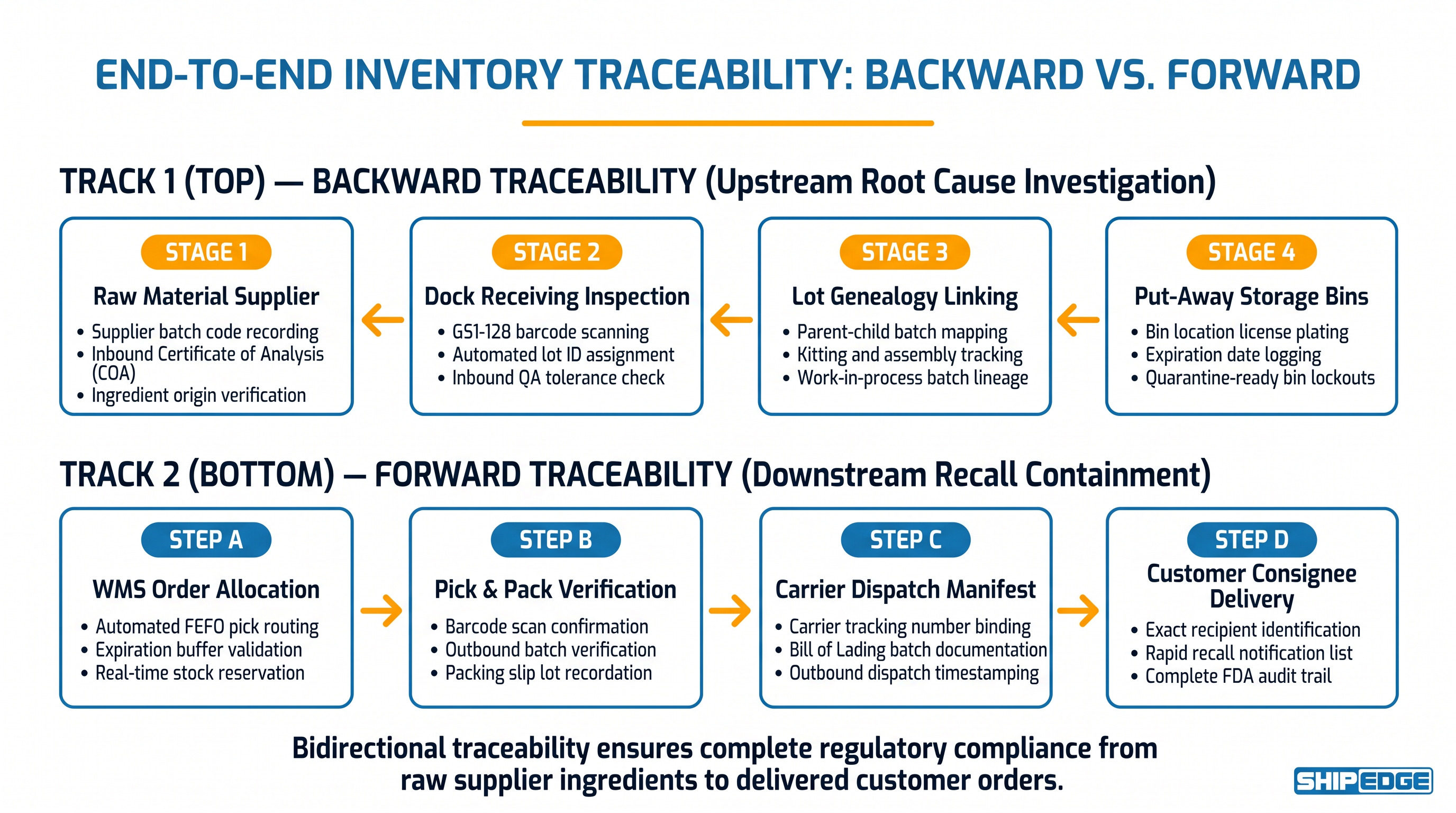
Effective traceability is bidirectional. Backward traceability allows managers to trace finished goods backward to original suppliers, purchase orders, and receiving docks. If a supplier identifies an undeclared allergen, backward traceability instantly reveals every finished SKU incorporating that input, holding vendors accountable with verifiable receiving records.
Forward traceability documents the outbound pathway of every departing item. When a recall strikes, forward traceability generates an instantaneous manifest of on-hand bins, retail recipients, and consumer delivery addresses. According to the FDA recall guidelines, rapid forward notification is vital for public health protection.
While lot tracking enables emergency containment, disciplined inventory rotation prevents aging crises. Facilities handling food, cosmetics, pharmaceuticals, and chemicals must replace static storage models with dynamic picking logic that accounts for product freshness.
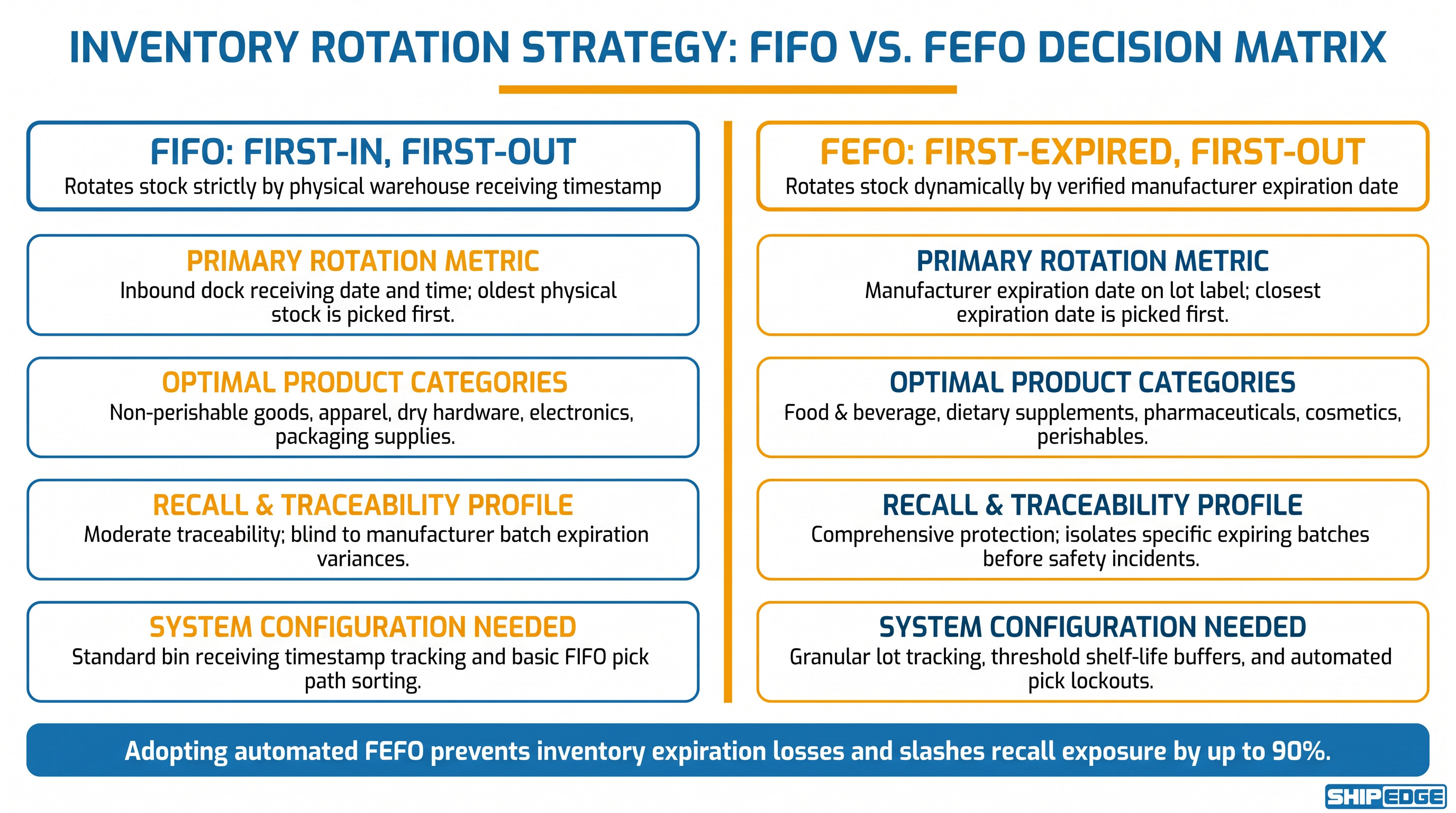
First-In, First-Out (FIFO inventory management) is the foundational rotation standard for non-perishable goods. FIFO directs pickers to dispatch the oldest recorded inventory before newer shipments are touched. Without system-directed FIFO picking, workers naturally pull pallets from front-facing locations, leaving deep stock to degrade past allowable shelf-life windows.
When evaluating fifo vs fefo, the critical differentiator is the presence of hard expiration dates. In perishable goods, receipt dates do not guarantee freshness. First-Expired, First-Out (FEFO) dynamically routes pickers to the batch with the closest expiration date regardless of arrival time, minimizing retail returns and eliminating expired shipments.
Modern operations rely on proactive expiration date management features that alert managers weeks before products enter decay windows. Implementing automated expiration date tracking establishes threshold buffers matching retailer rules. An intelligent WMS automatically flags lots approaching safety limits, reclassifying them for clearance before they become waste.
When recalls strike, speed determines survival. Manual tracking consumes days, risking accidental shipments. A modern warehouse management system automates containment across four phases:
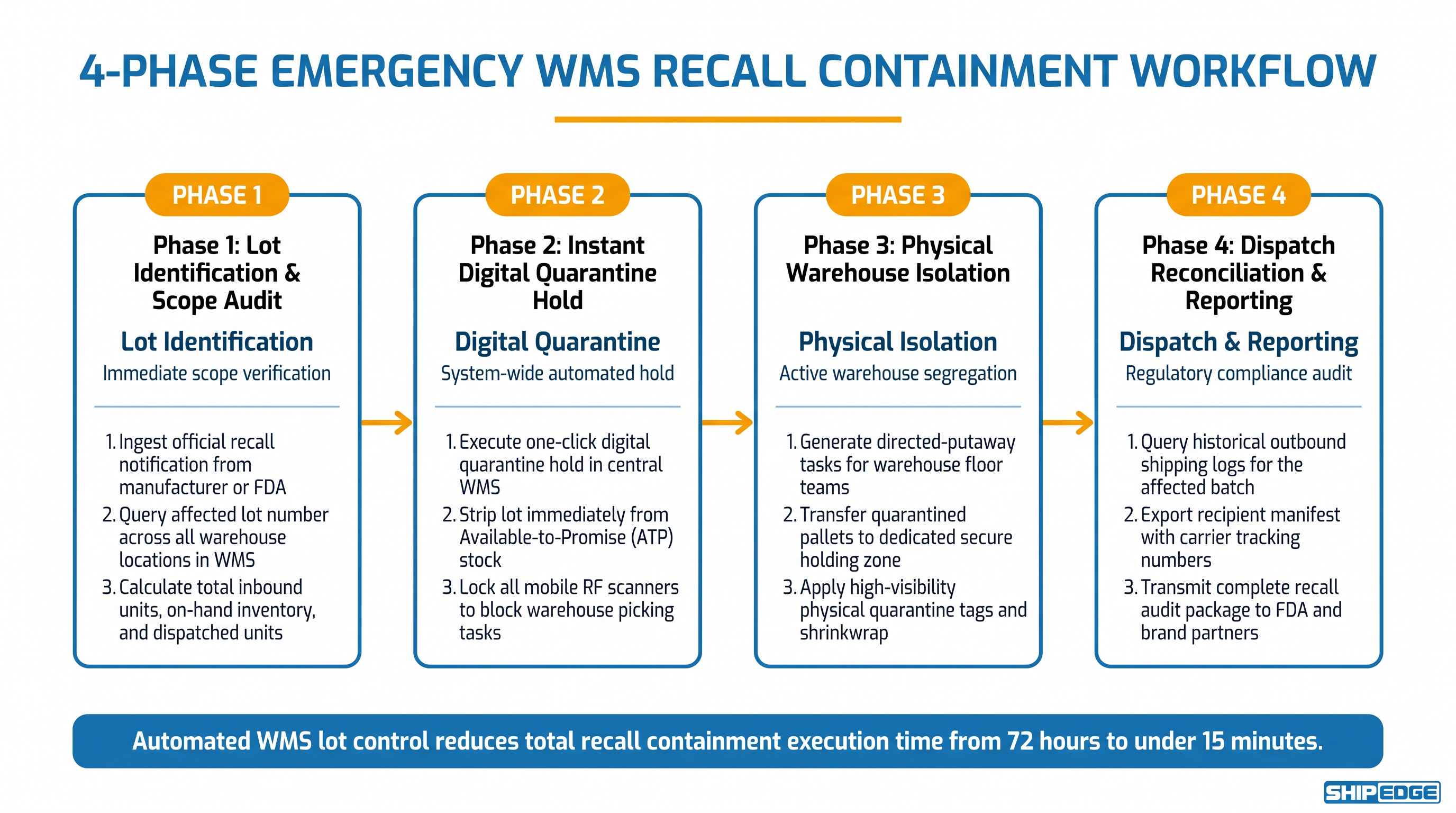
Recall preparedness begins at the receiving dock. Facilities enforce mandatory lot number and expiration date capture during inbound scans. Associates scan GS1-128 or 2D barcodes on master cartons. The WMS validates batch formats and forces confirmation before printing scannable pallet labels, halting put-away if data is missing.
Upon receiving a recall notice, managers input the compromised lot to trigger a quarantine inventory hold. With one click, the system applies a facility-wide digital hold and executes batch number isolation. For operations teams seeking granular inventory control, newer platforms like BinLogic offer real-time stock visibility across multiple locations at an accessible investment level. This digital hold immediately removes the lot from Available-to-Promise inventory, halting order allocation instantly.
Digital quarantine rules translate directly to the warehouse floor. If a picker approaches a quarantined bin, the WMS intervenes at the handheld device level. Scanning a locked bin triggers an audible alarm and physically blocks the transaction. The terminal prompts the picker to bypass the location and alerts supervisors immediately.
While active stock is locked down internally, the WMS generates downstream trace reports. Scanning historical dispatch logs identifies every shipment containing the affected lot. The resulting manifest details tracking numbers, carriers, ship dates, and customer addresses, delivering clean compliance records for immediate customer outreach.
Industry regulators like the FDA and USDA FSIS expect logistics facilities to demonstrate proactive recall preparedness. Review your facility against this 10-point checklist to resolve traceability vulnerabilities before an emergency strikes:
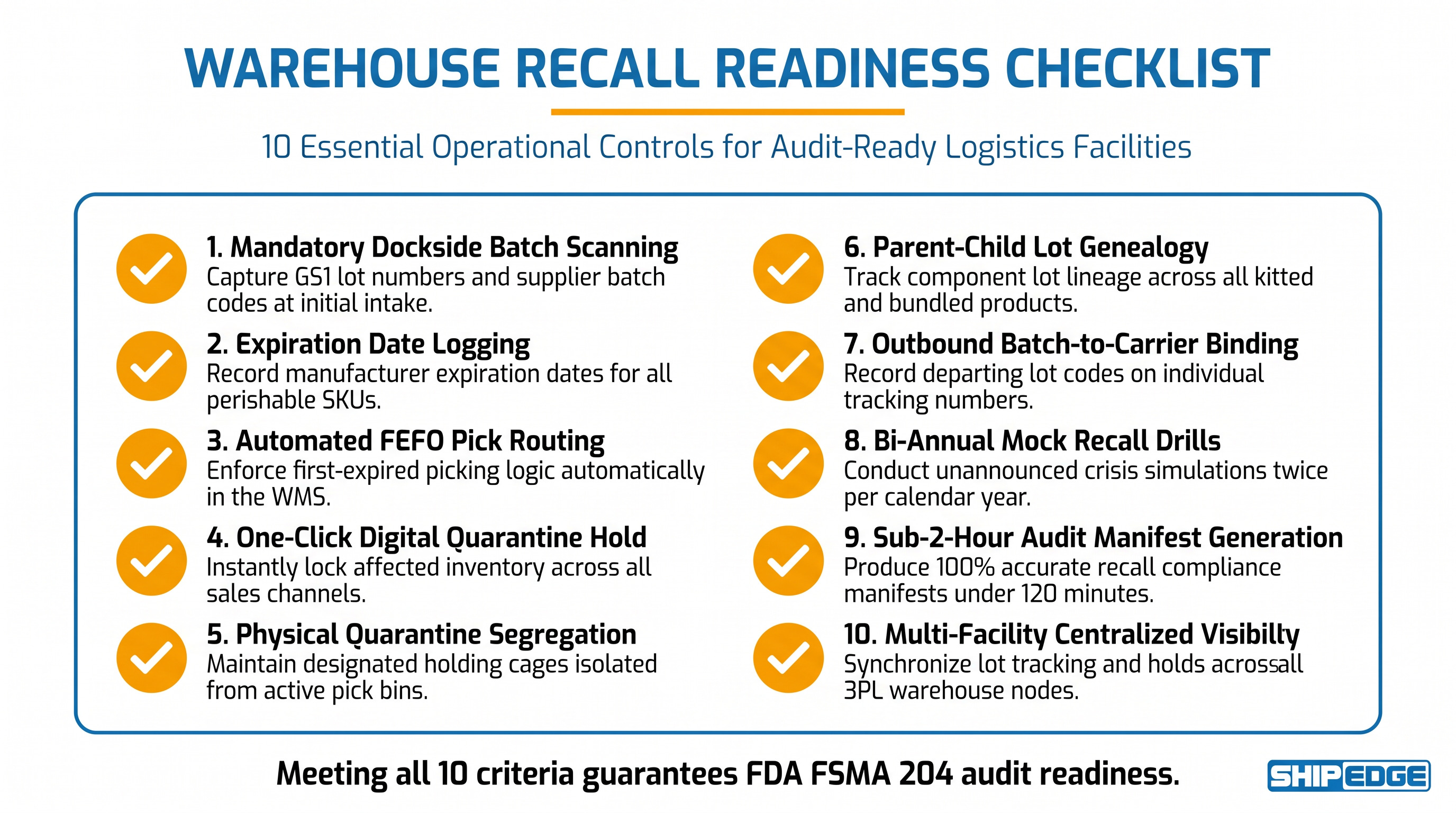
Dock scanning forms your primary barrier against untracked batches. Mobile scanners cross-reference supplier shipping notices via EDI 856 feeds. If box barcodes do not match ASN data, the WMS halts receiving and alerts inspectors immediately.
Digital holds require swift physical segregation to ensure complete batch number isolation. When a recall occurs, managers place suspect stock on a formal quarantine inventory hold and transfer pallets to a dedicated quarantine cage. Restricted-access physical zones guarantee total chain of custody until authorized disposal or return freight is dispatched.
Simulated crisis exercises verify recall readiness under pressure. Leading 3PLs execute unannounced mock recall drills bi-annually. Teams must locate on-hand inventory, map customer shipments, and produce audit manifests within two hours. Regular mock recall drills ensure rapid product recall containment and prove inspection readiness.
Handling complex inventory compliance across high-volume omnichannel fulfillment requires enterprise software designed around inventory integrity. Shipedge provides 3PLs and high-growth brands with native, industrial-grade lot and expiration date controls built directly into its core warehouse architecture.
Shipedge treats lots as dynamic inventory dimensions rather than static text notes. Every received unit is bound to its production lot, expiration date, and bin coordinate. When teams execute kitting or bundling, Shipedge maintains multi-level parent child lot genealogy. If a component is recalled, Shipedge traces that parent child lot genealogy to flag every finished multipack containing that item.
For brands utilizing distributed fulfillment networks, Shipedge unifies batch tracking visibility across facilities in a single interface. When a recall strikes, managers execute enterprise-wide quarantine holds across every building simultaneously. Built-in compliance reporting generates instant forward-and-backward audits satisfying FDA FSMA 204 compliance mandates, ensuring ongoing FDA FSMA 204 compliance during official audits.
The sudden wave of major product recalls in late October 2026 serves as an urgent wake-up call for the entire logistics industry. Whether triggered by heavy metal contamination, warehouse refrigeration system failures, or subtle manufacturing deviations, unexpected safety crises are inevitable across modern omnichannel supply chains.
The difference between a manageable, routine product isolation and a catastrophic multi-million-dollar disaster lies entirely in your facility’s technology stack. Spreadsheets and static inventory counts cannot keep pace with the velocity of modern fulfillment. Implementing comprehensive lot tracking, rigorous FEFO rotation, and automated digital quarantine protocols ensures your operations team can respond to any crisis with speed, precision, and complete regulatory compliance.
Ready to safeguard your warehouse against recall risks and automate your inventory lot control? Shipedge equips 3PLs and growing brands with enterprise-grade traceability, expiration date management, and real-time inventory control. Request a demo today and see how our modern warehouse management system keeps your operations protected and audit-ready.
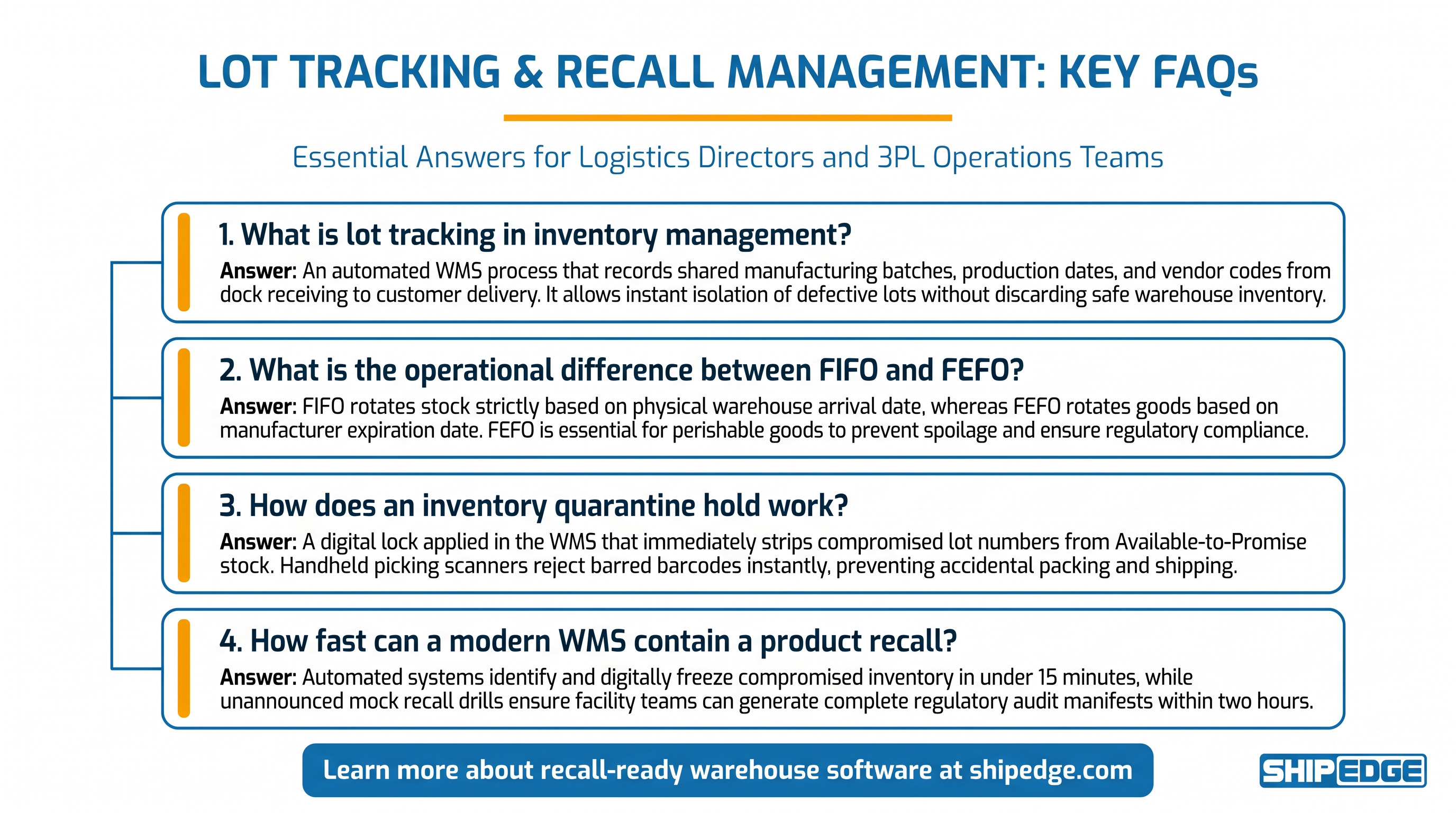
Lot tracking is an automated warehouse management process that groups products by shared production run, manufacturing date, and supplier batch code. It tracks these units as a cohesive group from initial receiving through storage, picking, packing, and final delivery. This visibility enables warehouses to isolate specific defective batches during safety recalls without impacting unaffected stock across the facility, saving significant inventory capital.
In modern logistics terminology, lot tracking and batch tracking are functionally identical and often used interchangeably across operations. Both refer to tracking groups of products that share common manufacturing attributes. Some process manufacturing sectors distinguish batches as raw material mixtures and lots as packaged finished goods; advanced warehouse management solutions track both seamlessly across parent-child genealogies to maintain end-to-end chain of custody.
FIFO (First-In, First-Out) directs pickers to dispatch the oldest inventory based on warehouse arrival date, making it ideal for non-perishable consumer products. FEFO (First-Expired, First-Out) directs pickers based strictly on product expiration dates, ensuring items closest to expiration ship first regardless of when they arrived. FEFO is essential for perishable goods, cosmetics, and pharmaceuticals to prevent decay and regulatory compliance failures.
When an administrator places a lot on quarantine hold, the WMS instantly removes those items from Available-to-Promise inventory across all integrated sales channels. Simultaneously, the system updates handheld RF scanner logic to reject any attempt to pick, move, or pack items from that lot, alerting floor supervisors with audio alarms and visual lockout screens to prevent accidental customer fulfillment across facilities.
FDA FSMA Rule 204 establishes strict traceability recordkeeping requirements for foods on the Food Traceability List. Warehouses must capture and maintain Critical Tracking Events and Key Data Elements, including lot codes, receiving dates, and shipment destinations. Facilities must be capable of providing this digital traceability data to regulators in a sorted electronic spreadsheet within 24 hours of an official inquiry.
A mock recall drill is a simulated crisis exercise that tests a facility’s operational ability to locate, quarantine, and account for 100% of a specific product lot across warehouse bins and outbound shipment records. High-compliance warehouses conduct mock recalls bi-annually, targeting complete trace verification and audit manifest generation in less than two hours to ensure regulatory audit readiness under pressure.
While micro-businesses occasionally attempt manual lot tracking using spreadsheets or paper clipboards, this approach reliably fails as order volume grows. Manual tracking creates severe human data entry errors, cannot block pickers in real time, and slows recall response times from minutes to weeks, leaving operations exposed to catastrophic regulatory penalties, distributor delisting, and extensive commercial product liability risks across operations.