TLDR Audio Summary
Get Access
Full audio article & PDF resources.
eCommerce
Shipedge
October 29, 2026
TLDR Audio Summary
Full audio article & PDF resources.
Title: Quick Commerce: Why DoorDash & Instacart Reshape Fulfillment Meta Description: DoorDash and Instacart are now instant fulfillment networks. Discover how quick commerce reshapes e-commerce inventory sync, order routing, and SLA execution. Slug: quick-commerce-fulfillment-doordash-instacart OG Title: Quick Commerce: Why DoorDash & Instacart Reshape Fulfillment OG Description: DoorDash and Instacart are now instant fulfillment networks. Discover how quick commerce reshapes e-commerce inventory sync, order routing, and SLA execution. OG Image: https://cdn.prod.website-files.com/66c49fa03d49b4159d143d54/quick-commerce-hero.png Canonical: https://www.shipedge.com/blog/ecommerce/quick-commerce-fulfillment-doordash-instacart
Quick commerce is an ultra-fast fulfillment model delivering retail goods within 15 to 60 minutes via micro-fulfillment hubs, dark stores, and crowdsourced couriers. As DoorDash and Instacart expand into consumer retail, e-commerce brands must modernize inventory architectures to support real-time synchronization, distributed nodes, and sub-hour dispatch.
For years, digital retail operated on a predictable fulfillment rhythm: customer orders arrived, warehouse pickers batched items during single shifts, and parcel carriers collected freight for standard two-day transit. Today, that conventional delivery model is no longer enough to protect your brand's market share against rapid fulfillment alternatives.
DoorDash and Instacart are aggressively expanding across consumer retail, beauty, electronics, and apparel. What began as restaurant takeout and grocery delivery has matured into nationwide on-demand fulfillment networks. These platforms now offer millions of non-food stock keeping units (SKUs) to local shoppers with delivery windows measured in minutes rather than business days.
This operational shift represents the rapid rise of quick commerce as a permanent commercial channel. When consumers order cosmetics, electronics, or apparel on DoorDash and receive them within 45 minutes, traditional shipping timelines lose appeal. For operations leaders, ignoring these networks is no longer viable as competitors leverage instant commerce to capture market share.
Winning in this landscape requires more than simply listing your catalog on a third-party mobile app. Quick commerce demands sub-second inventory visibility, dynamic buffer allocation, and warehouse execution optimized for immediate courier dispatch. Without modernized fulfillment infrastructure, brands face severe stockouts, canceled orders, and costly algorithm penalties across on-demand delivery channels.
To understand the quick commerce revolution, operations executives must look past consumer branding. DoorDash and Instacart operate as massive, hyper-localized on-demand logistics networks engineered to fulfill consumer orders across every retail category. This transformation is reshaping modern e commerce logistics from regional distribution into hyper-local urban dispatch.
Over the past 24 months, both platforms systematically onboarded tens of thousands of national retail partners. Official disclosures from DoorDash Investor Relations document partnerships spanning beauty, footwear, and specialty retail. Similarly, Instacart expanded its marketplace to encompass consumer electronics, home improvement, pet supplies, and apparel. By layering general merchandise onto existing driver density, these networks achieve unit economics that traditional parcel carriers cannot match over short distances. Specialized instacart fulfillment programs now allow retail brands to activate catalog items across thousands of urban zip codes simultaneously.
The architectural backbone of rapid delivery relies heavily on micro-fulfillment centers and dedicated dark stores. DoorDash continues to scale its proprietary DashMart network, which functions as urban distribution nodes closed to walk-in foot traffic. These micro-warehouses store high-velocity retail SKUs within dense population centers, allowing pickers to stage packages within five minutes of order ingestion. Retailers also convert backrooms into dark nodes, effectively utilizing dark store fulfillment strategies to bridge geographic distance directly to customer doorsteps.
Consumer tolerance for shipping latency has deteriorated sharply across all retail segments. When an online shopper needs an urgent replacement cable, a cosmetic product, or pet supplies, a two-day shipping window is an immediate disqualifier. The brand that captures the transaction is the one capable of fulfilling that demand within the hour through reliable sub-2-hour fulfillment workflows. This shift transforms instant commerce from an experimental marketing channel into an essential operational capability that directly drives customer retention.
The rapid maturation of quick commerce creates fundamental strategic challenges for traditional e-commerce brands. Consumer expectations established by rapid grocery delivery have migrated directly into lifestyle, apparel, and consumer packaged goods. Adapting your supply chain requires balancing operational speed against margin economics within a cohesive omnichannel fulfillment strategy.
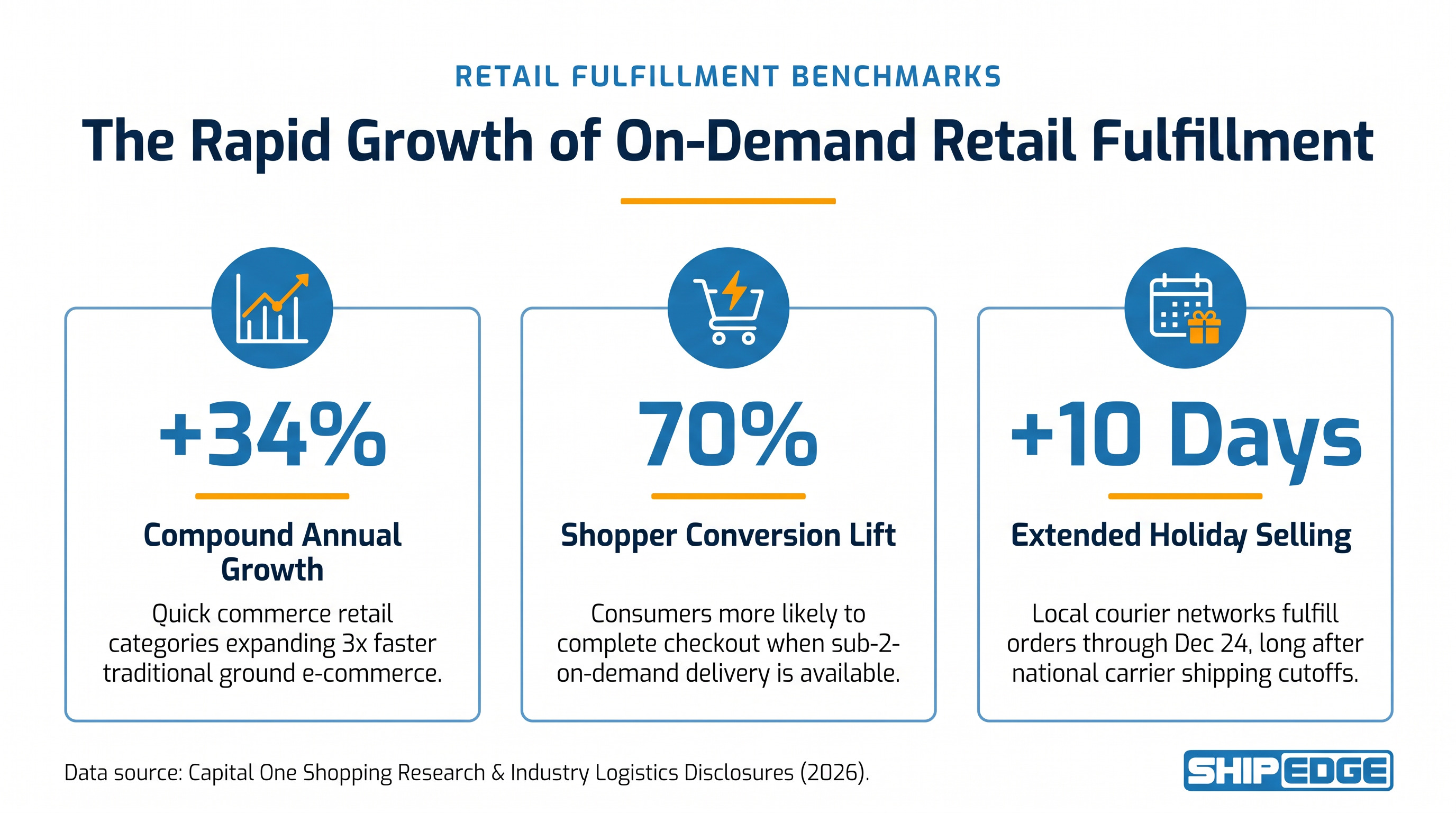
Consumer behavior research reveals a clear flight toward immediate fulfillment. According to commercial data compiled by Capital One Shopping Research, over 70% of online shoppers state they are significantly more likely to complete a purchase when same-day on demand delivery is available. Furthermore, quick commerce categories are expanding at a compound annual growth rate exceeding 34%, dramatically outpacing conventional e-commerce growth. Providing sub-hour delivery options has transitioned from a luxury perk into a baseline conversion driver.
Every year, e-commerce brands face a hard operational cliff during peak holiday season. Traditional parcel carriers like UPS, FedEx, and USPS impose strict shipping cutoff dates around December 15 to 18 for guaranteed Christmas delivery. After those dates pass, online conversion rates collapse as shoppers fear late arrivals. Because platforms like DoorDash and Instacart fulfill orders locally within hours, brands leveraging urban nodes can continue accepting gift orders through December 24. This capability extends peak Q4 selling windows by up to ten days while eliminating carrier transit surcharges.
Selling on third-party on-demand marketplaces introduces complex unit economics. Platforms typically charge merchant commission fees ranging between 10% and 25%, depending on order volume and fulfillment integration. However, forward-thinking operations teams evaluate these fees through the lens of blended customer acquisition cost (CAC). Sales generated through these platforms function as paid customer acquisition that simultaneously covers operational product costs and expands brand visibility.
Entering quick commerce channels exposes severe vulnerabilities inside traditional fulfillment operations. Many merchants integrate their product catalog with an on-demand marketplace expecting it to function like another sales channel. Within days, the operational reality of rapid delivery creates chaos inside their facilities as staff struggle to coordinate store fulfillment with warehouse queues.
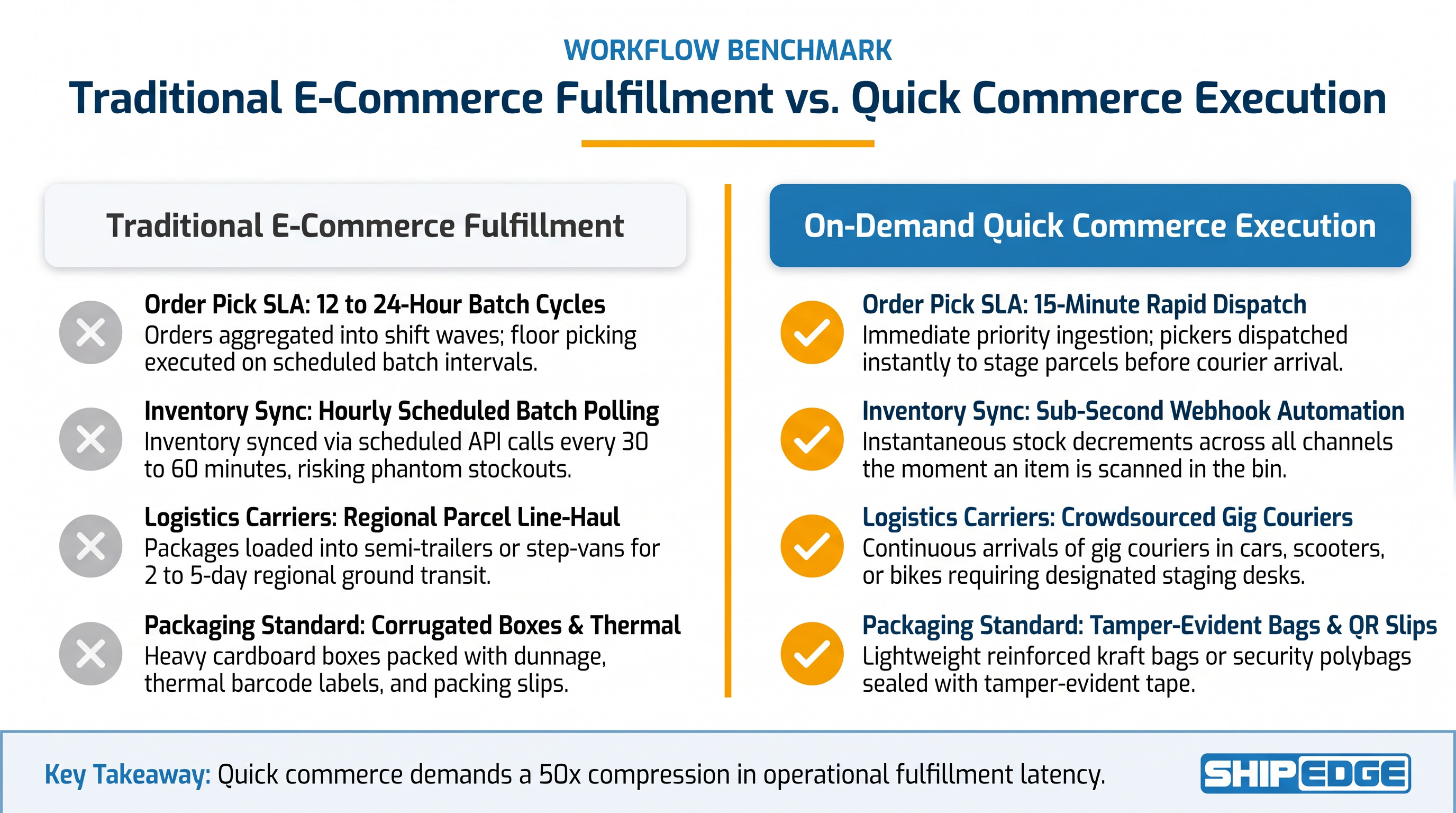
In traditional e-commerce fulfillment, operations teams operate against batch-picking schedules with service level agreements (SLAs) of 12 to 24 hours. Quick commerce operates on an entirely different cadence. When an order lands from DoorDash or Instacart, a courier is dispatched immediately and often arrives within 12 to 18 minutes. Warehouse and retail staff must ingest the order, pick the exact items, pack the parcel, and stage it for driver hand-off within a strict 15-minute window. Failing to meet this pick window leads to courier cancellations and algorithm de-ranking.
The most dangerous hazard in rapid fulfillment is phantom inventory. If your inventory management system updates stock levels via hourly batch synchronization, an item sold online 20 minutes ago may still display as available on Instacart. When a courier arrives and staff cannot locate the product, an out-of-stock cancellation occurs. These cancellations trigger severe algorithmic penalties, including store demotions, lower search visibility, and monetary cancellation fines that erode gross margins.
Traditional loading docks are engineered for high-volume tractor-trailers and scheduled parcel carrier vans. Gig couriers arriving from on-demand networks require a completely different operational approach. Drivers arrive continuously throughout the day in passenger vehicles, bicycles, or scooters. They require a designated, secure pickup desk with clear exterior signage and rapid verification protocols so staff avoid losing time searching for couriers.
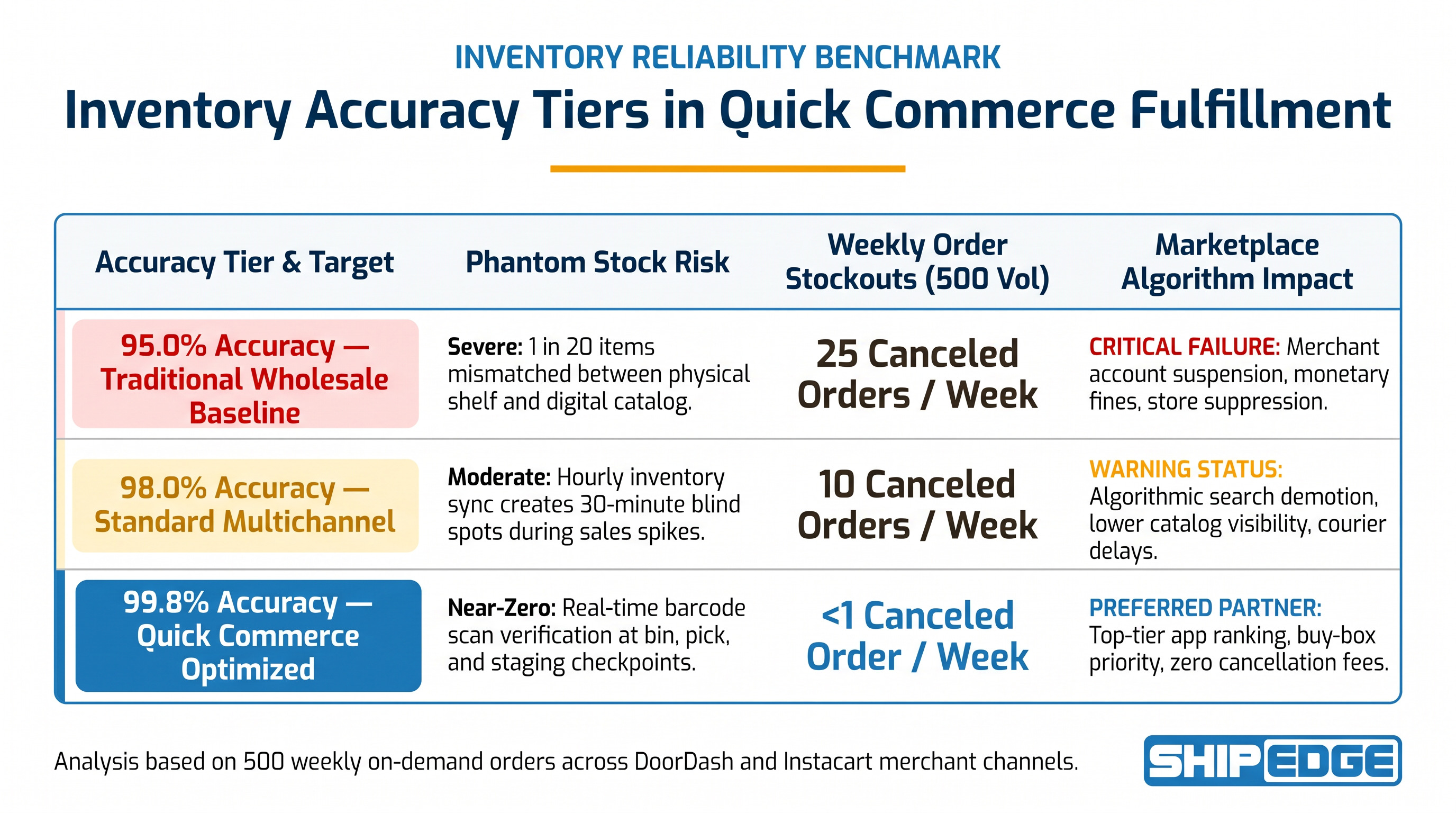
High-speed fulfillment is mathematically impossible without exceptional inventory control. While a standard wholesale or direct-to-consumer business can survive with 95% inventory accuracy by issuing backorders or customer service notifications, that margin of error is disastrous in rapid delivery networks. A reliable real-time inventory sync mechanism is essential to prevent inventory discrepancies.
Consider an e-commerce facility processing 500 on-demand orders per week at a 95% inventory accuracy rate. That five percent variance translates into 25 failed orders, 25 frustrated gig couriers waiting idle, and 25 disappointed consumers. In the quick commerce ecosystem, that level of failure results in merchant suspension. Achieving success in rapid commerce requires maintaining physical inventory accuracy above 99.5% across every bin location and shelf tag. In high-velocity warehouse environments, solutions like BinLogic focus on real-time bin-level tracking and rapid put-away workflows that keep physical stock synchronized with digital storefronts.
To safeguard against overselling, sophisticated merchants implement dynamic inventory buffering rules across their product catalog. Rather than exposing 100% of physical warehouse stock to on-demand marketplaces, software logic creates a virtual inventory buffer stock based on sales velocity. For example, if an SKU has 40 units remaining, the system caps exposed inventory on DoorDash at 30 units, reserving 10 units as a buffer against simultaneous website purchases. This automated throttling protects brand reputation during promotional sales spikes.
Traditional e-commerce platforms rely on scheduled application programming interface (API) polling, syncing inventory tallies every 30 to 60 minutes. In a quick commerce environment where inventory moves in real-time increments, batch polling creates unacceptable vulnerability windows. Modern fulfillment architectures require webhooks and sub-second event-driven synchronization to broadcast instant decrements across all channels the moment an item is scanned. Maintaining dark store fulfillment hubs without real-time sync inevitably leads to severe stock allocation failures.
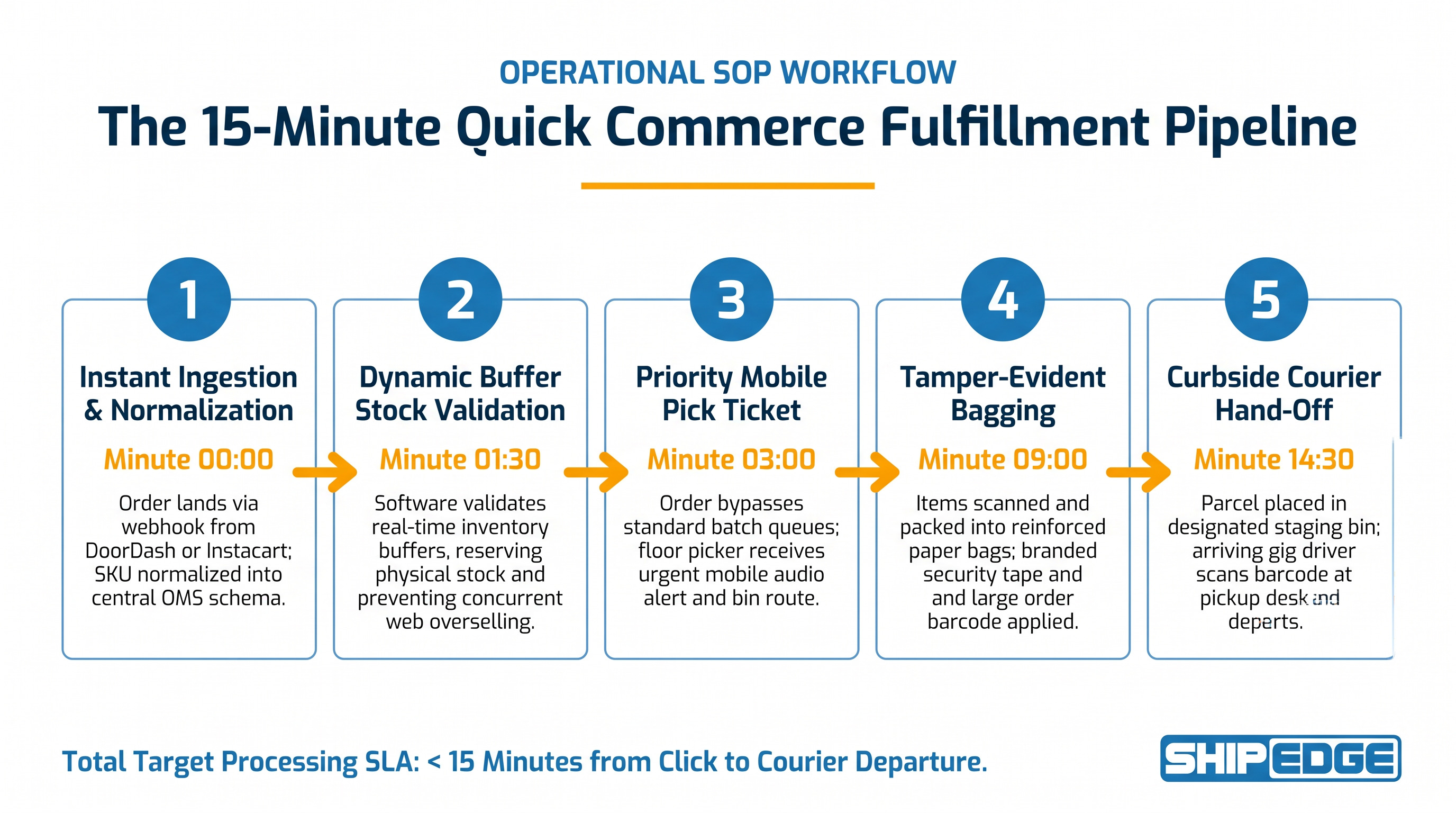
Successfully incorporating on demand fulfillment into your supply chain does not require rebuilding your fulfillment network from scratch. It requires establishing rigid operational boundaries, automated priority routing, and specialized pick-pack protocols designed specifically for rapid hand-off. Managing these elements seamlessly prevents disruption to core wholesale and D2C fulfillment.
When an on-demand order lands, your fulfillment software must prioritize it over standard ground-shipping orders. Delaying a DoorDash order by 30 minutes results in a missed SLA and courier abandonment. Your warehouse management rules must automatically assign incoming quick commerce orders to high-priority pick queues, alerting floor personnel immediately with audio and visual cues on handheld devices to pick the item before resuming batch tasks. This structured prioritization ensures consistent compliance with 15-minute hand-off thresholds.
Brands with existing brick-and-mortar storefronts possess a massive structural advantage in quick commerce. Instead of relying exclusively on centralized suburban fulfillment centers located far from city centers, brands can execute store fulfillment directly from local retail shelves. By deploying an enterprise order management system, incoming orders route to the closest retail location with verified stock, activating hyper-local retail inventory without expanding warehouse footprints.
Quick commerce packaging requirements differ fundamentally from standard e-commerce parcels. Corrugated shipping boxes and thermal shipping labels are inefficient for sub-hour transit over short delivery radiuses. Operations should utilize heavy-duty paper shopping bags or tamper-evident polybags secured with branded security seals. Thermal receipts displaying the marketplace order number in large typography allow couriers to verify items in seconds, minimizing curbside dwell times.
Scaling an on-demand delivery program alongside traditional wholesale and direct-to-consumer operations requires a resilient, multi-tiered technological architecture. Disconnected software silos create inventory blind spots and manual fulfillment friction that prevent sustainable expansion. Modern brands must deploy comprehensive multi channel order management systems to orchestrate disparate order streams effectively.
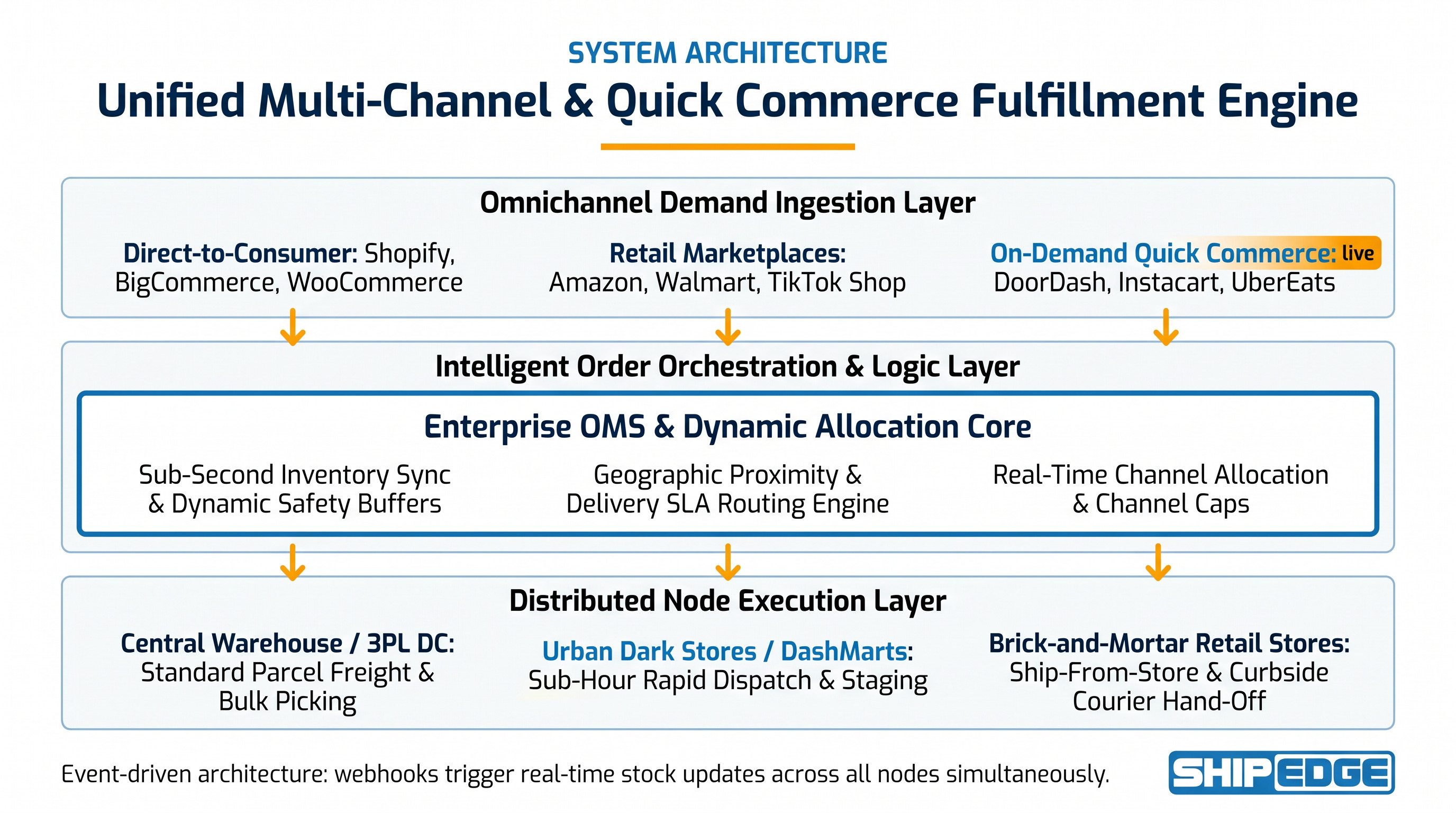
An enterprise fulfillment architecture must ingest order streams from every sales endpoint into a centralized control center. Whether an order originates on Shopify, Amazon, TikTok Shop, a wholesale connection, DoorDash, or Instacart, it must normalize into a standard data schema. This unified ingestion gives operational executives single-pane visibility over total inventory commitments, live order volume, and labor allocation across all fulfillment workflows. Automated order routing logic evaluates every ticket against real-time operational constraints.
The core technical challenge of on-demand fulfillment is geographic routing. When an order arrives with an expectation of delivery within 45 minutes, fulfillment logic cannot route that ticket to a regional warehouse located states away. Automated order orchestration calculates real-time proximity rules, querying local urban micro-fulfillment centers and inventory availability to route tickets to the optimal point of dispatch. By pairing accurate geofencing with real-time inventory sync, brands ensure sub-2-hour fulfillment promises are consistently met.
Maintaining manual order routing across complex channel environments is an unsustainable operational liability. Modern multichannel networks depend on automated routing engines capable of executing complex business rules in milliseconds. For growing brands evaluating multichannel routing options, platforms like OmniOrders provide a purpose-built alternative designed to unify retail order streams without the complexity of legacy enterprise software. These specialized tools enable merchants to expand sales channels without compromising warehouse throughput.
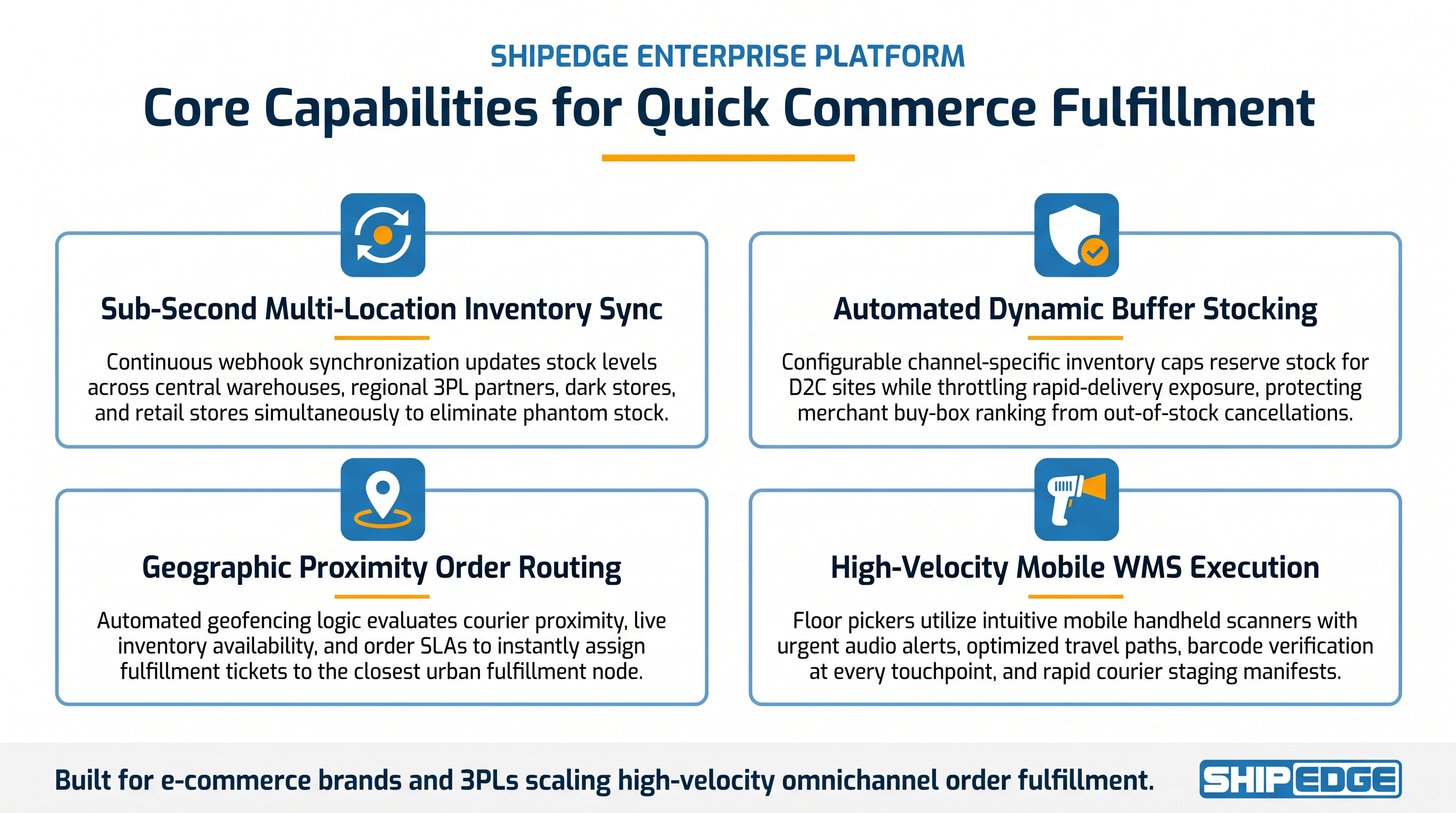
Operating a modern, high-velocity distribution network requires an infrastructure layer built for complex multi-channel execution. Shipedge delivers the unified technology stack that enables brands and 3PLs to integrate on-demand quick commerce networks without disrupting core warehouse efficiency. Our software connects seamlessly to emerging retail channels while safeguarding order accuracy.
The cornerstone of the Shipedge platform is its high-performance inventory management engine. Built specifically for high-volume multichannel merchants, Shipedge tracks stock levels across central warehouses, regional 3PL partners, dark stores, and retail backrooms with sub-second accuracy. By enforcing automated inventory buffer stock rules and dynamic channel caps, Shipedge protects your brand from stockouts and platform penalties on DoorDash, Instacart, and retail marketplaces alike.
Shipedge’s comprehensive omnichannel fulfillment capabilities eliminate the friction of managing disparate sales channels. The system automatically ingests orders, evaluates SLA constraints, and routes fulfillment tickets to the optimal geographic node based on proximity, stock availability, and shipping economics. Sophisticated order routing logic ensures high-priority quick commerce orders bypass standard batch queues and route directly to mobile picking stations with immediate operator alerts.
Inside the four walls of your distribution facility, the Shipedge warehouse management system optimizes physical movement for rapid turnaround. Floor personnel utilize intuitive mobile workflows that support wave picking, zone picking, and expedited single-item dispatch. With precise bin-level tracking, barcode verification at every touchpoint, and automated staging manifests, Shipedge reduces pick-and-pack times from hours down to minutes across all distribution nodes. These advanced capabilities position third-party logistics providers to offer premium instacart fulfillment and rapid dispatch services to high-growth e-commerce merchants.
The expansion of DoorDash and Instacart into consumer retail marks a permanent shift in customer expectations. Quick commerce is no longer an experimental niche reserved for late-night snacks and groceries; it has become an essential distribution channel for modern e-commerce brands across apparel, cosmetics, electronics, and home essentials.
Thriving in this hyper-fast environment requires bridging the operational gap between traditional warehouse workflows and sub-hour delivery demands. Brands that master real-time inventory synchronization, dynamic safety buffering, and intelligent multi-node routing will capture market share and customer loyalty, while those relying on outdated batch systems will struggle with costly stockouts and operational friction.
Transforming your fulfillment infrastructure is the key to turning the quick commerce challenge into a lasting competitive advantage. Discover how Shipedge empowers high-growth brands and 3PLs with enterprise order orchestration and precision warehouse management. Request a demo today to see how our unified platform connects your inventory to the modern on-demand economy.
Quick commerce, also known as q-commerce, is an on-demand e-commerce model designed to deliver retail goods to consumers in under an hour, frequently within 15 to 45 minutes. The process operates through hyper-local micro-fulfillment centers, dark stores, or retail partner locations integrated with crowdsourced courier networks. Advanced order management software ingests orders, triggers immediate picking, and coordinates courier dispatch to complete rapid local transit.
DoorDash and Instacart fulfill non-food retail orders using two primary operational models. In the partner store model, retail partners connect inventory systems to the platform, and gig couriers pick items directly from retail shelves or collect pre-staged packages from store staff. In the dark store model, platforms leverage dedicated micro-warehouses, such as DashMart, stocking high-velocity retail SKUs for rapid internal pick, pack, and courier dispatch.
Quick commerce platforms cause stockouts when merchants rely on batch inventory updates rather than real-time synchronization. Traditional systems sync inventory every hour, creating blind spots where items sold online or in-store remain visible on delivery apps. When on-demand couriers arrive for missing items, orders are canceled. These stockouts trigger severe platform penalties, fines, and algorithmic demotions in local search rankings.
Traditional e-commerce fulfillment relies on centralized regional warehouses, batch-picking workflows, 24-hour processing SLAs, and national parcel carriers delivering packages across two to five business days. In contrast, quick commerce depends on hyper-local urban nodes, immediate single-order picking within 15 minutes, tamper-evident bag packaging, and crowdsourced couriers delivering within sub-hour windows. The operational tempo requires continuous real-time inventory visibility and dedicated curbside courier staging hubs.
Integrating same-day delivery into an existing warehouse requires segmenting rapid-delivery workflows from standard bulk-processing lines. Incoming on-demand orders receive top queue priority via warehouse management software. Floor pickers receive instant mobile notifications to pick items immediately. Packaged orders are staged in an accessible courier pickup depot with dedicated parking, allowing gig drivers to collect packages without entering secure industrial zones.
Connecting to on-demand networks requires an omnichannel order management system (OMS) and warehouse management system (WMS) capable of sub-second inventory synchronization. The software must support real-time webhooks, dynamic inventory safety buffers, automated channel allocation, and intelligent proximity routing. This technological infrastructure ensures orders route to the correct urban node while preventing simultaneous overselling across other connected e-commerce storefronts and regional warehouses.
Order fulfillment in quick commerce represents the compressed, high-velocity execution of order ingestion, rapid picking, specialized packaging, and courier hand-off within a 15-minute operational SLA. Unlike conventional fulfillment that optimizes for labor batching and pallet density, on-demand fulfillment prioritizes absolute throughput speed, real-time data integrity, and seamless hand-off to local gig couriers navigating urban delivery radiuses under tight deadlines.