EN │ ES
Raul Chavez Valdivia Velarde
09/01/2026
15 minutes
Understanding how to calculate ROI for OMS/WMS investment remains one of the most challenging aspects of modernizing fulfillment operations. We have worked with hundreds of warehouse managers, e-commerce business owners, and fulfillment center operators who recognize the need for better systems but struggle to articulate the financial justification. The initial investment cost in warehouse management systems represents a significant commitment, and stakeholders rightfully expect a clear business case that demonstrates measurable returns.
The challenge most operations face is not whether they need better technology—that much is usually obvious. The real difficulty lies in quantifying the current costs of inefficiency and projecting the operational savings that modern fulfillment systems can deliver. Without this foundation, even the most compelling operational arguments fall short when finance teams ask for concrete numbers regarding the gain from investment and the total value added to the business.
Building a comprehensive business case for warehouse management system investment extends far beyond securing budget approval; it is about defining the importance of roi for the entire organization. When we help operations calculate their expected return on investment, we are actually establishing the framework for measuring success over time. This calculation compels leadership to scrutinize current processes critically and pinpoint precisely where money and efficiency are being wasted every day.
The process of calculating ROI creates accountability on both sides of the decision. Your organization sets clear expectations for what the investment should deliver, and you establish metrics that can be tracked monthly and quarterly to prove financial performance. We have seen too many implementations where operations could not determine whether the system delivered value because they never defined what success looked like before signing the contract. Proper ROI calculation prevents this outcome by creating specific, measurable targets that everyone agrees on upfront, effectively improving the financial situation of the company.
Also, the exercise of building your business case is a bit of a pain point you may not have fully appreciated. When you quantify the annual cost of shipping errors or calculate the overtime expenses driven by inefficient picking routes, these numbers often surprise even experienced operations managers. This clarity helps prioritize which system capabilities will deliver the most significant impact for your specific operation and ensures a good roi percentage at the end of the fiscal year.
The first component of any ROI calculation requires a thorough understanding of your total investment. Many organizations make the mistake of focusing exclusively on software licensing fees while overlooking the substantial costs associated with implementation and change management. A realistic cost assessment includes both the obvious expenses and the less visible investments required to make the system successful.
Initial implementation costs typically include software configuration, data migration from legacy systems, integration with existing platforms such as e-commerce stores and shipping carriers, and any required hardware such as barcode scanners or mobile devices. We have consistently observed that implementation costs often equal or exceed the first year's software licensing fees. Organizations that budget only for software costs find themselves facing difficult conversations about budget overruns within the first few months of the project.
Beyond the upfront investment, ongoing operational costs must be factored into your three-year or five-year ROI calculation. Monthly subscription fees, support and maintenance agreements, training for new employees, and periodic system updates all represent recurring expenses. Some systems charge per user, which means your costs may increase as your team grows. Understanding this total cost of ownership provides the denominator in your roi equation and ensures you are comparing complete investment against complete returns. In a broad portfolio, the interest generated by optimized operations often outweighs the inflation of overhead costs. A positive roi ensures that the cash flow remains healthy while the assets of the company are utilized to their full potential.
To determine the true value of a software investment, you cannot rely on a single number. Instead, you need a formula that accounts for the initial investment cost versus the total value of operational gains over time.
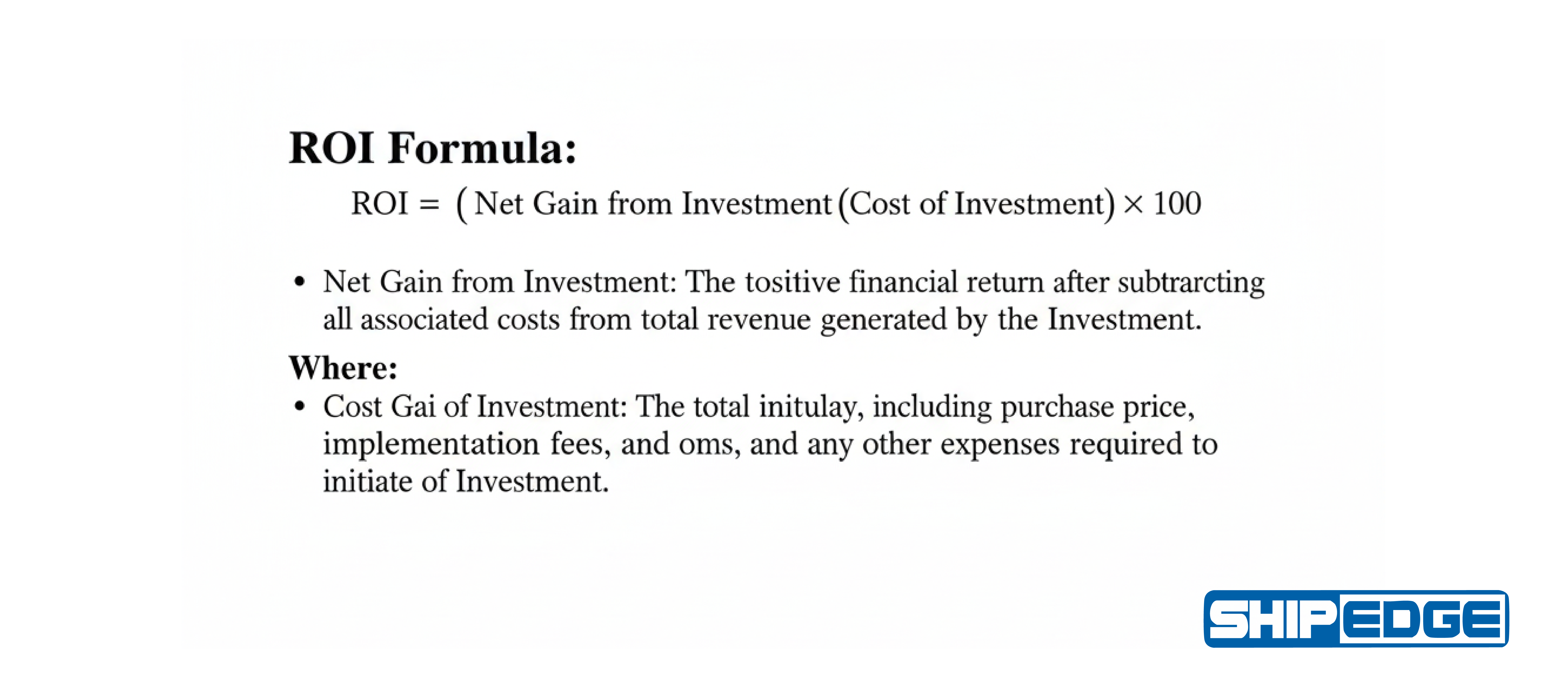
For a Warehouse Management System (WMS) or Order Management System (OMS), the basic formula used by most investors and project managers is the simple return equation:
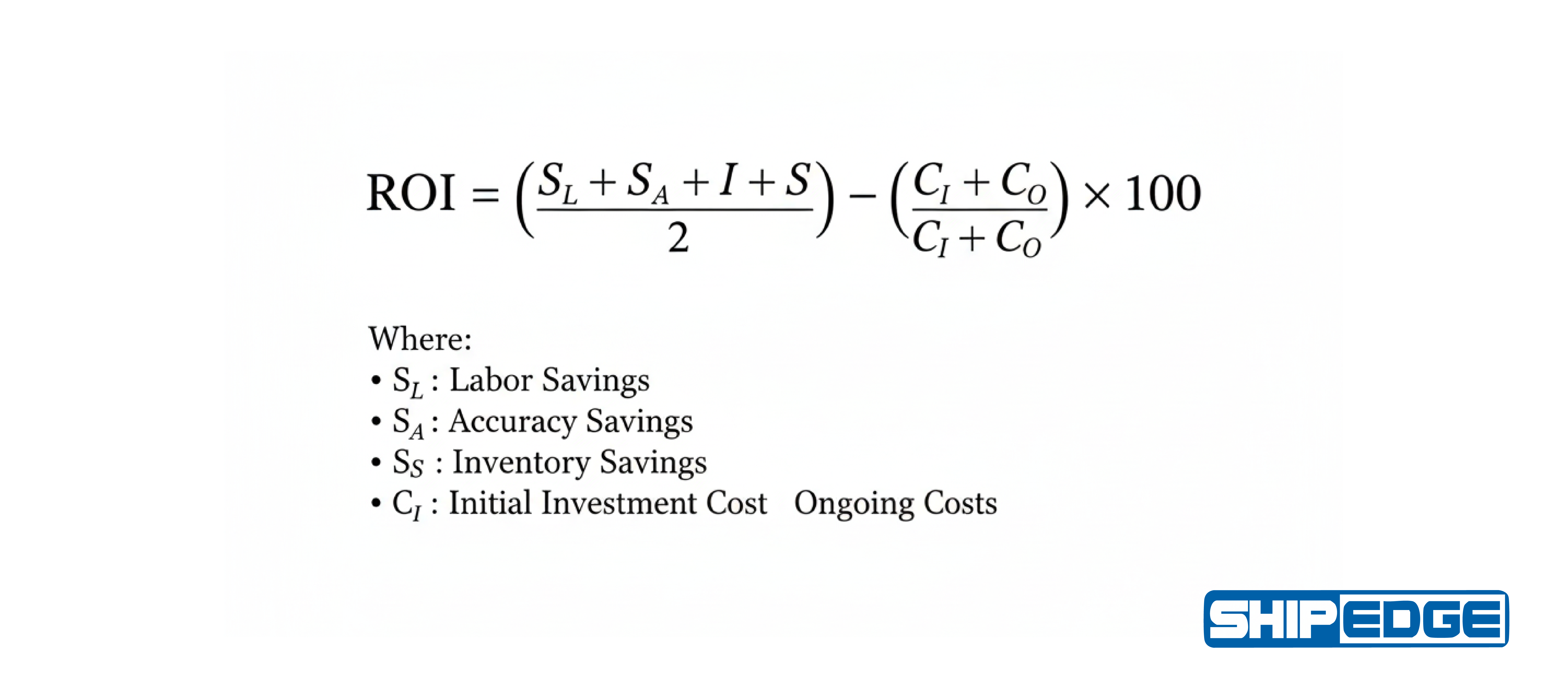
However, to get the actual roi that a finance team will respect, you need to break down the "Net Gain."
The total value of your financial gain is calculated by subtracting your investment cost from your total operational savings.
In the logistics industry, a good roi percentage is generally considered to be anything over 20% annually, with a full payback of the initial investment cost within 12 to 18 months. If your roi figures show a payback in under 6 months, you likely have a "low-hanging fruit" situation where manual errors are currently draining your capital.
Would you like me to create a customized ROI spreadsheet template where you can plug in your actual roi variables like order volume and current error rates?
The most powerful element of your business case comes from documenting what your current operation actually costs. These expenses exist whether you acknowledge them or not, and they represent the opportunity cost of delaying your investment in modern fulfillment technology. We encourage every operation to spend time gathering real data rather than relying on estimates, because the actual numbers often exceed what people expect.
Labor inefficiency typically represents the largest source of hidden costs in warehouse operations. Without optimized picking routes, intelligent slotting, and automated workflows, your team spends significantly more time processing each order than necessary. We have measured operations where implementing a warehouse management system reduced the time to pick and pack an order by thirty to forty percent. When you multiply that efficiency gain across thousands of orders per month, the annual operational savings become substantial enough to justify the entire system investment and ensure a high potential roi.
Accuracy problems create another significant cost category that many operations underestimate. Every shipping error triggers a cascade of expenses, including the cost of the incorrectly shipped item, outbound and return shipping charges, customer service time to resolve the issue, and the replacement item that must be shipped. Industry research suggests that each shipping error costs operations between twenty-five and fifty dollars when all factors are included. Operations shipping ten thousand orders monthly with a two percent error rate are losing approximately eighty thousand dollars annually to preventable mistakes—a clear example of negative roi that a modern order management system would eliminate.
Inventory carrying costs represent another area where poor visibility drives unnecessary expenses. When your operational reporting cannot provide accurate, real-time inventory data, you compensate by holding excess safety stock. This strategy protects against stockouts but ties up capital and incurs carrying costs that typically run twenty to thirty percent of inventory value annually. We have seen operations reduce their inventory levels by fifteen to twenty-five percent once they gained confidence in their inventory accuracy, freeing up substantial working capital while simultaneously reducing storage and handling costs.
With a clear picture of your current costs, you can now project the specific operational savings that a modern fulfillment system will deliver. These benefits fall into several categories, each contributing to your overall return. The key is using conservative estimates that you feel confident defending when stakeholders question your assumptions.
Labor efficiency improvements typically provide the most immediate and measurable returns. A warehouse management system optimizes every aspect of warehouse operations, from receiving and putaway to picking, packing, and shipping. The system directs workers along the most efficient paths, eliminates time wasted searching for inventory, and reduces the training time required for new employees. When we work with operations to calculate this benefit, we typically see potential labor savings of twenty-five to forty percent. For an operation with ten warehouse employees earning twenty dollars per hour, including benefits, a thirty percent efficiency improvement saves approximately two hundred fifty thousand dollars annually in labor costs alone.
Accuracy improvements deliver both direct cost savings and important secondary benefits. Reducing your error rate from two percent to point-three percent eliminates the direct costs of shipping mistakes while also improving customer satisfaction and reducing churn. The cost-benefit analysis becomes even more compelling when you factor in the lifetime value of customers who might have left due to fulfillment problems. For operations processing significant volume, error reduction alone can justify the system investment, with all other benefits representing additional returns.
Inventory optimization generates savings in multiple ways. Better operational reporting allows you to make informed decisions about reorder points and safety stock levels. You can identify slow-moving inventory before it becomes dead stock, optimize your product mix based on actual velocity data, and prevent stockouts of your best sellers. The combination of reduced carrying costs, fewer write-offs, and increased revenue from better stock availability typically delivers annual savings of fifteen to thirty percent of your current inventory carrying costs.
Space utilization improvements may seem less tangible but can deliver significant value, particularly for operations paying for warehouse space or contemplating expansion. A warehouse management system optimizes slotting to place fast-moving items in easily accessible locations, improves vertical space utilization, and reduces the footprint required for the same inventory volume. We have seen operations delay or avoid expensive warehouse expansions by implementing better space management, saving hundreds of thousands of dollars in capital expenditure or additional rent.
With your costs and benefits quantified, you can construct a robust ROI calculation that withstands scrutiny from financial stakeholders. The framework we recommend uses a three-year time horizon, which provides enough time for the investment to deliver meaningful returns while remaining within a reasonable planning window for most businesses.
Your total three-year cost of ownership includes the initial implementation investment plus three years of software subscriptions, support, training, and any other recurring costs. For many mid-sized operations, this total might range from one hundred fifty thousand to three hundred thousand dollars, depending on the system complexity and the scale of the operation. This represents your complete investment cost over the analysis period.
The benefits side of the equation totals all the annual operational savings we discussed earlier. Labor efficiency gains, error reduction, inventory optimization, and space savings combine to create your total annual benefit. We recommend calculating these benefits conservatively and separately for each year, as some benefits may increase over time as your team becomes more proficient with the system. Total benefits over three years typically range from three hundred thousand to over one million dollars for mid-sized fulfillment operations.
The actual basic roi calculation divides your net profit (or net gain) by your total investment and expresses the result as a percentage. Using a realistic example, an operation investing one hundred seventy-five thousand dollars over three years and generating eight hundred fifty thousand dollars in total benefits would achieve an ROI of three hundred eighty-six percent. Your payback period, calculated by dividing your initial implementation cost by your annual benefits, indicates how quickly you recover your upfront investment. In well-justified cases, payback periods typically range from four months to eighteen months.
Presenting your ROI calculation effectively requires more than just sharing the numbers. The most successful business cases tell a compelling story about current challenges, quantified impacts, and a clear path to improvement. We have learned that the presentation approach matters as much as the underlying analysis.
Start your business case by establishing the current situation and its costs. Rather than beginning with system features or capabilities, describe the specific operational challenges your team faces daily. Quantify these problems using the data you gathered. For example, you might explain that your operation currently processes forty-five units per person per hour, requires eighteen thousand dollars monthly in overtime during peak seasons, and experiences a 2.3 percent error rate costing sixty-five hundred dollars monthly. These concrete numbers make the problem real and urgent for decision makers who may not spend time on the warehouse floor.
Present your solution in terms of outcomes rather than features. Instead of listing system capabilities, explain how those capabilities translate into operational savings and efficiency gains. Connect each category of benefits back to specific pain points you established earlier. This approach helps stakeholders understand not just what the system does, but why it matters for your operation specifically.
Include a comparison between implementing the system and maintaining your current approach. This "do nothing" scenario helps frame the decision correctly by showing that keeping your current system has its own costs. Those costs include all the inefficiencies you quantified plus the opportunity cost of not being able to scale efficiently or compete on fulfillment speed. When presented this way, implementation becomes the fiscally responsible choice rather than just another capital request.
Address implementation risks proactively rather than waiting for stakeholders to raise concerns. Acknowledge that system implementations require change management, that there will be a learning curve, and that integration challenges may arise. Then explain your mitigation strategies, such as going live during slower periods, conducting parallel runs to validate data, and working with experienced implementation partners. This transparency builds credibility and confidence in your plan.
We have reviewed hundreds of business cases over the years and observed several recurring mistakes that undermine otherwise solid analyses. Understanding these pitfalls helps you build a more credible and comprehensive case for investment.
The most common error involves counting only direct labor savings while ignoring equally valuable benefits. Labor efficiency certainly matters, but focusing exclusively on this single benefit undersells the true value of modern fulfillment systems. Quality improvements, scalability, risk reduction, and enhanced customer experience all contribute meaningful value even if they prove harder to quantify precisely. A complete business case acknowledges these benefits and, where possible, assigns conservative values to them to show a good roi.
Another frequent mistake involves underestimating implementation time and complexity. Vendors naturally want to portray implementations as quick and painless, but reality often requires more time than initial estimates suggest. We recommend adding twenty-five to fifty percent to vendor time estimates and ensuring your cost projection includes adequate contingency for training, testing, and problem resolution. This conservative approach prevents unpleasant surprises and maintains credibility when actual timelines extend beyond initial projections.
Many organizations fail to establish baseline metrics before implementation, which makes measuring actual results nearly impossible. Your ROI calculation sets expectations, but you need to track whether you achieved those results. Before implementation, document your current orders per person-hour, error rates, inventory accuracy, and order cycle times. Then monitor these same metrics monthly after going live. This data allows you to demonstrate actual returns and identify areas where additional optimization could improve results further.
The temptation to select systems based purely on initial cost often leads to poor long-term outcomes. A less expensive system that lacks critical capabilities may save money upfront, but fail to deliver the operational savings that justify the entire investment. We encourage operations to evaluate the cost-benefit analysis based on net value over three years rather than focusing on minimizing upfront expenditure. The system that delivers the best ROI may not be the cheapest option, but it will generate the greatest return on your investment.
When building your business case, consider the often-overlooked advantages of implementing a complete solution rather than assembling multiple point systems. Many operations purchase a warehouse management system separately from their order management system and later struggle with integration challenges. This fragmented approach creates hidden costs that erode the financial benefits you expected to achieve.
A unified platform that combines WMS, OMS, and 3PL capabilities in a single system eliminates integration complexity. Your team learns one system rather than three, your IT resources manage one vendor relationship rather than multiple, and your data remains consistent across all fulfillment operations without requiring synchronization between separate databases. We have calculated that this architectural advantage alone can save operations twenty to forty thousand dollars annually in reduced IT overhead and eliminated integration maintenance costs.
Operational reporting becomes dramatically more powerful when all your fulfillment data resides in a single system. Rather than reconciling reports from your warehouse management system with separate order management reports, you gain unified visibility into your entire operation. This comprehensive view enables better decision-making and helps identify optimization opportunities that would remain hidden when data is fragmented across multiple systems.
The scalability advantages of a complete solution become particularly valuable as your operation grows. Adding new sales channels, opening additional fulfillment locations, or expanding into new product categories all become simpler when your core systems already provide the necessary capabilities. Operations using fragmented point solutions often face expensive re-implementation projects when they outgrow their original systems, while those using complete platforms can scale within their existing architecture.
Different types of fulfillment operations face unique challenges that should inform how you structure your business case and where you expect to see the greatest returns. Understanding these nuances helps you focus your ROI calculation on the benefits most relevant to your specific situation.
E-commerce brands typically prioritize multi-channel order management, real-time inventory synchronization, and fulfillment speed. Your business case should emphasize how accurate inventory prevents overselling across channels, which protects revenue and preserves customer relationships. The ability to promise accurate delivery dates and fulfill orders quickly often translates into higher conversion rates and reduced cart abandonment. When calculating your operational savings, include revenue protection from eliminated stockouts and potential revenue gains from improved customer satisfaction.
Third-party logistics providers and fulfillment centers have different priorities centered on client management, transparency, and operational efficiency across multiple client inventories. Your ROI calculation should emphasize how better systems allow you to take on more clients without proportional increases in infrastructure or staff. The ability to provide clients with real-time visibility into their inventory and orders reduces inbound inquiries and builds trust that improves client retention. When one of our 3PL clients reduced client churn by just ten percent through better service, the retained revenue exceeded their entire annual software investment.
Retailers operating their own distribution centers focus on store replenishment accuracy, returns processing, and omnichannel capabilities. Your business case should quantify the cost of stockouts at retail locations and the complexity of managing inventory across multiple channels. The ability to fulfill online orders from store inventory and efficiently process returns through any location can generate significant value. Include in your calculation the competitive advantage of offering buy-online-pickup-in-store and ship-from-store capabilities that customers increasingly expect.
The decision to invest in modern warehouse and order management systems ultimately comes down to whether the projected returns justify the required investment and whether the timing makes strategic sense for your operation. Several indicators suggest that now is the right time to move forward with implementing better fulfillment technology.
Rapid growth often exposes the limitations of legacy systems faster than expected. If your current infrastructure struggles to handle existing volume or you anticipate significant growth in the coming year, waiting only makes the eventual transition more difficult and costly. Operations that implement systems proactively, before reaching crisis point, execute smoother implementations and start realizing benefits sooner.
When your operation begins expanding into new sales channels or preparing to open additional locations, modern systems become essential infrastructure rather than optional upgrades. The complexity of managing inventory and orders across multiple channels or locations exceeds what manual processes and legacy systems can handle reliably. In these situations, the question shifts from whether to invest to whether you can afford to delay implementation.
If your financial analysis shows a payback period under eighteen months and a three-year ROI exceeding two hundred percent, the investment merits serious consideration regardless of other factors. These returns substantially exceed what most organizations expect from capital investments and indicate that your current inefficiencies are costing more than the system investment would require.
We have guided hundreds of fulfillment operations through this decision process, and we understand that calculating ROI for warehouse management systems and order management systems requires careful analysis and honest assessment. The organizations that achieve the best results are those that invest time upfront to understand their current costs, set realistic expectations for improvement, and commit to measuring actual results.
Your next step involves gathering the specific data from your operation that will inform your unique business case. Pull actual numbers for labor costs, error rates, inventory values, and current throughput metrics. Document the specific pain points that drive these costs and estimate conservatively how much improvement modern systems could deliver. With this foundation, you can build a comprehensive ROI calculation that provides confidence in your investment decision.
The operations that move forward with implementation consistently tell us they wish they had acted sooner. Every month of delay represents another month of preventable costs and missed efficiency gains. While the investment requires careful consideration, operations that can demonstrate solid financial returns should act decisively to begin realizing those benefits.
At Shipedge, we have helped hundreds of warehouses, fulfillment centers, and ecommerce operations build comprehensive business cases for modern fulfillment technology. Our complete solution combines warehouse management system capabilities, order management system functionality, and 3PL features in a single, unified platform. This architectural approach eliminates integration complexity while maximizing your operational savings through comprehensive visibility and control.
We would be pleased to review your specific operation and help you develop an accurate ROI calculation based on your current costs and operational characteristics. Our team brings extensive experience across diverse fulfillment operations, and we can provide realistic projections based on similar implementations we have completed. This collaborative approach ensures your business case reflects achievable results rather than overly optimistic vendor promises.
We invite you to schedule a demonstration where we can discuss your current challenges and walk through how Shipedge addresses your specific needs. During this conversation, we can help you identify the operational savings most relevant to your situation and provide data points from comparable operations. There is no pressure and no obligation—just a straightforward discussion about whether implementing modern fulfillment systems makes financial sense for your operation right now.
Get started today and book a demo of Shipedge. Let us work together to build a business case that demonstrates the clear path to operational excellence and measurable return on investment. Your future state of efficient, error-free fulfillment operations begins with understanding exactly what better systems can deliver for your specific situation.
Would you like me to help you create a checklist of the data points you need to collect from your warehouse to finalize your ROI calculation?
Click here => Shipedge